Carpet Beetles in the UK: Larvae, Signs and How to Get Rid of Them
How to identify carpet beetle larvae (woolly bears) and the three UK species, where they breed, the damage they do and how to get rid of them.

By the Urgent Pest Control team
Updated · 7 min read
The short answer
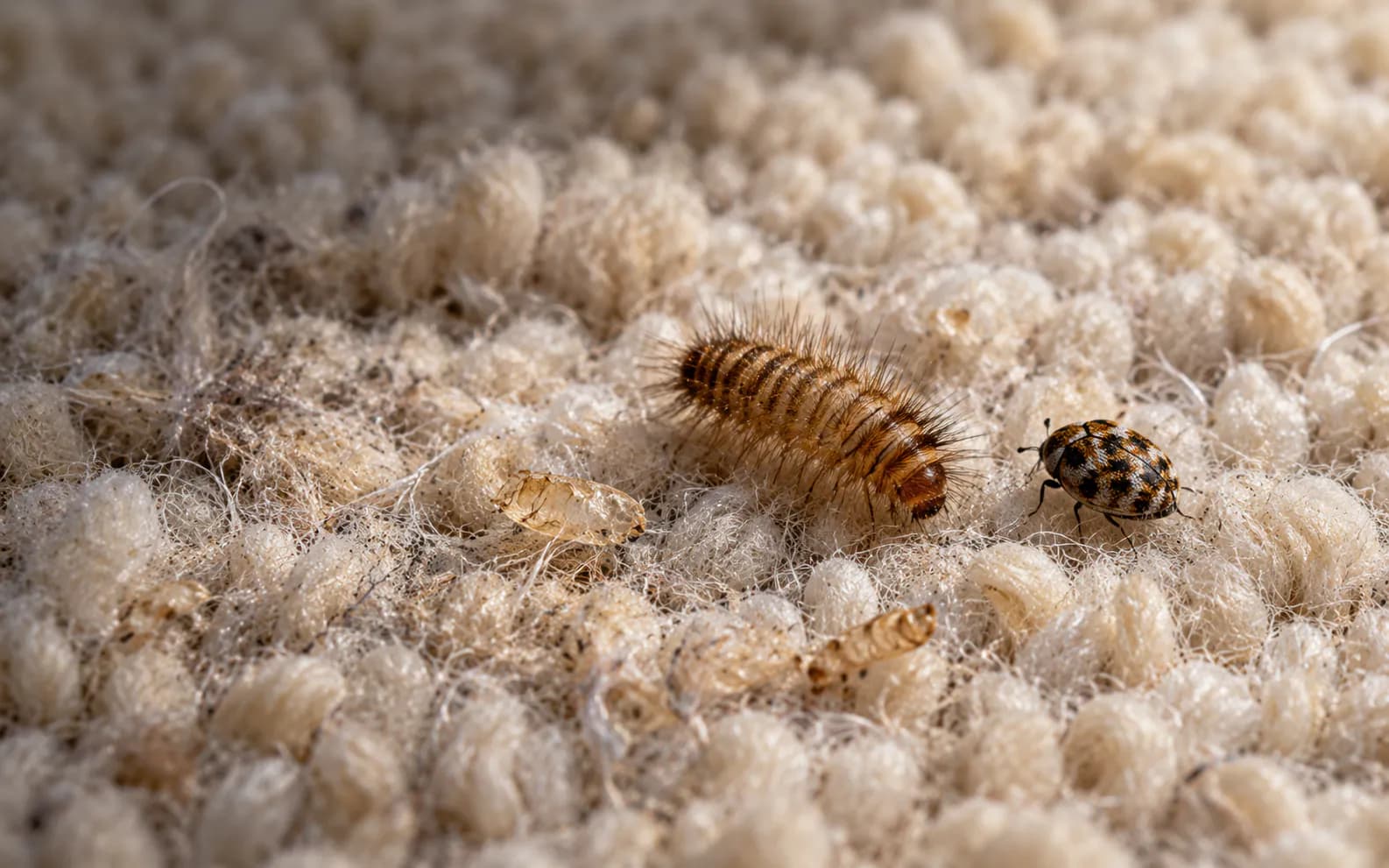
Carpet beetle larvae, often called woolly bears, are small hairy grubs that eat wool, fur, feathers and other natural fibres. In UK homes the varied carpet beetle is the most common species. Get rid of them by finding the source, vacuuming edges and voids thoroughly, freezing or discarding infested items, removing old bird nests and treating with insecticide.
- The larvae do the damage; adult carpet beetles feed on pollen and nectar and are often seen on windowsills.
- Three species matter in UK homes: the varied, two-spot and brown (vodka) carpet beetle.
- Signs are small clean holes without silk webbing, powdery droppings and shed larval skins.
- Old bird nests and dead insects in lofts are a common source, so clearing them is part of the cure.
- Derby City Council lists carpet beetle treatment at £130 online for up to three bedrooms (2026/27); most councils in our area don't treat them.
On this page
Carpet beetle larvae, known as woolly bears, are small hairy grubs that eat wool, fur, feathers and other natural fibres; the adults are tiny round beetles you often find on windowsills. To get rid of them, find the source, vacuum edges and voids thoroughly, freeze or discard infested items, remove old bird nests and treat the affected areas. If the larvae keep coming back, the carpet beetle treatment from Urgent Pest Control combines a residual insecticide with monitoring over 4–6 weeks, across Nottinghamshire, Derbyshire, Leicestershire and Lincolnshire.
What are carpet beetles?
Carpet beetles are small beetles whose larvae are household textile pests. The Natural History Museum says the larvae, not the adults, cause the damage, feeding on woollen goods, fur, feathers and similar materials. Outdoors they live in bird and mammal nests, and the museum notes they "will not feed on entirely synthetic fabrics".
The adults are harmless to fabrics. They visit flowers to feed on pollen and nectar, and indoors they are often found on windowsills, trying to get back out to the light.
Which carpet beetles are found in the UK?
Three species cause most problems in UK homes: the varied carpet beetle, the two-spot carpet beetle and the brown carpet beetle (also called the vodka beetle). The details below are from the Natural History Museum's identification guide.
| Varied carpet beetle | Two-spot carpet beetle | Brown (vodka) carpet beetle | |
|---|---|---|---|
| Latin name | Anthrenus verbasci | Attagenus pellio | Attagenus smirnovi |
| Adult size | 1.5–3.5mm, round | 4.5–6mm | 2–5mm |
| Adult appearance | White, orange and black pattern, black legs | Very dark brown to black with two white spots | Black base colour, brown to reddish-yellow wing cases |
| Larva | 4–4.5mm, hairy "woolly bear" | Up to 6.5mm, torpedo-shaped, two long orange tufts at the rear | Up to 8mm |
| Life cycle | Two summers outdoors; may finish in a year indoors | Six months to three years | 6 to 18 months in real conditions |
| Notes | The commonest domestic species | Adults active March to September; mainly a pest in the southern half of England and Wales | Warmth-loving; relies on central heating in northern Europe |
The brown carpet beetle is a newcomer. The museum says it comes from East Africa, was first observed in Russia in 1961 and was introduced to Britain in the 1970s. Its optimal conditions are 24°C and 70–80% humidity, which is why it does well in centrally heated homes.
What are the signs of carpet beetles?
The signs are small, clean holes without silk webbing, powdery droppings and shed larval skins, plus tiny beetles on windowsills in spring and summer. The museum lists "small clean holes without silk webbing, powdery droppings, and shed larval skins" as signs of the varied carpet beetle. English Heritage adds that two-spot carpet beetle damage "is often accompanied by the distinctive striped cast-off shells of their larvae".
Check for:
- bare patches or small holes in wool carpets, especially at edges and under furniture
- holes in woollen clothes, blankets and felt
- hairy larvae or empty, banded skins in fluff along skirting boards and in drawers
- small round beetles on windowsills or near lights
- damage to fur, feather pillows, or taxidermy and natural history items
- larvae in the loft near old bird nests or dead insects
The absence of silk is the quickest way to tell beetle damage from moth damage. Clothes moth larvae leave webbing or carry silk cases; carpet beetle larvae don't. Our guide to clothes moths shows the moth signs side by side, and if you have a larva but aren't sure what it is, try our pest identifier.
Where do carpet beetles breed in a house?
They breed in dark, undisturbed places with fluff, hair, feathers or dead insects: under carpets, behind skirting boards, in floor voids and in lofts. English Heritage's fact sheet on the two-spot carpet beetle and vodka beetle notes that two-spot adults and larvae are often found in top-floor rooms and attics feeding on dead insects, and that vodka beetle larvae gather in clumps of fluff and organic dirt in hidden spaces, where they are hard to eradicate once established.
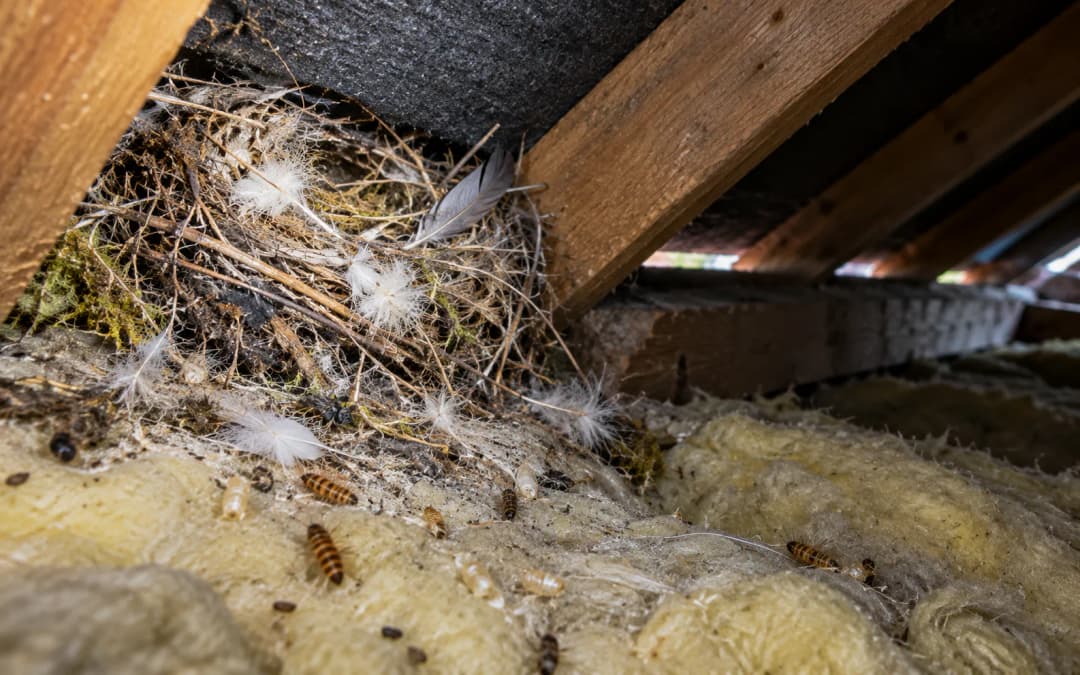
That is why a carpet beetle problem often starts somewhere you never look. The beetles you notice on a bedroom windowsill may have bred in the loft above, and larvae found on a landing carpet may have crawled out of a floor void rather than the carpet itself. Common breeding sites include:
- old bird nests in the loft, eaves or a disused chimney;
- dead insects collected in the loft or along window frames; lofts with cluster flies every autumn are a classic example;
- fluff under fitted carpets and in gaps between floorboards;
- behind built-in furniture and in the backs of drawers;
- wool insulation, stored rugs and boxes of old clothes.
Temperature matters too. The museum says varied carpet beetle larvae need 15–25°C to develop and two-spot larvae 15–30°C, so warm homes suit them year round.
How do you get rid of carpet beetles?
Remove the source, physically clear the larvae, then treat and monitor. The Natural History Museum recommends regular vacuuming, cleaning behind skirting boards and under carpets, removing or blocking bird nests, and either insecticide or freezing affected items at -18°C for a day or two.
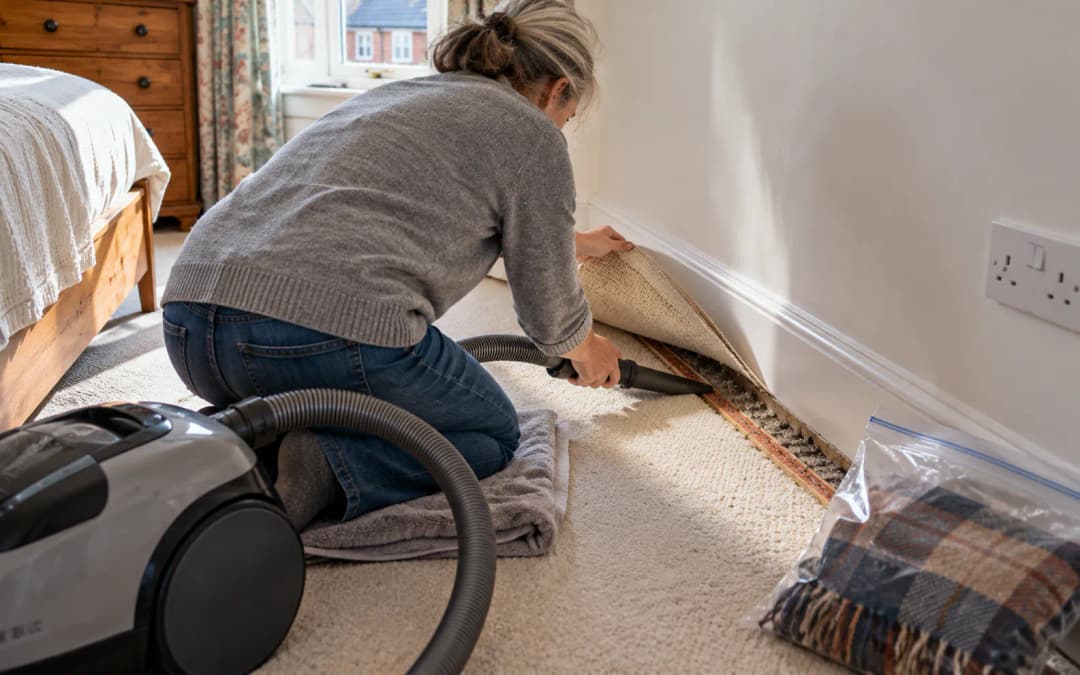
Step 1: Find the source
Follow the damage and the larvae back to where they are breeding. Check the loft for old nests and dead insects, lift a corner of carpet near the worst damage, and look behind furniture that hasn't moved in years. Make a note of each place you find larvae or shed skins; a cluster of larvae and skins is the best clue to where they are breeding.
Step 2: Remove what is feeding them
Bag and remove old bird nests (only when they are no longer in use). Throw away badly damaged items or anything you can't clean. The museum says an existing infestation "can be controlled by physical measures such as discarding infested items, vacuuming and brushing".
Step 3: Vacuum thoroughly
Vacuum carpet edges, under furniture, skirting boards, floorboard gaps, curtains, upholstery and the backs of drawers. Use the crevice tool. Empty the vacuum outside or seal and bin the bag straight away.
Step 4: Freeze, wash or clean small items
Seal clothes, cushions and small rugs in bags and freeze them at -18°C for a day or two, as the museum advises. Wash or dry clean what you can.
Step 5: Treat and monitor
Treat carpet edges and voids with a suitable residual insecticide, following the label exactly, and keep pets and children off treated areas until dry. The museum also mentions sticky traps and pheromone lures for the brown carpet beetle. Keep checking windowsills and traps for several weeks.
How do you stop carpet beetles coming back?
Keep fluff and debris down, keep nests out of the roof, and store natural fabrics sealed. Adults live for two to six weeks, according to the Natural History Museum, and they spend time outdoors feeding on flowers, so new beetles can find their way back in; prevention is ongoing rather than a one-off. Practical steps:
- vacuum under furniture and along skirting boards regularly, not just the open floor;
- clear dead insects from lofts and window frames;
- block access for birds at eaves and remove old nests once the birds have gone;
- store wool, fur and feather items clean and in sealed bags or boxes;
- check second-hand rugs and furniture before bringing them indoors;
- keep an eye on windowsills from spring onwards for adult beetles.
When to call a professional
Call a professional if larvae keep turning up after a thorough clean, the damage is spreading to carpets in several rooms, you can't find the source, or the source is in the loft or under floors where you can't safely reach. Carpet beetle larvae in floor voids and under fitted carpet are hard to reach with household products. When we inspect, the breeding site is very often somewhere the customer hasn't looked: an old nest in the eaves, a drift of dead flies in the loft, or the fluff along the gripper strip under a bed.
Our carpet beetle treatment starts with an inspection to confirm the species, find the breeding site and check the loft. We then apply a residual insecticide to the affected areas, set monitoring traps and return to check them, typically over 4–6 weeks, and tell you how long to keep children and pets out of treated rooms. If we find moths rather than beetles, we treat them under our moth treatment, and our guide on how to get rid of carpet moths explains the difference.
Some councils still treat carpet beetles: Derby City Council lists fleas or carpet beetles at £130 booked online for up to three bedrooms in its 2026/27 fees, but most councils in our area offer no insect treatments; see our guide to council pest control charges.
We'll explain the likely cost before any work starts; prices depend on the infestation, the property and when you need us (see our pest control prices). We work 7 days a week, 6am to 8pm, across Nottingham, Derby, Leicester, Lincoln and the surrounding counties. Book online, or call or WhatsApp 07999 935 929 with a photo of a larva or beetle.
Sources
- Natural History Museum: carpet beetles identification guide
- Natural History Museum: common insect pest species in homes
- English Heritage: pest fact sheet 11, two-spot carpet beetle and vodka beetle
- English Heritage: how to protect your home from moths and beetles
- Derby City Council: pest control for householders (2026/27 fees)
Frequently Asked Questions
About the author
The Urgent Pest Control team
A family-run pest control company based in Southwell, treating homes and businesses across Nottinghamshire, Derbyshire, Leicestershire and Lincolnshire since 2020. Our guides are written from the jobs we do and checked against UK sources. More about us
Cite this guide: “Carpet Beetles in the UK: Larvae, Signs and How to Get Rid of Them”, Urgent Pest Control, 20 October 2026. https://urgentpestcontrol.uk/blog/carpet-beetles