How to Get Rid of Fleas in the House, Step by Step
A step-by-step plan to clear fleas from your home: treat pets through the vet, wash and vacuum, treat every room, and keep going until the cocoons have hatched.

By the Urgent Pest Control team
Updated · 8 min read

The short answer
To get rid of fleas in the house, treat every pet through your vet, wash pet bedding on the hottest setting, vacuum floors and furniture thoroughly, then treat every room with a residual insecticide. Keep vacuuming for at least two weeks afterwards, because fleas still in their cocoons keep hatching and need to meet the treated surfaces.
- Adur & Worthing Councils say fewer than 1% of a flea population is an adult on a pet; the rest are eggs, larvae and cocoons in the home.
- The MSD Veterinary Manual says a female cat flea can lay up to 40 to 50 eggs a day at peak.
- Treat pets through the vet first; a house treatment alone won't stop new eggs being laid.
- Flea cocoons resist treatment, so expect some fleas for up to two weeks while they hatch onto treated surfaces.
- Our flea treatment starts from £150, with the final price depending on the property.
On this page
- Why are fleas so hard to get rid of in the house?
- Where do fleas in the house come from?
- How do you get rid of fleas in the house, step by step?
- Do shop-bought flea sprays and bombs work?
- How should you prepare for a professional flea treatment?
- How long does it take to get rid of fleas in the house?
- How much does flea treatment for a house cost?
- Can fleas live on humans?
- How do you stop fleas coming back?
- When to call a professional
To get rid of fleas in the house, treat every pet through your vet, wash pet bedding on a hot wash, vacuum thoroughly, and treat every room with a residual insecticide on the same day. Then keep vacuuming daily for two weeks while the cocoons hatch. Our flea treatment starts from £150; the final price depends on the job.
The reason fleas feel impossible to shift is their life cycle. This guide explains where they hide, the steps that clear them in the right order, how long it takes, and what you can do yourself.
Why are fleas so hard to get rid of in the house?
Because most of the population isn't on your pet, and the cocoons resist treatment. Adur & Worthing Councils say fewer than 1% of a flea population is an adult on a host at any one time; the rest are eggs, larvae and pupae hidden in the home.
The MSD Veterinary Manual explains how that happens with the cat flea (Ctenocephalides felis), the species usually found on both cats and dogs:
| Life stage | Where it is | How long it lasts (MSD Veterinary Manual) | What clears it |
|---|---|---|---|
| Egg | Falls off the pet onto bedding, carpet or soil | Hatches in about 1–6 days | Hot washing, vacuuming |
| Larva | Deep in carpet, under furniture, in pet bedding | Usually 5–11 days, up to 2–3 weeks | Vacuuming, residual insecticide |
| Pupa (cocoon) | Carpet fibres, cracks, soft furnishings | Emergence can be delayed up to 30 weeks | Vacuuming to trigger hatching, then treated surfaces |
| Adult | On the pet, or waiting to jump onto a host | Newly emerged adults need a blood meal within days | Vet treatment on pets, residual insecticide in the home |
The MSD manual says a female cat flea can lay up to 40 to 50 eggs a day at peak, and that under typical household conditions the full life cycle takes 3 to 8 weeks. That is why a single spray rarely works: it kills adults, but the next wave is already developing in the carpet.
Where do fleas in the house come from?
Most come in on a cat or dog; the rest were already waiting in the home as cocoons. Fleas can also be waiting in a home you've just moved into. Adur & Worthing say pupae can lie dormant and resist starvation for many months, and that a property that has been empty for many months can suddenly become infested when somebody enters. Adult fleas emerge when they sense vibration and higher carbon dioxide levels, which is exactly what a new occupier brings.
So fleas in a house with no pets are not unusual, especially after moving. Our guide on how long fleas can live without a host explains why an empty house is no protection.
How do you get rid of fleas in the house, step by step?
Treat the pets, wash, vacuum, treat every room, then keep vacuuming. Order matters. Follow these steps together, ideally on the same day, so the whole cycle is broken at once.
- Treat every pet through the vet. Every cat and dog in the home, even the one that isn't scratching. Pets must be treated by the vet, not by a pest controller, and a house treatment won't hold while a pet keeps dropping eggs.
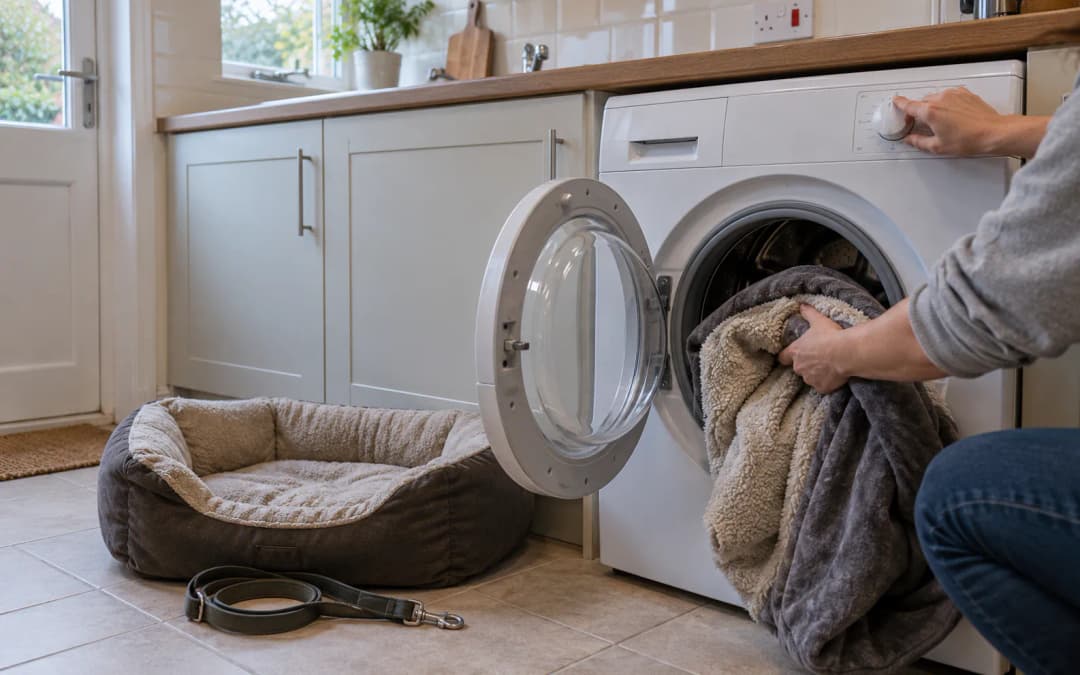
- Wash pet bedding, throws and cushion covers on the hottest setting the fabric allows. Adur & Worthing advise washing pet bedding on the hottest setting possible.
- Clear the floors. Pick up clothes, toys and anything stored under beds, so every floor and the edges of every room can be reached.
- Vacuum thoroughly. Adur & Worthing advise paying particular attention to the pet's sleeping area and all cracks and crevices. Include sofas, under cushions, skirting boards, stairs and the car if the pet travels in it. Put the bag or the bin contents straight in the outside bin.
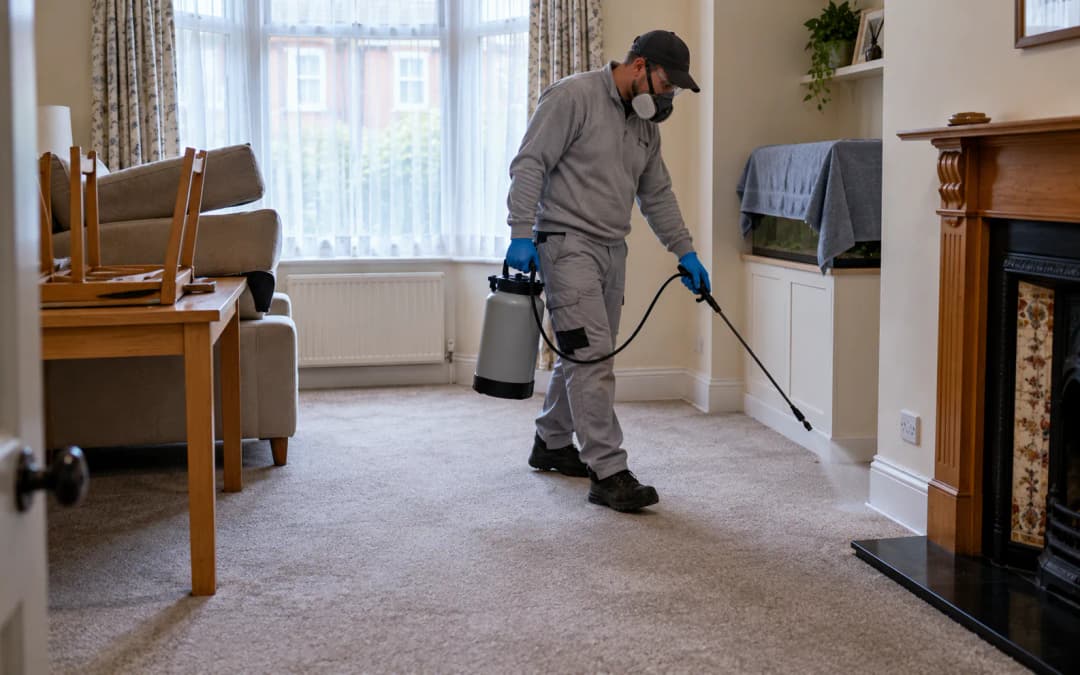
- Treat every room with a residual insecticide. Fleas move between rooms with the pet, so treating only the lounge leaves the bedrooms to re-infest it. We use a residual insecticide across all rooms; it stays active on surfaces after it dries.
- Stay out until it is dry, then let people and pets back in.
- Keep vacuuming daily for two weeks. The vibration encourages cocoons to hatch, and new adults then land on treated surfaces. Hold off on steam cleaning or shampooing carpets during this time.
Do shop-bought flea sprays and bombs work?
They can kill adult fleas, but they often miss the rest of the cycle. Always follow the label exactly, keep pets and fish away from any product not meant for them, and never use a product for dogs on a cat. Pupae in their cocoons are very resistant, and a fogger that settles on open surfaces may not reach under furniture or deep into carpet where larvae live.
If you've tried a spray or fogger and fleas are still biting after a couple of weeks, the problem is usually coverage or timing, not the product. A professional treatment covers every room at once and is timed with the pets' vet treatment.
How should you prepare for a professional flea treatment?
Clear the floors, wash pet bedding, vacuum every room and book the pets' vet treatment for the same week. Preparation decides whether the spray reaches the places larvae live. Before we arrive:
- Book the pets' vet treatment for the same week, so every animal is treated at the same time as the house.
- Clear every floor, including under beds and the bottom of wardrobes, and stand light items on beds or tables.
- Wash and dry pet bedding, throws and loose covers, and bag anything that can't go back down until the spray is dry.
- Vacuum every room, including stairs, sofas and skirting boards, and empty the vacuum into the outside bin.
- Cover fish tanks and switch off their pumps, and move other small pets such as birds, rabbits and reptiles out of the treated rooms.
- Plan to be out with children and pets until the treatment has dried.
Don't skip rooms the pet "never goes in". Eggs and larvae can end up anywhere the pet, or its bedding, has been, and an untreated room can restart the problem.
How long does it take to get rid of fleas in the house?
Plan for two to three weeks from treatment to quiet. With our residual treatment, results are usually seen within 24 to 48 hours as adult fleas die. Eggs and cocoons continue to hatch for up to two weeks, so you may still see a few fleas during that time. That is expected: they are hatching onto treated surfaces.
If numbers are not clearly falling after two weeks, call us, as something may have been missed, such as an untreated pet, a room that was locked, or a car or caravan.
"Gino came at very short notice after we had just moved into our new house and found we had a flea infestation. … He sprayed and fumigated the house and again made sure we fully understood his aftercare advice. I haven’t seen a flea since" — Andrew Hood, Google review, November 2024
How much does flea treatment for a house cost?
Urgent Pest Control's flea treatment starts from £150. The final price depends on the property, the size of the problem and the time of the visit, including evenings and weekends, and we'll explain the likely cost before any work starts. Larger homes and heavy infestations are quoted individually. See our pest control prices page for our published starting prices.
For comparison, Derby City Council's 2026/27 fees list a flea treatment for a home with up to three bedrooms at £130 booked online or £151 by phone, rising with the number of bedrooms. Not every council offers flea treatments: Leicester City Council treats fleas only in council properties (£90 for up to three bedrooms), and Nottingham City Council's pest control page doesn't list fleas.
Can fleas live on humans?
Not in the way they live on pets. Fleas bite people, but the MSD Veterinary Manual says it is newly emerged, unfed fleas that bite humans, and that fleas which have started breeding generally stay on their animal host. Our guide on how long fleas can live without a host explains what that means for a home with no pets.
The NHS says flea bites are usually found in groups below the knees. If you're not sure what is biting you, our guide to bed bug bites vs flea bites compares the two.
How do you stop fleas coming back?
Keep every pet on regular vet flea treatment all year; prevention is mostly about the pet.
- Keep pets on regular flea treatment from the vet. Adur & Worthing advise having pets checked by a vet and treated for fleas regularly.
- Wash pet bedding often on a hot wash.
- Vacuum regularly, especially where pets sleep.
- Check new homes before moving pets in, and treat early if you're bitten in the first days.
- Treat everything together if fleas return: pets, bedding and every room.
When to call a professional
Call a professional if fleas are still biting two weeks after you have treated your pets and cleaned, if you've moved into a home and are being bitten, if the infestation is spread across several rooms, or if anyone in the home is vulnerable to bites. We treat every room in one visit, tell you exactly how to prepare, and explain the aftercare so the cocoons hatch out and die.
We cover Nottinghamshire, Derbyshire, Leicestershire and Lincolnshire, including Nottingham, Derby, Leicester, Mansfield and Grantham. We work 7 days a week, 6am to 8pm, with emergency call-outs 365 days a year, and same-day visits are often available. Call or WhatsApp 07999 935 929, or book online.
Sources
Frequently Asked Questions
About the author
The Urgent Pest Control team
A family-run pest control company based in Southwell, treating homes and businesses across Nottinghamshire, Derbyshire, Leicestershire and Lincolnshire since 2020. Our guides are written from the jobs we do and checked against UK sources. More about us
Cite this guide: “How to Get Rid of Fleas in the House, Step by Step”, Urgent Pest Control, 4 November 2026. https://urgentpestcontrol.uk/blog/how-to-get-rid-of-fleas-in-the-house