How Long Can Fleas Live Without a Host?
Adult fleas last days without a blood meal, but cocoons can wait for months. Why empty homes fill with fleas, and how to clear them.

By the Urgent Pest Control team
Updated · 8 min read
The short answer
A newly emerged adult cat flea can survive about 12 days without a blood meal at 27°C and 90% humidity, but only about 3 days at 50% humidity, according to the MSD Veterinary Manual. Fleas inside their cocoons last far longer: emergence can be delayed by up to 30 weeks, which is why empty homes can suddenly fill with fleas.
- Newly emerged adult cat fleas survive about 12 days without feeding in warm, humid conditions and about 3 days at 50% humidity (MSD Veterinary Manual).
- Cocoons are the long-lived stage: emergence can be delayed up to 30 weeks, and 6–8 months has been observed in sheltered spaces.
- Fleas hatch when they sense vibration and carbon dioxide, so a house that has been empty can become infested when someone moves in.
- Removing the pet or going away does not reliably clear fleas from a home.
- Our flea treatment starts from £150, with the final price depending on the property.
On this page
- How long can adult fleas live without a host?
- How long does each flea life stage last?
- Why can fleas survive for months in an empty house?
- Will fleas die if you go on holiday or rehome the pet?
- Can humans get fleas?
- What should you do if you find fleas in a house without pets?
- Does temperature or the time of year matter?
- How can you tell if fleas are still in the house?
- How long does a professional flea treatment take to work?
- When to call a professional
A newly emerged adult cat flea can live about 12 days without a blood meal in warm, humid conditions, and only about 3 days in drier air, according to the MSD Veterinary Manual. But fleas still in their cocoons can wait up to 30 weeks, which is why empty homes fill with fleas when people move in. Our flea treatment deals with every stage.
So "how long can fleas live without a host?" has two answers: days for adults, months for cocoons. This guide explains both, using figures from the MSD Veterinary Manual and council guidance, and what that means if you've just moved, been away, or rehomed a pet.
How long can adult fleas live without a host?
Days, not months. The MSD Veterinary Manual says that under ideal conditions of 27°C and 90% relative humidity, a newly emerged cat flea can survive approximately 12 days before needing a blood meal. At 50% relative humidity, that drops to about 3 days.
Humidity matters more than most people expect. A warm, damp utility room or a carpet near a radiator in a humid house is far kinder to fleas than a dry, well-ventilated room.
Those figures are for a flea that has never fed. They are the best guide to how long the jumping adults in an empty room will last, but they say nothing about the eggs, larvae and cocoons still developing in the carpet. That is the part of the population that keeps a flea problem going long after the pet has gone.
Adult fleas that have already fed and started breeding behave differently. The MSD manual says they generally don't leave their host unless forced off by grooming or insecticides. In other words, the fleas you see jumping on the carpet are mostly newly hatched adults looking for their first meal.
How long does each flea life stage last?
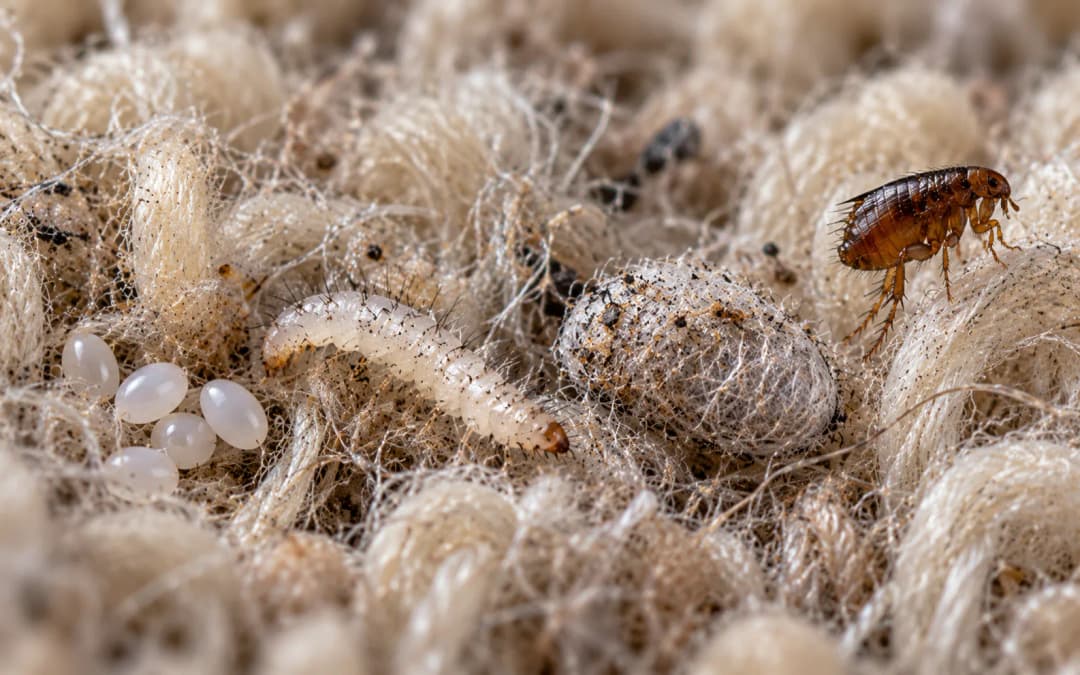
Eggs last days, larvae one to three weeks and cocoons up to 30 weeks. The cat flea (Ctenocephalides felis) is the flea usually found on both cats and dogs. Its four stages last very different lengths of time:
| Stage | Where it lives | How long it lasts without a host |
|---|---|---|
| Egg | Falls off the pet into bedding, carpet or soil | Hatches in about 1–6 days |
| Larva | Carpet, bedding, under furniture | Usually 5–11 days, up to 2–3 weeks |
| Pupa (cocoon) | Carpet fibres, cracks, soft furnishings | Emergence can be delayed up to 30 weeks; 6–8 months seen in sheltered spaces |
| Newly emerged adult | Floor, furniture, waiting to jump | About 12 days at 27°C and 90% humidity; about 3 days at 50% humidity |
All figures are from the MSD Veterinary Manual, which says the whole life cycle can take as little as 12 to 14 days or be prolonged for up to 350 days. Under typical household conditions it takes 3 to 8 weeks.
Why can fleas survive for months in an empty house?
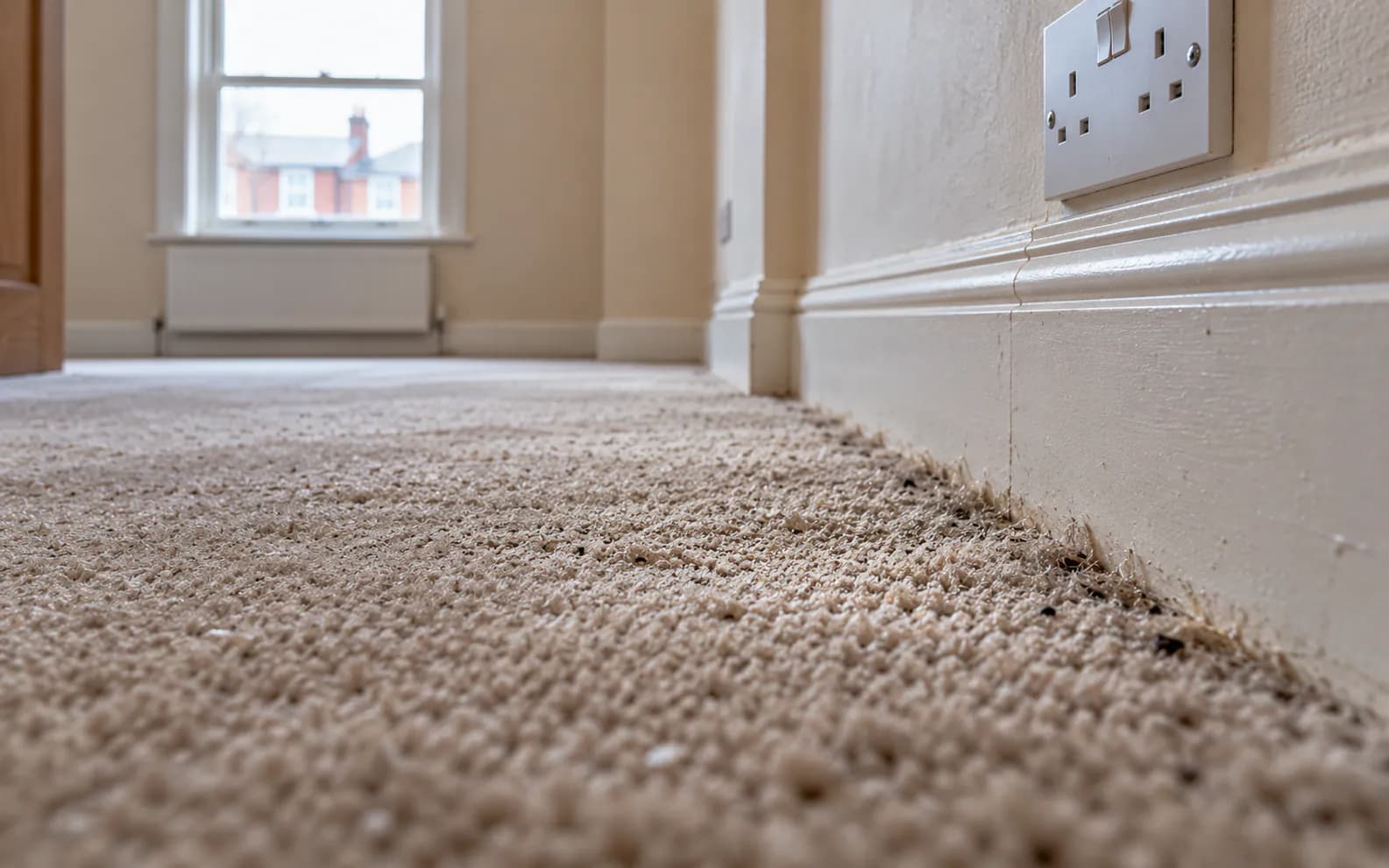
Because the adult flea waits inside its cocoon until a host turns up. Adur & Worthing Councils say pupae can lie dormant and resist starvation for many months, and that a property that has been empty for many months can suddenly become infested when somebody enters.
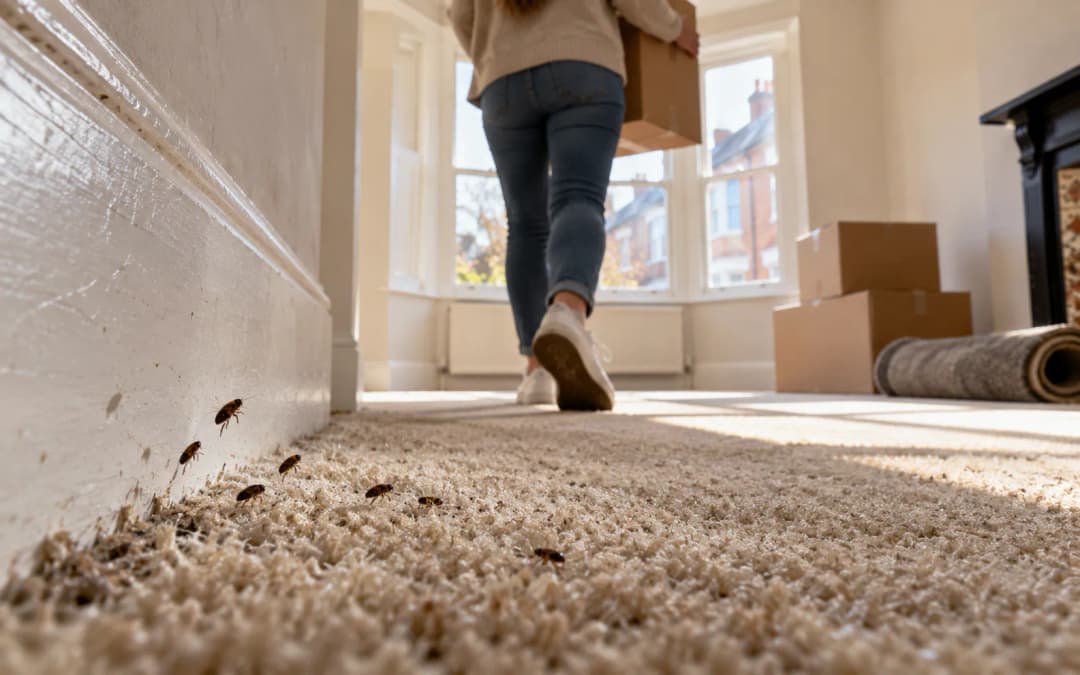
The trigger is the host itself. Adult fleas emerge when they sense vibration and higher carbon dioxide levels: footsteps, a vacuum cleaner, a person breathing nearby. The MSD manual says emergence can be delayed up to 30 weeks if the cocoon is protected from drying out, and that delays of 6 to 8 months have been observed in unfinished basements and crawl spaces.
That explains a common pattern: a family moves into a home where the previous occupants had a cat or dog, and within days everyone is being bitten around the ankles.
Will fleas die if you go on holiday or rehome the pet?
Not reliably, because the cocoons wait for you to come back. Going away for a fortnight may let some unfed adults die, but the cocoons wait. When you come home, the vibration and carbon dioxide trigger a wave of hatching, and the hungry adults go for whoever is there.
Rehoming or boarding a pet doesn't clear the house either. The eggs, larvae and cocoons are already in the carpet and soft furnishings. Adur & Worthing say fewer than 1% of a flea population is an adult on a host at any one time; the rest are developing in the home.
If you want to break the cycle, the house needs treating while the pets are treated by the vet, followed by regular vacuuming to bring the cocoons out.
Can humans get fleas?
Humans get flea bites, but fleas don't normally live on people the way they live on cats and dogs. The MSD manual says newly emerged, unfed fleas are what infest animals and bite humans, and that fleas which have started breeding generally stay on their animal host. In a home without pets, hungry fleas bite whoever is available, usually around the feet, ankles and lower legs, then drop back to the floor.
The NHS says flea bites are usually found in groups below the knees. If you're getting bitten higher up, on skin exposed while you sleep, bed bugs are worth ruling out: see our guide to bed bug bites vs flea bites.
"Called in the morning same day booking, came out and resolved flea treatment, very professional and general a nice guy!" — James Hunt, Google review, April 2024
What should you do if you find fleas in a house without pets?
Treat every room, then vacuum daily for two weeks so the remaining cocoons hatch onto treated surfaces. This checklist works whether you've just moved in or come back from a long trip.
- Find out whether pets lived there before. Ask the agent, landlord or previous owner; it tells you where to focus.
- Vacuum every room thoroughly, including stairs, edges of carpets and under furniture, and put the contents straight in the outside bin.
- Wash bedding, throws and rugs on a hot wash.
- Treat every room, not just the one where you were bitten.
- Keep vacuuming daily for two weeks after treatment, to trigger the remaining cocoons.
- If a pet is joining the household, get it on vet flea treatment before it arrives.
Our step-by-step guide to getting rid of fleas in the house covers each step in more detail. If you're a tenant who found fleas on moving in, our guide to whether landlords are responsible for pest control explains who usually pays.
Does temperature or the time of year matter?
Yes. Warmth and humidity speed fleas up; cool, dry conditions slow them down. The MSD Veterinary Manual says the whole cat flea life cycle can be completed in as little as 12 to 14 days, or prolonged for up to 350 days, depending on conditions. Its figures for unfed adults show the same effect: about 12 days at 27°C and 90% humidity, but about 3 days at 50% humidity.
In practice, centrally heated homes keep fleas going all year. A cold snap outdoors doesn't clear fleas from a warm carpet, and turning the heating off in an empty house may simply slow the cycle down rather than end it. Cocoons protected from drying out are the stage most likely to sit out a cold, empty spell.
How can you tell if fleas are still in the house?
New bites around the ankles and small dark insects jumping on pale socks mean fleas are still there. Adur & Worthing describe the cat flea as about 2mm long and dark brown.
- Bites around the ankles and lower legs, usually in groups, especially after walking on carpet.
- Small dark insects jumping on pale socks, rugs or bedding.
- Pets scratching, licking or chewing at their coat, particularly at the base of the tail.
- New bites after a period away, which suggests cocoons have hatched now that someone is home.
- Bites continuing more than two weeks after a full treatment, which suggests a pet, room or vehicle was missed.
If the bites are on your face, neck and arms rather than your legs, see our guide on how to check for bed bugs before treating for fleas.
How long does a professional flea treatment take to work?
Most adult fleas die within 24 to 48 hours, but expect a few for up to two weeks. With our residual insecticide treatment across all rooms, results are usually seen within 24 to 48 hours as adult fleas die. Eggs and cocoons continue to hatch for up to two weeks, and those new adults die on the treated surfaces. Seeing a few fleas in that window is normal; numbers should fall steadily.
Pets must be treated by the vet. We treat the home, and the two together break the cycle.
When to call a professional
Call a professional if you're being bitten in a home with no pets, if fleas appeared soon after moving in, or if they are still around two weeks after you've cleaned and treated your pets. Fleas waiting in cocoons are hard to reach with shop-bought products, and a whole-house treatment timed with vacuuming clears them far faster.
Urgent Pest Control's flea treatment starts from £150; the final price depends on the property and when you need us, and we'll explain the likely cost before any work starts. See all our pest control prices. For comparison, Derby City Council's 2026/27 fees list fleas in a home with up to three bedrooms at £130 booked online or £151 by phone. We cover Nottinghamshire, Derbyshire, Leicestershire and Lincolnshire, including Nottingham, West Bridgford, Derby, Leicester and Lincoln, 7 days a week from 6am to 8pm, with emergency call-outs 365 days a year. Call or WhatsApp 07999 935 929, or book online.
Sources
Frequently Asked Questions
About the author
The Urgent Pest Control team
A family-run pest control company based in Southwell, treating homes and businesses across Nottinghamshire, Derbyshire, Leicestershire and Lincolnshire since 2020. Our guides are written from the jobs we do and checked against UK sources. More about us
Cite this guide: “How Long Can Fleas Live Without a Host?”, Urgent Pest Control, 4 November 2026. https://urgentpestcontrol.uk/blog/how-long-can-fleas-live-without-a-host