How to Get Rid of Moles in Your Garden
How to get rid of moles in the lawn: what molehills tell you, which deterrents are worth trying, why trapping in the run works best, and what the law allows.

By the Urgent Pest Control team
Updated · 7 min read
The short answer
The most reliable way to get rid of moles is trapping in the main tunnel by someone experienced. Deterrents such as castor oil smoke or sonic spikes may push a mole along, but often only to another part of the garden. Moles aren't protected, but welfare law means any control must be humane, never poison or gas.
- Moles eat earthworms and soil invertebrates, not plant roots; damage to plants is incidental.
- Moles are territorial, so the molehills in a small garden are often the work of one animal.
- Bolton Council says trapping works best between October and April, when moles are most active.
- Spring traps commonly used for moles are exempt from the general trap-approval rules under the Small Ground Vermin Traps Order 1958.
- Traps must be checked daily, and any killing must be swift and humane under the Wild Mammals (Protection) Act 1996.
On this page
- Why do I have moles in my lawn?
- How do you know it is a mole?
- When are moles most active?
- Which mole deterrents are worth trying?
- How does trapping work?
- Is it legal to trap moles?
- What should you do about the molehills?
- What happens when a mole catcher visits?
- Should you just leave moles alone?
- When to call a professional
The most reliable way to get rid of moles is to trap them in their main tunnels, done by someone who knows how to read the ground. Deterrents such as castor oil smoke or sonic spikes may push a mole along, but often only to another part of the garden. Moles aren't protected, but any control must be humane. Our mole catcher service traps in the run, with no poison or gas.
This guide explains what molehills tell you, which home remedies are worth trying, how trapping works, what the law says, and when to call a professional.
Why do I have moles in my lawn?
You have moles because your soil has plenty of food. Moles eat earthworms and other soil animals. The RHS says moles don't feed on plants; they eat earthworms and invertebrates that fall into their tunnels, so damage to plants is incidental. Bolton Council puts it simply: earthworms are what attract moles to your lawn.
That's why a well-kept, worm-rich lawn is often the one that suffers. It isn't a sign of neglect.
How do you know it is a mole?
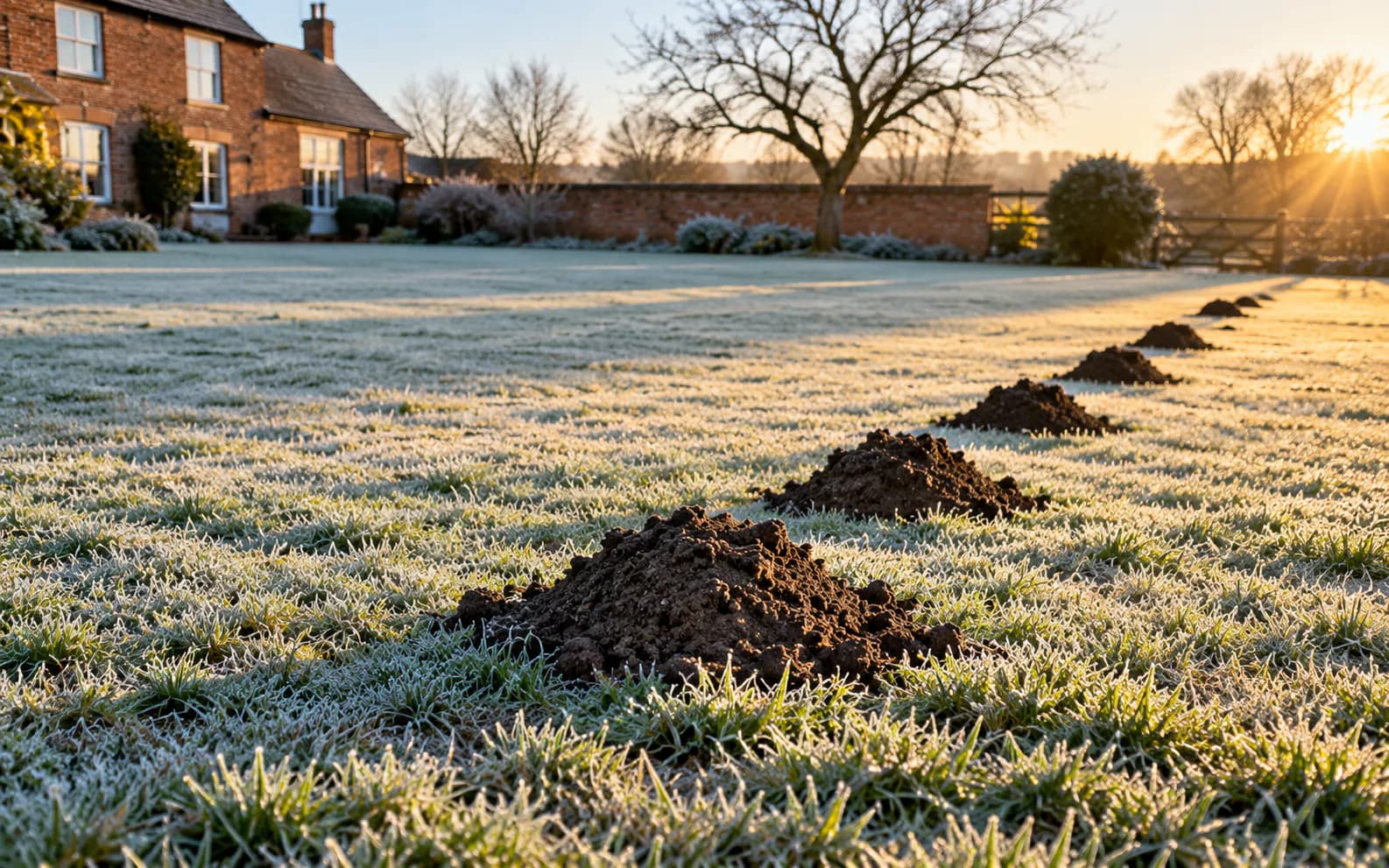
Molehills are the giveaway. Moles live almost entirely underground and push the soil from their tunnels up to the surface. Bolton Council describes two kinds of tunnel:
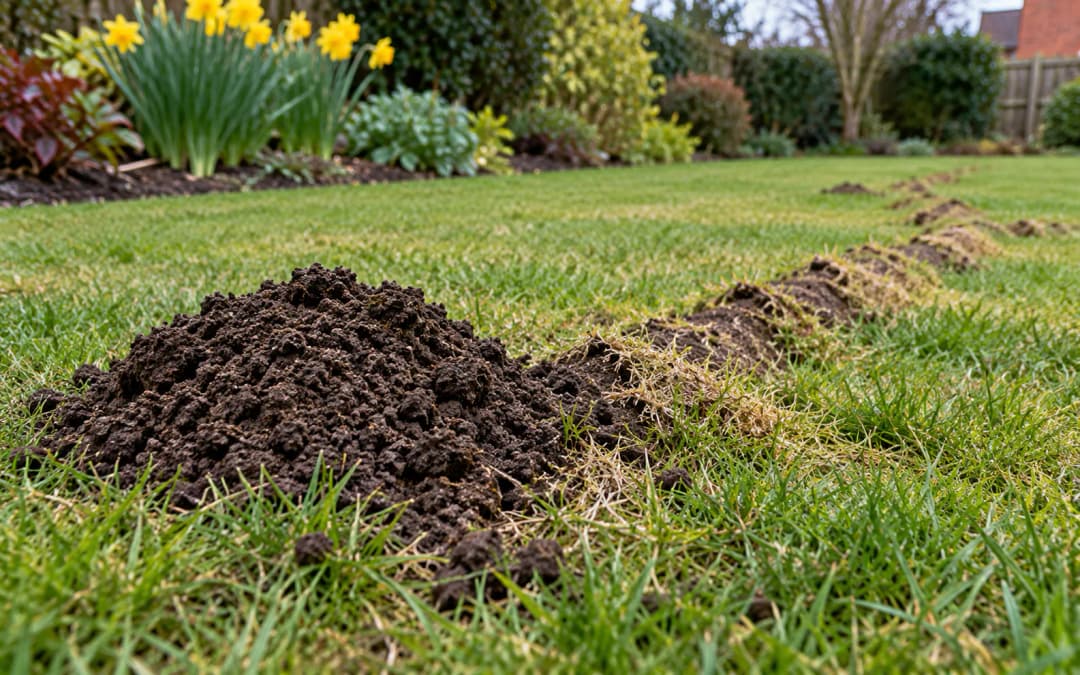
- deep tunnels, between 2 and 8 inches (or more) below the surface, which produce molehills;
- surface tunnels, just below the ground, which show as a raised ridge of soil or grass.
The RHS says moles are about 15 cm long, with dense blackish-brown fur and broad front paws for digging. You will rarely see one.
The RHS also notes moles are very territorial, so the molehills in a small garden are often the work of just one mole. A dozen fresh hills doesn't mean a dozen moles.
When are moles most active?
Moles are active all year, but you notice them most from late autumn to spring. The RHS says activity is usually greatest in late winter and early spring. The breeding season runs from February to June, and Bolton Council says a female usually has one litter of two to seven young in an underground nest.
Bolton Council advises that trapping is best carried out between October and April, when moles tend to be at their most active.
Which mole deterrents are worth trying?
Some deterrents are worth a try, but none reliably removes a mole. They usually make it move, sometimes only a few metres.
| Method | What it does | How well it works |
|---|---|---|
| Castor oil smoke (sold as mole smoke) | Fumes said to deter worms from the tunnels | The RHS says the mole may move on or dig new tunnels nearby |
| Electronic or sonic devices | Buzzing noise said to drive moles away | The RHS says they may only move to another part of the garden |
| Caper spurge (Euphorbia lathyris) | Roots said to repel moles | The RHS says this is unproven, and the plant can become invasive |
| Mole netting under turf | Stops moles reaching the surface | Only possible before turf is laid |
| Killing earthworms | Removes the mole's food | Not advised: Bolton Council says it damages your soil |
| Trapping in the run | Removes the mole | The most reliable method, but needs skill |
Methods to avoid completely: poisons, gas, exhaust fumes, flooding tunnels and home-made chemical mixtures. Apart from the risks to pets, children and other wildlife, using a product in a way its label doesn't allow can be unlawful. Strychnine, once the main poison used on moles in Britain, was withdrawn in 2006, according to a 2016 study of mole control on British farms and gardens.
How does trapping work?
Trapping works by setting a trap inside the mole's main run, where it travels repeatedly. Bolton Council's advice gives a good picture of what's involved:
- find the deep runs by probing the ground with a stick, which suddenly gives when it breaks into a tunnel;
- avoid leaving any foreign scent, using old traps or new traps buried in soil for a few weeks, and rubbing soil on your hands;
- set the trap so it sits just above the base of the run;
- pack soil around the top so no light gets into the tunnel;
- check the traps every day.
Bolton Council adds that trapping is very difficult, and that unless you are experienced you are unlikely to remove the problem entirely. That matches what people find: a badly set trap is often pushed full of soil or simply avoided.
Is it legal to trap moles?
Yes. Moles are not a protected species, so they can be lawfully controlled. The rules are about how.
The Small Ground Vermin Traps Order 1958 lists "spring traps of the kind commonly used for catching moles in their runs", which exempts spring traps of the kind commonly used for catching moles in their runs from the general rule that spring traps must be an approved type. The Wild Mammals (Protection) Act 1996 makes cruelty to any wild mammal an offence, but section 2 sets out exceptions, including killing a mammal "in a reasonably swift and humane manner" and acts done with a trap lawfully used to kill or take it.
The same 2016 study notes that mole traps are not tested or regulated, so a badly designed or badly set trap may not kill quickly. In practice, that means:
- use traps designed for moles, set in the run;
- check them daily, as Bolton Council stresses;
- never leave an animal suffering;
- don't use poison or gas unless you are trained and the product is approved for that use.
What should you do about the molehills?
Deal with the molehills even after the mole has gone, so the lawn recovers. The RHS advises removing molehills before mowing and filling collapsed surface tunnels to keep the lawn level. The soil from molehills is fine and loose, so it can be spread thinly or used in pots and borders.
If moles come back year after year, a new mole has usually moved into the empty tunnel system. That's normal, and a mole catcher can return when it happens.
What happens when a mole catcher visits?
A mole catcher's first visit is mostly about reading the ground. Fresh molehills show where a mole has been, but the traps go into the main runs, the tunnels it uses again and again, rather than into the surface ridges that may only be used once.
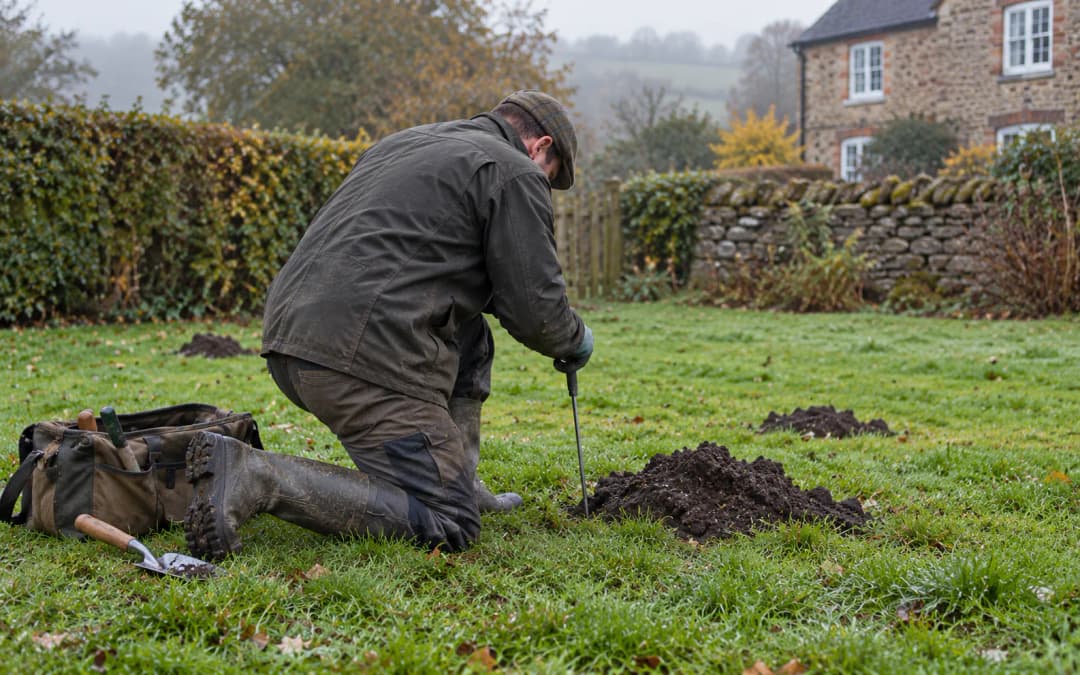
A typical visit runs like this:
- Walk the site. Fresh hills and ridges are mapped to work out where the tunnel system runs and which parts are active.
- Probe for the main run. A probe finds the deeper tunnels between molehills.
- Set the traps. The run is opened carefully, traps are set inside, and the tunnel is closed again so it stays dark.
- Return visits. Traps are checked and reset or moved if the mole has changed its route.
- Finish. Once activity stops, traps are removed and the molehills can be raked back.
On larger areas such as paddocks, farms and sports grounds, the same approach is spread over a programme of visits. If more than one mole is active, it can take a few rounds before the ground goes quiet.
Should you just leave moles alone?
You can, if they aren't causing a real problem. The RHS suggests treating moles as part of the garden's biodiversity where possible. In a large garden, a wildlife area or a field edge, a few molehills may be a fair trade.
Rushcliffe Borough Council in south Nottinghamshire is one of the few local councils still listing moles on its pest control fees (£105 for a home when we checked on 18 October 2026); many other councils don't treat them.
Control makes more sense where molehills cause trip hazards on paths and play areas, ruin a lawn you've invested in, or affect paddocks and sports pitches.
Other wildlife can cause lawn damage too. Our guides to how to get rid of foxes in the garden and are grey squirrels protected? cover two other common garden visitors.
When to call a professional
Call a mole catcher when fresh molehills keep appearing, when deterrents haven't worked, or when you want the problem dealt with quickly and humanely. Experience matters most in reading the ground: finding the main run rather than the surface tunnels.
Urgent Pest Control's mole catcher service starts from £150. It finds the active tunnels, sets traps in the main runs and checks them on return visits until activity stops. We don't use poison or gas, so it's safer around children and pets. We cover gardens, paddocks, farms and sports grounds. Ask us for a price; it depends on the size of the area and how many visits are needed.
We work 7 days a week, 6am to 8pm, across Nottingham, Derby, Leicester, Lincoln, Southwell, Melton Mowbray and the rest of Nottinghamshire, Derbyshire, Leicestershire and Lincolnshire. Book online, or call or WhatsApp 07999 935 929.
Sources
- RHS: moles
- Bolton Council: moles (PDF)
- The Small Ground Vermin Traps Order 1958 (legislation.gov.uk)
- Wild Mammals (Protection) Act 1996, section 2 (legislation.gov.uk)
- Baker et al. (2016), Moles and mole control on British farms, amenities and gardens after strychnine withdrawal, Animals 6(6):39
- Rushcliffe Borough Council: pest control fees
Frequently Asked Questions
About the author
The Urgent Pest Control team
A family-run pest control company based in Southwell, treating homes and businesses across Nottinghamshire, Derbyshire, Leicestershire and Lincolnshire since 2020. Our guides are written from the jobs we do and checked against UK sources. More about us
Cite this guide: “How to Get Rid of Moles in Your Garden”, Urgent Pest Control, 4 November 2026. https://urgentpestcontrol.uk/blog/how-to-get-rid-of-moles