Pigeons Under Solar Panels: How to Get Rid of Them for Good
Why pigeons nest under solar panels, the signs, what the law says about nests, and how mesh guards fitted around the array keep them out for good.

By the Urgent Pest Control team
Updated · 7 min read
The short answer
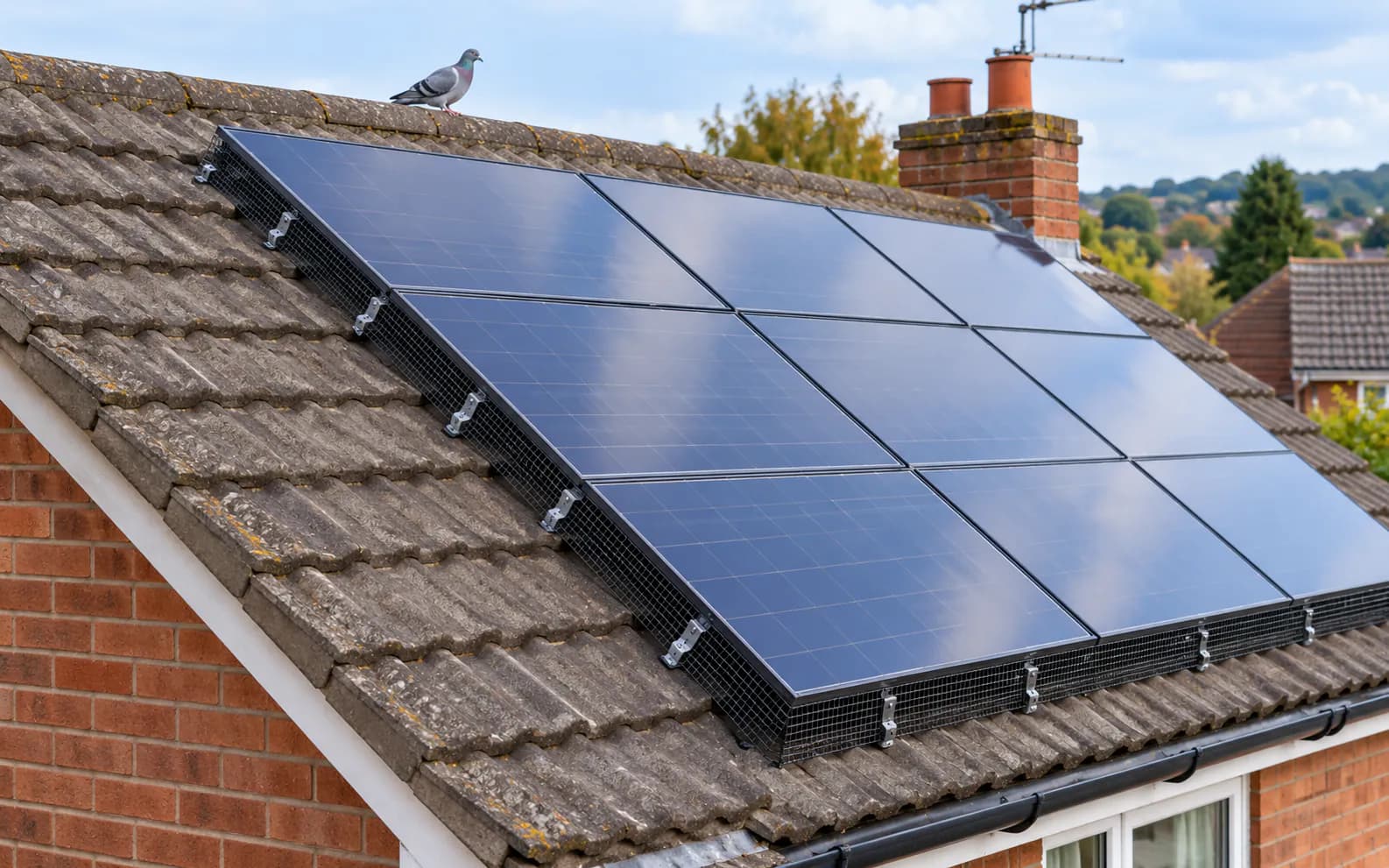
Pigeons nest under solar panels because the gap is warm, dry and sheltered. To get rid of them, wait until any active nest is empty, clear out nests and droppings, then fit a mesh guard around the edge of the array. The mesh clips to the panel frame, so the panels aren't drilled.
- The gap under roof-mounted panels gives pigeons shelter, so the fix is to close it off with mesh.
- Nests in use and eggs are protected by the Wildlife and Countryside Act 1981, so timing matters.
- Feral pigeons can breed up to six times a year, according to Richmond council, so problems grow quickly.
- Droppings and nest material can block gutters and drains as well as foul the roof.
- Mesh should be fitted only after nests are cleared, so no birds are trapped behind it.
On this page
- Why do pigeons nest under solar panels?
- What are the signs of pigeons under solar panels?
- What problems do pigeons under solar panels cause?
- Can you remove pigeons from under solar panels legally?
- How do you stop pigeons nesting under solar panels?
- What about spikes, gel and decoys?
- How do you know if a nest is still in use?
- Is it worth proofing panels before pigeons arrive?
- Should you clean the panels yourself?
- How can you stop pigeons choosing your roof?
- When to call a professional
Pigeons nest under solar panels because the gap between the panels and the roof is warm, dry and sheltered. The fix is to wait until any active nest is empty, clear out the nests and droppings, then fit a mesh guard around the edge of the array so they can't get back underneath. Our solar panel bird proofing service does all three after a free survey.
This guide covers the signs that pigeons are under your panels, the problems they cause, what the law says about nests, and how proofing works.
Why do pigeons nest under solar panels?
Pigeons nest under solar panels because the space mimics their natural nesting site. Feral pigeons are descended from rock doves, which live on cliffs. The London Borough of Richmond upon Thames explains that their descendants occupy the same niche in towns, perching and nesting on ledges, roofs and window sills.
Roof-mounted panels add shelter from wind and rain, protection from predators and warmth. A pair that finds a site like that keeps using it, and other pigeons follow.
They also breed quickly. Richmond's guidance says pigeons can breed from six months old, normally lay two eggs, incubate them for 16 to 18 days, and can breed up to six times a year. That's why a couple of birds in spring can become a colony under the array by autumn.
What are the signs of pigeons under solar panels?
The signs are usually obvious once you look up. Check for:
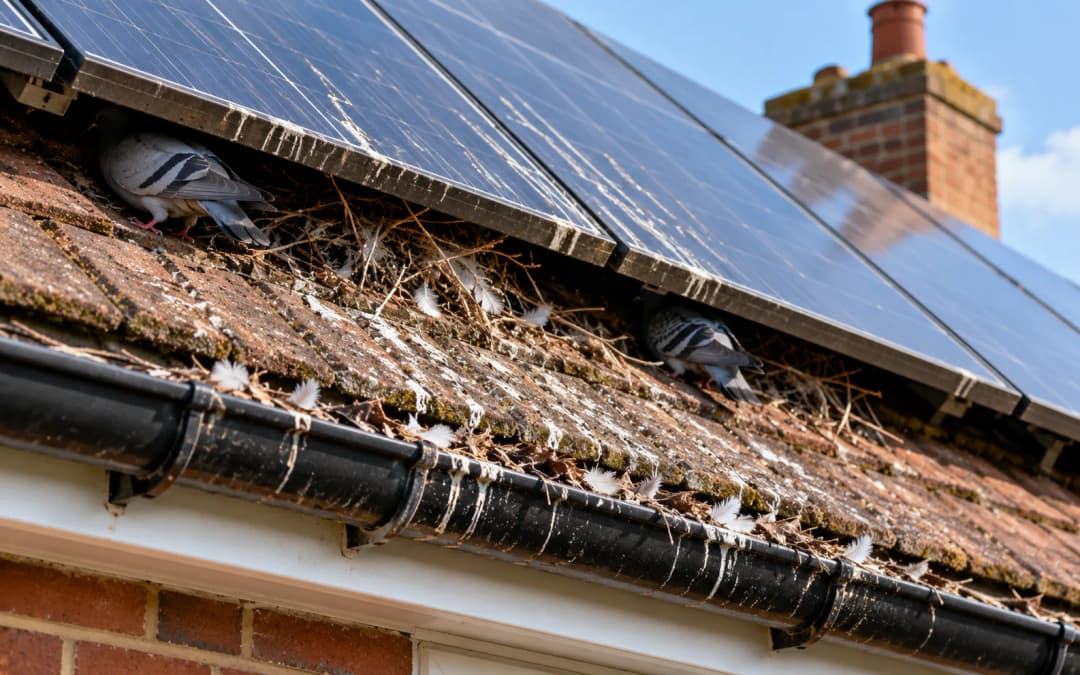
- pigeons landing on the roof and disappearing under the panel edge;
- cooing, scratching or flapping from the roof, often early in the morning;
- twigs, feathers and nest material poking out from under the panels;
- droppings running down the roof tiles, on the panels or on the ground below;
- blocked or overflowing gutters below the array;
- a drop in generation that your monitoring app shows, when droppings coat the glass.
A pair or two sitting on the ridge is a warning. Birds actually going under the array means they are nesting or roosting there.
What problems do pigeons under solar panels cause?
The main problems are mess, blocked gutters, noise and possible damage around the array. Richmond's guidance notes that droppings, nest material and dead birds can block guttering and drains and cause water damage to buildings, and that the acid in droppings corrodes stonework. Under solar panels, nest material and droppings build up where you can't easily reach them.
| Problem | What you notice | Why it matters |
|---|---|---|
| Droppings on panels and roof | Streaks and white patches | Dirty glass reduces the light reaching the cells |
| Nest material under the array | Twigs and feathers at the edge | Builds up each breeding cycle and holds moisture |
| Blocked gutters and downpipes | Overflowing gutters in rain | Can cause damp and water damage |
| Noise | Cooing and scratching at dawn | A nuisance in bedrooms below the roof |
| Cabling and fixings | Nest debris around wiring | Debris and birds around electrics are best avoided; ask your installer to check |
Can you remove pigeons from under solar panels legally?
Yes, as long as you deal with active nests correctly. Section 1 of the Wildlife and Countryside Act 1981 makes it an offence to take, damage or destroy a wild bird's nest while it is in use or being built, or to take or destroy its eggs. Feral pigeons are wild birds for this purpose.
Government guidance says that if you are certain birds are no longer using a nest, you can remove or destroy it without a licence. It also says to try non-lethal management, such as physical barriers, before lethal control.
Natural England's general licence GL41 allows an authorised person to remove feral pigeon nests and eggs for public health or safety reasons, including safety problems caused by nesting, within its conditions. Licences are reissued each year, so the current version must be checked. Our guide are pigeons protected? explains the licences in detail.
The practical rule: never fit mesh over a gap where there are eggs or chicks, or where adult birds are inside. Doing so would trap them, which is cruel and unlawful.
How do you stop pigeons nesting under solar panels?
A mesh guard around the whole perimeter of the array stops pigeons nesting under solar panels. The mesh runs along every exposed edge, between the panel frame and the roof, and is held by clips that attach to the panel frame. It doesn't need drilling into the panels or the roof covering.
A typical job runs in this order:
- Survey. We check the array, the roof and access, and look for active nests.
- Timing. If eggs or young are present, work is planned for when the nest is empty, unless a licence purpose genuinely applies.
- Clear out. Nests, debris and droppings are removed from under the panels. Where needed, the panels are cleaned.
- Fit the mesh. Mesh is cut to follow the array and clipped around every edge, leaving no gaps at corners.
- Check gutters. Debris washed down from the roof is cleared so water can flow.
We use UV-resistant materials and stainless fixings so the guard copes with years of sun and weather on a roof.
What about spikes, gel and decoys?
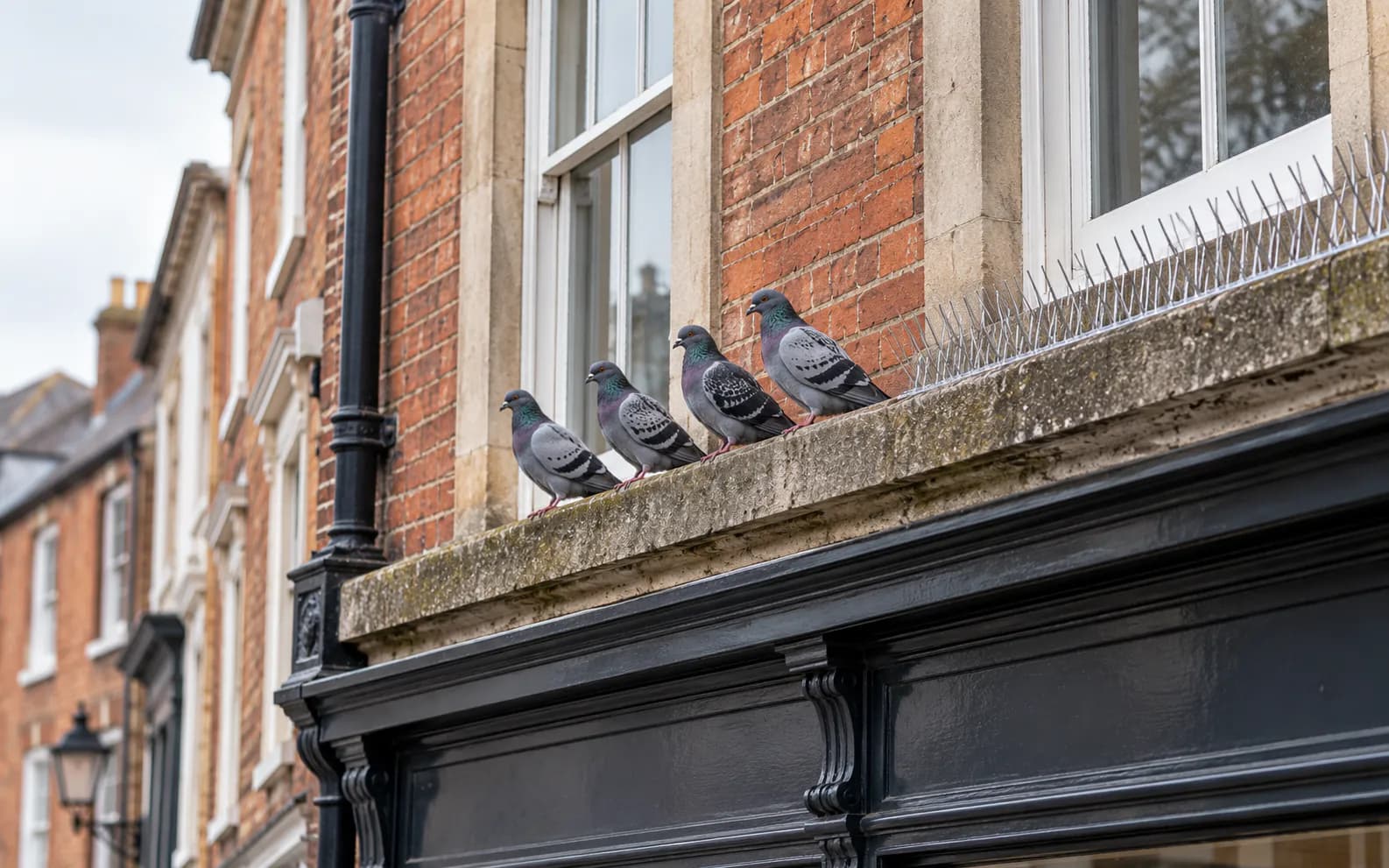
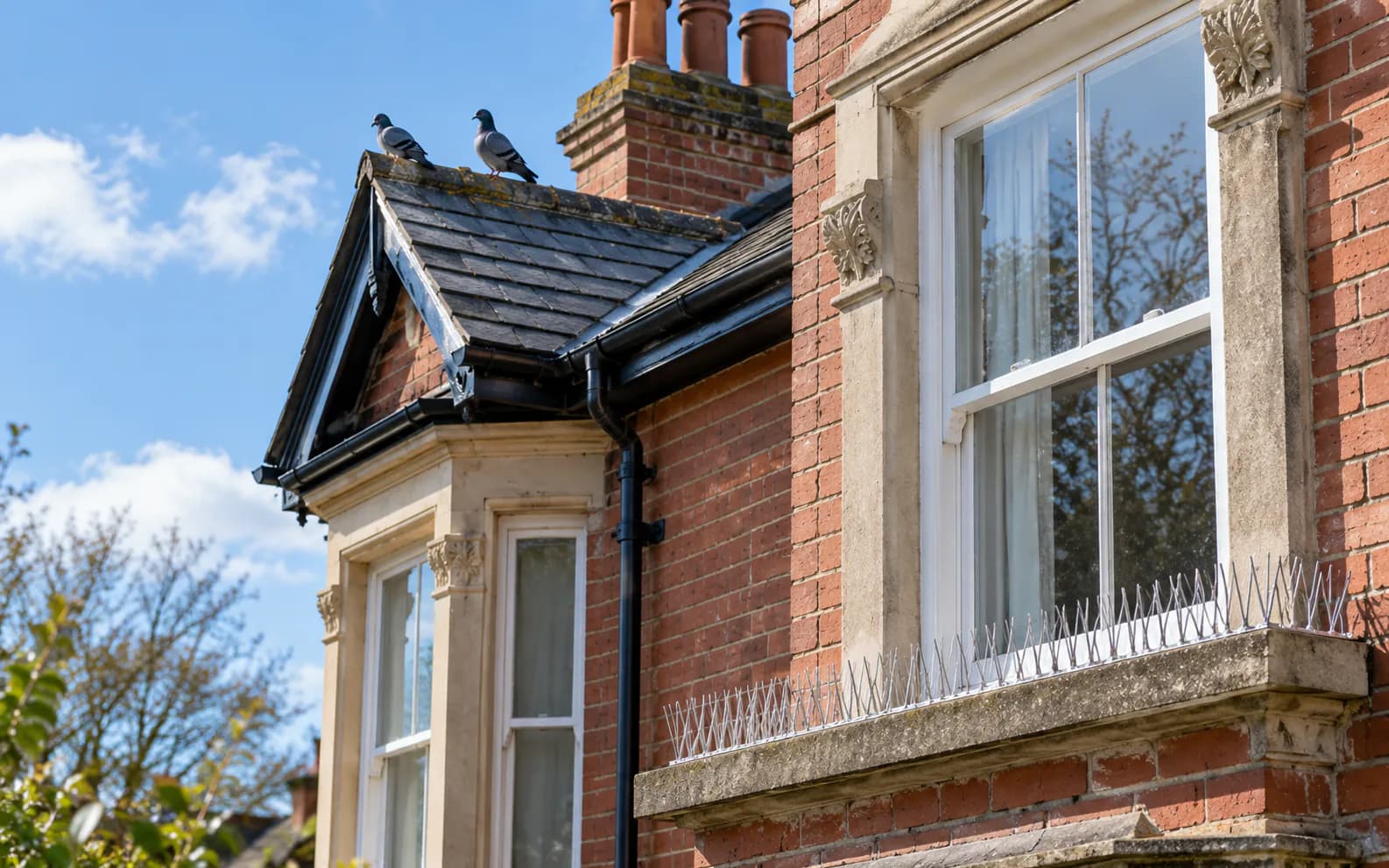
These don't solve pigeons under panels. Spikes protect a ledge, but pigeons can still walk under the panel from the side. Decoy owls and hawks lose their effect as birds get used to them, which is why government guidance recommends rotating scaring methods. Sticky or gel products are messy on a roof and can harm birds.
Spikes, netting and post-and-wire still have a place on ledges, chimneys and dormers next to the array. Our guide to how to get rid of pigeons covers those methods.
How do you know if a nest is still in use?
Watch the array before anyone touches it. A nest is likely in use if adult birds keep going under the same panel, if you hear chicks or see an adult sitting tight, or if fresh nest material keeps appearing. Richmond's guidance gives the timings: eggs are incubated for 16 to 18 days, and the young leave the nest after about five weeks but still rely on their parents for a week or two after that.
That means a nest found with eggs is usually empty within around seven or eight weeks. The catch is that pigeons can start again soon afterwards, so the best moment to fit mesh is right after a nest has been abandoned and cleared, before the pair lays again.
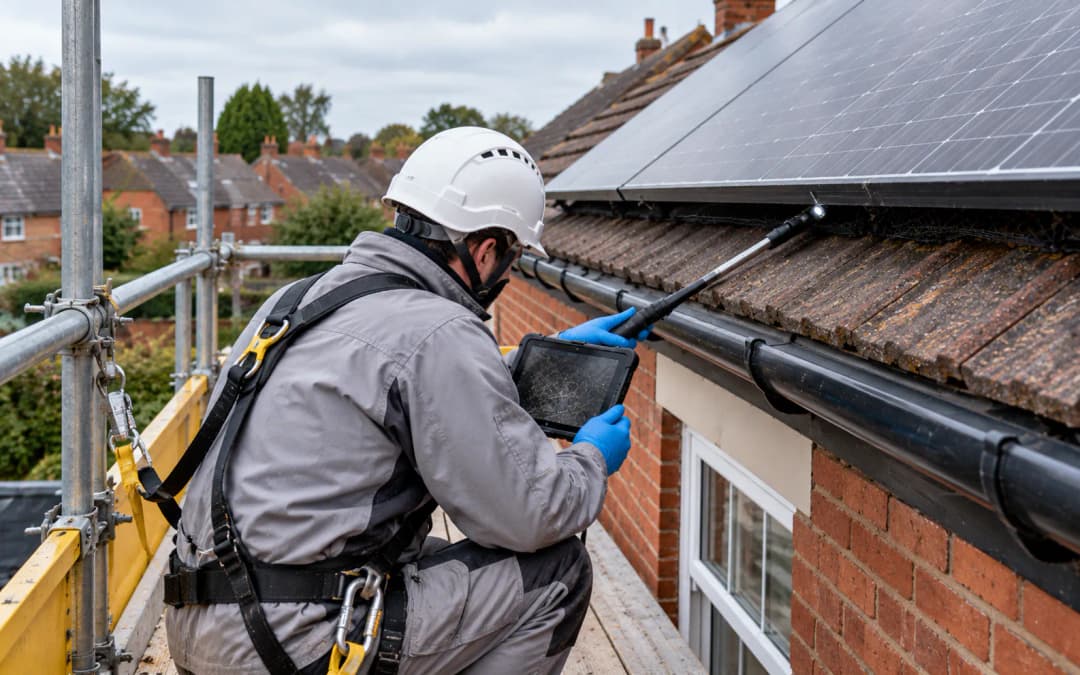
If you aren't sure, leave it. A surveyor can look under the array with a camera or from a ladder or platform and confirm what's there before any work is booked.
Is it worth proofing panels before pigeons arrive?
Yes, if pigeons are already active on or around your roof. Fitting mesh while the gap is empty avoids the clean-up, the wait for nests to clear and any damage to gutters. It's also simpler to do while access equipment is already in place, for example straight after installation.
If your street has no pigeon problem at all, it may not be needed straight away. Keep an eye on the roof and act at the first sign of birds going under the array.
Should you clean the panels yourself?
Leave roof work to people with the right access equipment. Working on a pitched roof is risky, and pressure-washing or scraping can damage panels or roof tiles. If you clean droppings at ground level, follow simple hygiene: wear gloves, dampen droppings before removing them so dust doesn't rise, and wash your hands afterwards. Gravesham Borough Council describes the infection risk from droppings as minor, but basic care is still sensible.
How can you stop pigeons choosing your roof?
Make your roof and garden less attractive. Before or after proofing:
- stop leaving bread or seed on the ground or flat roofs;
- use feeders that don't spill onto the ground;
- keep bins closed;
- fit mesh soon after panels go up, before birds find the gap;
- check other gaps on the roof, such as missing tiles or open soffits.
If you're having panels installed, ask the installer about bird protection at the same time.
When to call a professional
Call a professional if you see pigeons going under your panels, hear them on the roof or find nest material and droppings around the array. The work is at height and must be timed around nesting, so it isn't a DIY job.
Urgent Pest Control's solar panel bird proofing service starts with a free survey. We clear nests and droppings, clean where needed and fit clip-on mesh around the array using UV-resistant materials and stainless fixings. For pigeons on ledges, chimneys and other parts of the building, our bird control service fits netting and spikes. Ask us for a price; it depends on the size of the array, the roof and access.
We work 7 days a week, 6am to 8pm, across Nottingham, Derby, Leicester, Lincoln, Southwell and the surrounding counties. Book online, or call or WhatsApp 07999 935 929.
Sources
- London Borough of Richmond upon Thames: information about pigeons (PDF)
- Wildlife and Countryside Act 1981, section 1 (legislation.gov.uk)
- Wild birds: prevent damage to your land, farm, fishery or business (gov.uk)
- GL41: general licence to preserve public health or public safety (gov.uk)
- Gravesham Borough Council: feral pigeon advice
Frequently Asked Questions
About the author
The Urgent Pest Control team
A family-run pest control company based in Southwell, treating homes and businesses across Nottinghamshire, Derbyshire, Leicestershire and Lincolnshire since 2020. Our guides are written from the jobs we do and checked against UK sources. More about us
Cite this guide: “Pigeons Under Solar Panels: How to Get Rid of Them for Good”, Urgent Pest Control, 20 October 2026. https://urgentpestcontrol.uk/blog/pigeons-under-solar-panels