How to Get Rid of Pigeons on Your Roof and Ledges
How to get rid of pigeons legally: remove food, proof ledges and roofs with spikes or netting, deal with nests at the right time and clean droppings safely.

By the Urgent Pest Control team
Updated · 8 min read
The short answer
To get rid of pigeons, take away what draws them: food and somewhere to roost or nest. Stop feeding, secure bins, then proof ledges, roofs and solar panels with spikes, wires, netting or mesh once no nest is active. Scarers work briefly at best. Pigeons are protected, so lethal control needs a licence.
- Pigeons stay where there is food and shelter, so removing both is the only lasting fix.
- Councils name netting, wires and spikes as the main ways to stop pigeons roosting on buildings.
- Feral pigeons are protected wild birds; nests in use and eggs must not be disturbed unless a general licence applies.
- Scarers and decoys lose their effect as birds get used to them, so rotate them or rely on proofing.
- Pigeon droppings carry a minor infection risk; wear gloves and a mask and avoid dry-sweeping.
On this page
- Why are pigeons on my house?
- Step 1: how do you remove their food?
- Step 2: which pigeon deterrents work?
- Step 3: what should you do about nests?
- Do pigeon spikes work?
- How do you get rid of pigeons on your roof?
- How do you get rid of pigeons under solar panels?
- How do you clean up pigeon droppings safely?
- Can you kill pigeons legally?
- What about pigeons stuck in a chimney or loft?
- When to call a professional
To get rid of pigeons, take away what draws them: food and a safe place to roost or nest. Stop feeding, secure bins and fallen scraps, then proof ledges, roofs and solar panels with spikes, wires, netting or mesh once no nest is active. Our bird control service fits proofing that lasts, after a free survey.
Pigeons are protected wild birds, so the lawful approach is to make your building unattractive rather than to harm the birds. This guide covers why pigeons choose a property, which deterrents work, how to handle nests and how to clean up droppings safely.
Why are pigeons on my house?
Pigeons settle where they find food, water and a sheltered place to roost or nest. A flat ledge out of the wind, a gap under roof tiles, the space under solar panels or a balcony corner can all do the job. If someone nearby is feeding them, they have every reason to stay.
Councils agree on the cause. Gravesham Borough Council says a breeding pair with access to a regular food supply can produce a dozen eggs a year, and the young quickly reach breeding age, so numbers can rise fast. The London Borough of Richmond upon Thames notes excessive feeding can lead to overcrowding at feeding sites.
So the two questions to ask are: what are they eating, and where are they sitting?
Step 1: how do you remove their food?
Remove food first, or proofing will only push the birds to the next ledge. Work through this list:
- stop putting bread or seed on the ground or on flat roofs;
- use bird feeders designed for small birds and clean up spilt seed;
- keep bin lids shut and don't leave bags out overnight;
- clear fallen fruit and food waste from gardens and yards;
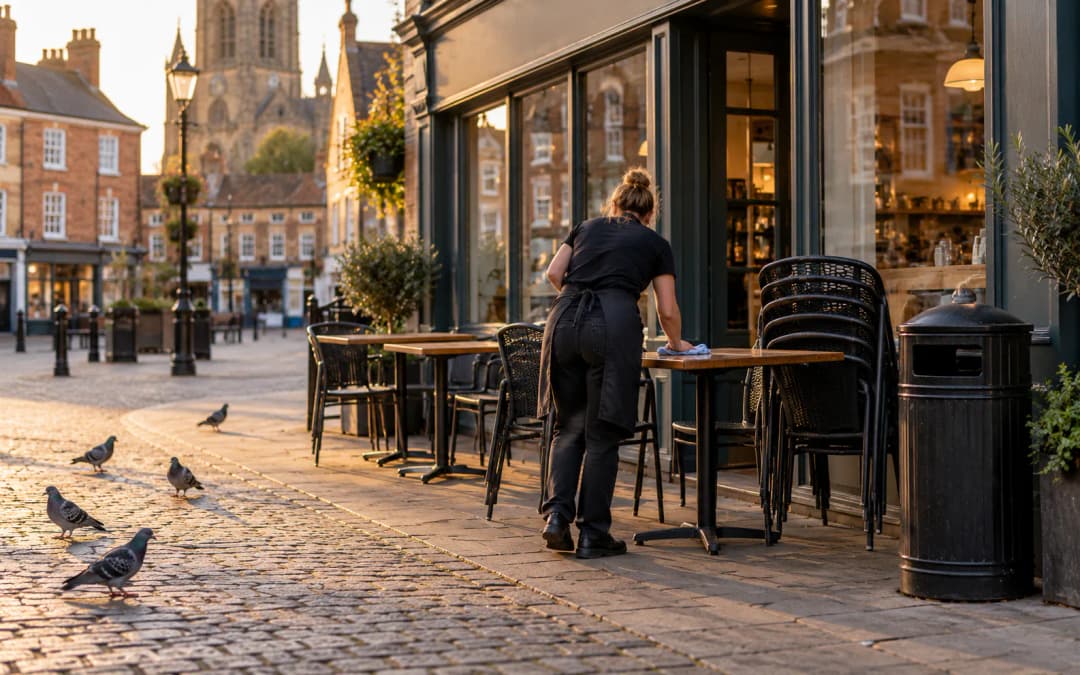
- for businesses, keep outdoor seating and waste areas clear at closing time.
If a neighbour feeds pigeons, it isn't a criminal offence in itself. Gravesham says it is not an offence to feed pigeons, but advises against it because food thrown in public areas can encourage rodents. A friendly word often helps more than a complaint.
Step 2: which pigeon deterrents work?
Physical proofing works best because it stops birds landing or getting in, rather than trying to frighten them. Gravesham Borough Council says netting, wires or spikes can be used to prevent roosting. The London Borough of Redbridge adds that "the only effective way to control pigeons in the long term is to remove their food source", which is why proofing and food removal go together.
| Method | Best for | How it works | Notes |
|---|---|---|---|
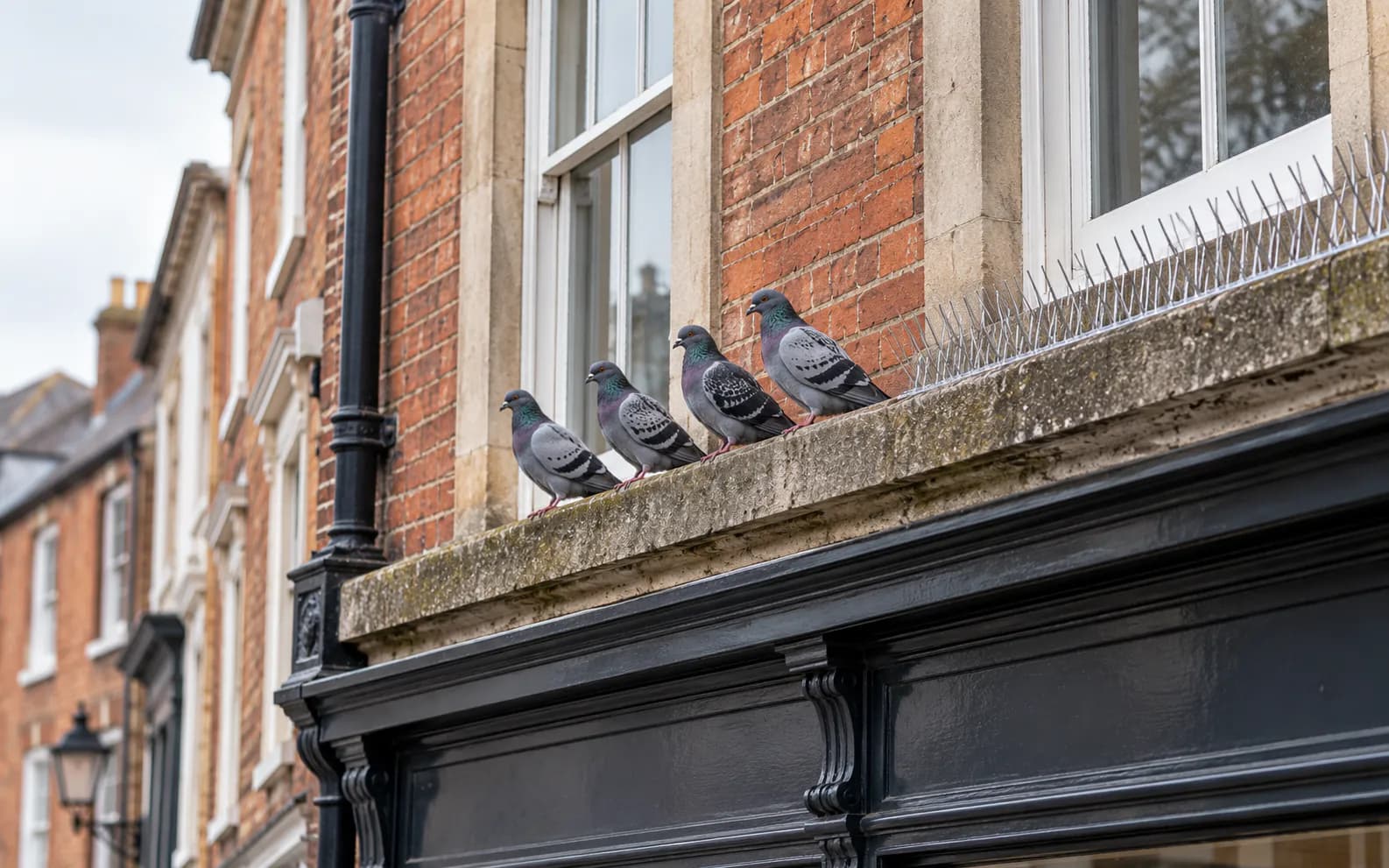
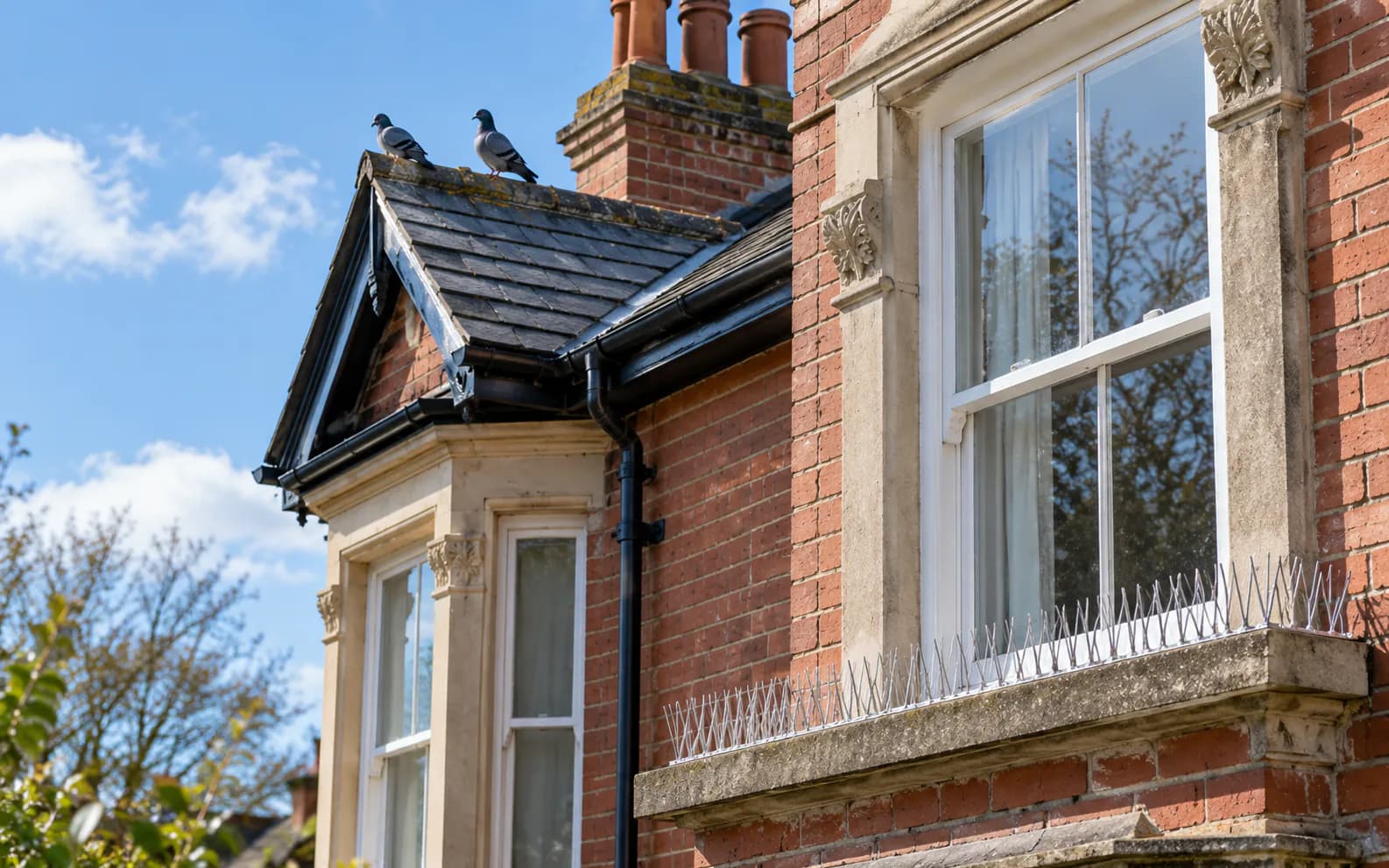
| Spikes | Window ledges, signs, parapets, pipes | Stops birds landing on narrow surfaces | Must cover the full width; birds nest in gaps |
| Post-and-wire | Long ledges and roof ridges | Tensioned wires make the surface unstable | Low visual impact on period buildings |
| Netting | Courtyards, balconies, roof voids, loading bays | Physically closes off the whole space | Must be taut and checked, so birds can't get trapped |
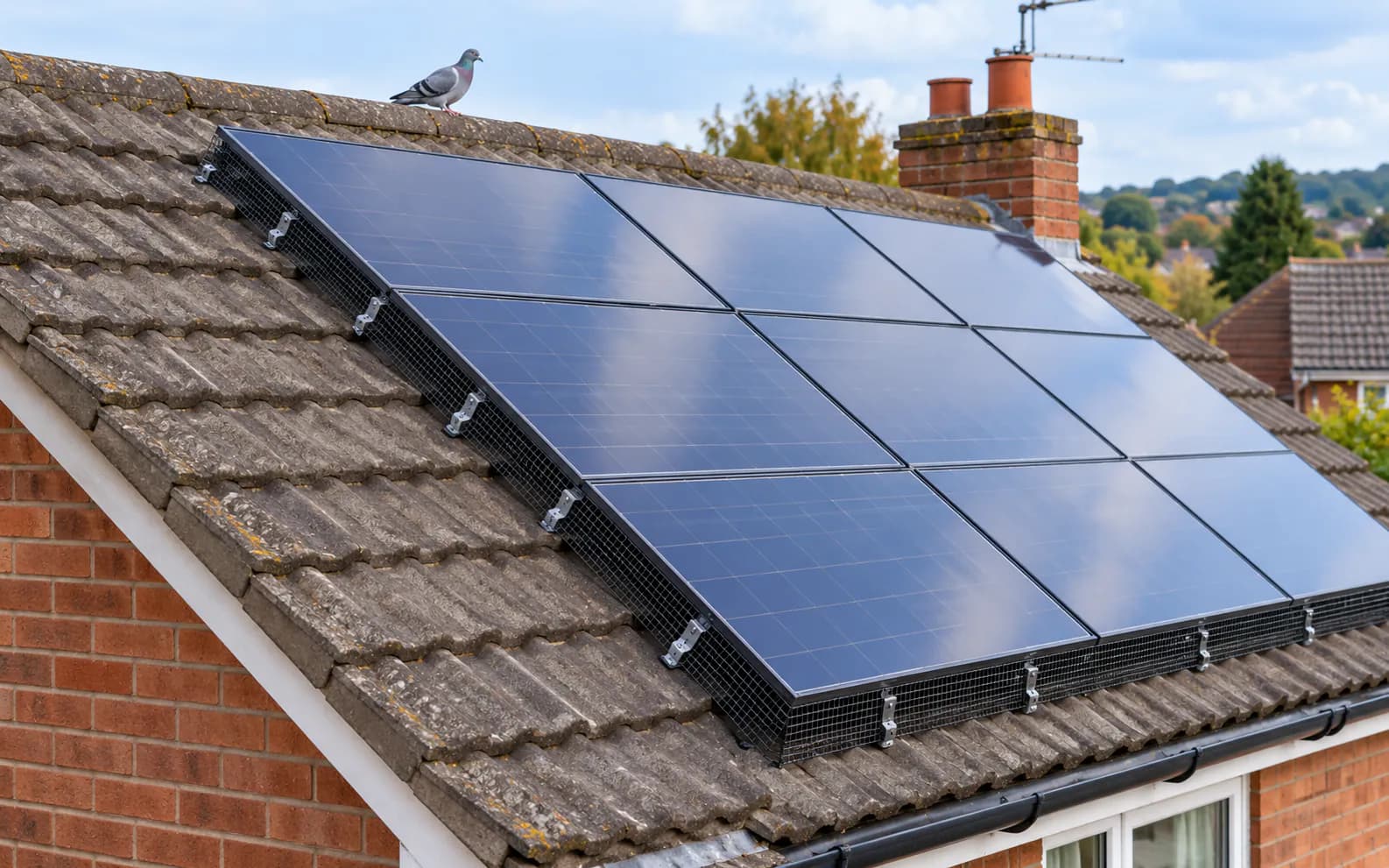
| Solar panel mesh | Gaps under roof-mounted panels | Clips around the array edge to block access | Fitted without drilling the panels |
| Scarers and decoys | Short-term or seasonal problems | Visual or sound disturbance | Birds get used to them, so effect fades |
| Removing food | Every site | Takes away the reason to stay | Needed alongside any of the above |
Government guidance on wild birds lists scaring, restricting food, netting roosting or nesting areas and physical barriers as the non-lethal options to try first, and notes birds get used to methods, so they should be rotated.
What doesn't work well on its own: plastic owls, shiny tape, CDs and ultrasonic devices. They might move birds along for a few days. Proofing the spot they use is what keeps them away.
Step 3: what should you do about nests?
Leave an active nest alone, then proof the site once it is empty. All wild birds are protected, and section 1 of the Wildlife and Countryside Act 1981 makes it an offence to take, damage or destroy a nest while it is in use or being built, or to take or destroy eggs.
Government guidance says you can remove a nest without a licence once you are certain birds are no longer using it. Natural England's general licences allow nests and eggs of feral pigeons to be removed only for listed purposes, such as public health or safety, and only by an authorised person who follows the conditions. Our guide are pigeons protected? explains those licences in full.
In practice:
- Check whether there are eggs or chicks.
- If there are, wait until the young have left, unless a genuine licence purpose applies.
- Remove the empty nest and droppings.
- Fit proofing straight away so the pair can't rebuild.
Never seal a gap with a bird still inside. Netting or mesh fitted over an active nest can trap adults or chicks, which is both cruel and an offence.
Do pigeon spikes work?
Yes, on narrow ledges, signs, pipes and parapets, if they cover the full width of the surface. Spikes stop pigeons landing; they don't stop birds getting into a gap, so they are the wrong tool for roof voids, balconies and the space under solar panels, where netting or mesh is needed.
What goes wrong with DIY spikes is usually coverage. A strip that leaves a few centimetres at the ends, or a gap between two strips, gives pigeons a perch, and debris that collects among the spikes can become a nest base. On wide ledges a single row isn't enough, and post-and-wire is often neater on long runs such as roof ridges.
How do you get rid of pigeons on your roof?
Work out what the birds are using the roof for, then block that spot. Pigeons sitting on the ridge or chimney are roosting; birds disappearing under tiles, soffits or panels are nesting.
| Where on the roof | What usually fixes it |
|---|---|
| Ridge tiles | Post-and-wire along the ridge |
| Chimney stack and pots | Spikes on the ledges; a cowl or cage over open pots |
| Gaps under tiles, soffits or fascias | Repair the gap once any nest is empty |
| Under solar panels | A clip-on mesh guard around the array |
| Flat roofs, dormers and parapets | Spikes or wire on the edges; netting for enclosed areas |
Fix food sources at the same time, or the birds will simply move to the next roof along.
How do you get rid of pigeons under solar panels?
Fit a mesh guard around the edge of the array after any nests have been cleared. The gap between the panels and the roof is warm and sheltered, so pigeons use it for nesting. The mesh clips around the panel frame, so there is no need to drill the panels. Our guide to pigeons under solar panels covers the signs, the law on nests and what installation involves.
How do you clean up pigeon droppings safely?
Clean droppings damp, not dry, and protect yourself while you do it. Gravesham Borough Council says pigeons do not significantly contribute to the spread of diseases to humans, but contact with their droppings poses a minor risk of some infections, and droppings left for a long time can damage buildings. Richmond adds that, except for people in close contact with large numbers of birds or droppings, the risk from casual contact is negligible, and advises washing hands after contact.
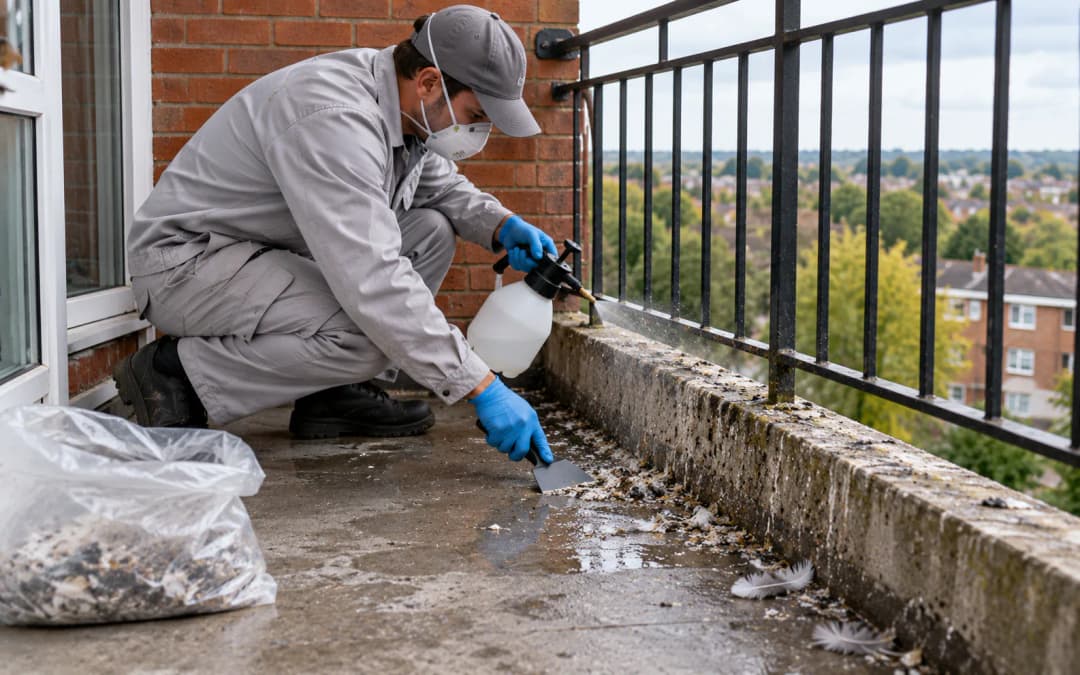
A simple safe-cleaning checklist:
- wear disposable gloves and a dust mask;
- dampen droppings with water or disinfectant before scraping, so dust doesn't rise;
- don't use a dry brush or leaf blower on dried droppings;
- bag the waste and wash hands thoroughly afterwards;
- leave large build-ups in lofts or at height to a professional.
Droppings on paths and steps are also a slip hazard, which is one reason businesses deal with them promptly.
Can you kill pigeons legally?
Only under a licence and within its conditions. Natural England's general licence GL41 allows an owner or occupier, or someone they authorise, to kill or take feral pigeons to preserve public health or public safety, and GL42 covers serious damage to crops and livestock foodstuffs. Any bird killed must be killed quickly and humanely. Poison is not a lawful option for a householder.
For homes and most businesses, lethal control isn't the answer anyway. Richmond's guidance says that for most pigeon problems lethal methods are "totally ineffective": the remaining birds breed more to compensate and numbers soon recover. Reduced food, plus proofing, deals with the cause.
What about pigeons stuck in a chimney or loft?
A pigeon trapped inside a chimney, loft or building should be freed or removed humanely, then the gap it came through should be closed. Chimney cowls or caps stop it happening again. This is a common call-out:
"Removed pigeon stuck in my fireplace." Fiona S, Google review, July 2026
Leave a trapped bird in a quiet room with a window open if it's in the house. If it's stuck inside the chimney or a wall void, get help rather than pulling at flue liners or brickwork.
When to call a professional
Call a professional when the problem is at height, on a roof or under solar panels, when droppings have built up in a loft or plant room, or when you're not sure whether a nest is still in use. Working on roofs and ladders carries real risk, and badly fitted netting can trap birds.
Urgent Pest Control's bird control service fits netting, spikes, post-and-wire and solar panel bird proofing, and includes guano clean-up. We use UV-resistant materials and stainless fixings so the proofing lasts outdoors. The survey is free, and we'll explain the likely cost before any work starts.
We work 7 days a week, 6am to 8pm, across Nottingham, Derby, Leicester, Lincoln, Melton Mowbray and the surrounding counties. Book online, or call or WhatsApp 07999 935 929.
Sources
- Gravesham Borough Council: feral pigeon advice
- London Borough of Redbridge: feral pigeons
- London Borough of Richmond upon Thames: information about pigeons (PDF)
- Wild birds: prevent damage to your land, farm, fishery or business (gov.uk)
- Wildlife and Countryside Act 1981, section 1 (legislation.gov.uk)
- GL41: general licence to preserve public health or public safety (gov.uk)
Frequently Asked Questions
About the author
The Urgent Pest Control team
A family-run pest control company based in Southwell, treating homes and businesses across Nottinghamshire, Derbyshire, Leicestershire and Lincolnshire since 2020. Our guides are written from the jobs we do and checked against UK sources. More about us
Cite this guide: “How to Get Rid of Pigeons on Your Roof and Ledges”, Urgent Pest Control, 20 October 2026. https://urgentpestcontrol.uk/blog/how-to-get-rid-of-pigeons