Masonry Bees: Do They Damage Walls and How Do You Stop Them?
Masonry bees are solitary bees that nest in soft mortar in spring. Why they rarely sting, how much damage they do and why repointing is the lasting fix.

By the Urgent Pest Control team
Updated · 8 min read
The short answer
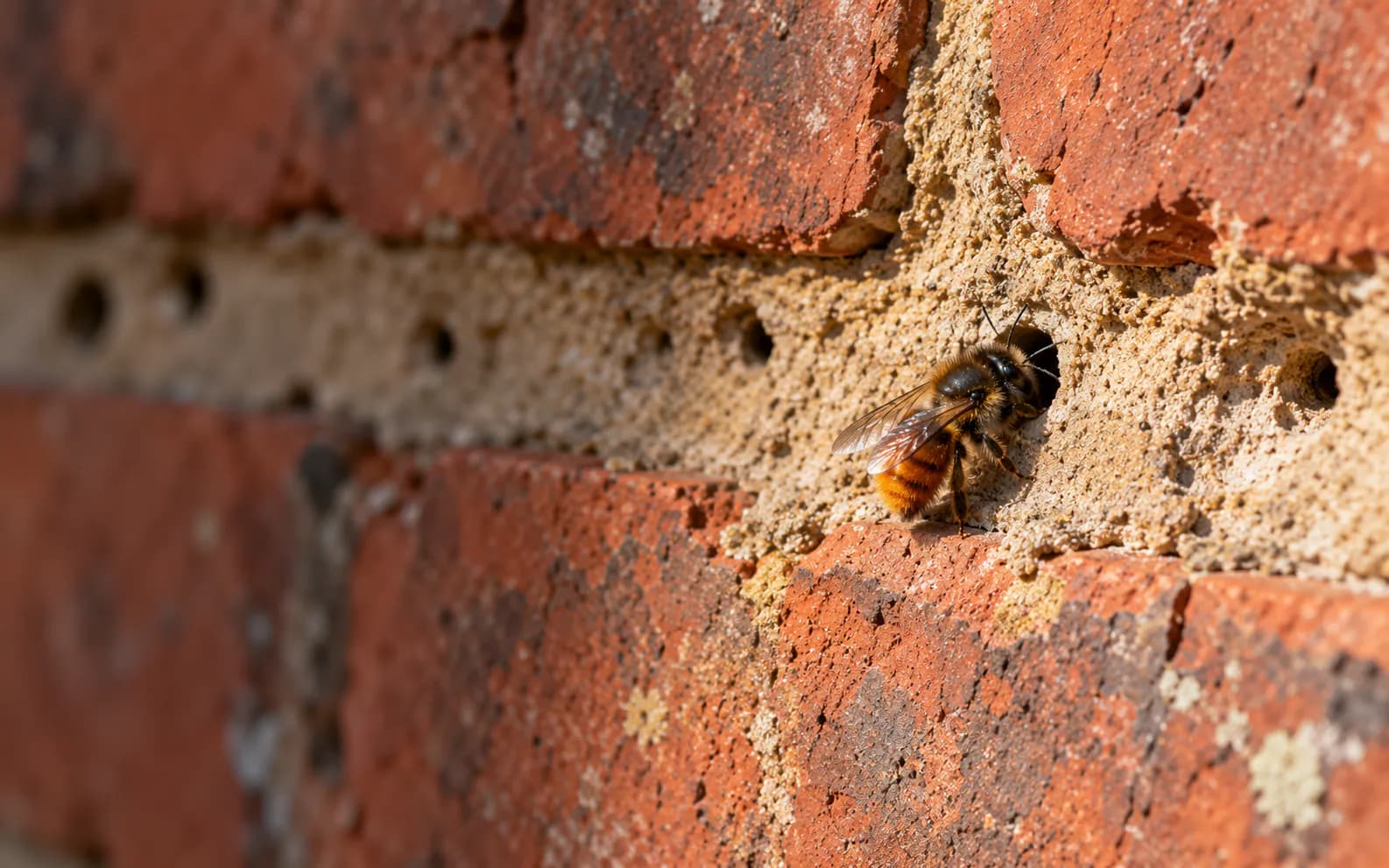
Masonry bees, also called mason or mortar bees, are solitary bees that nest in soft or crumbling mortar for a few weeks in spring. The most common is the red mason bee. They are not aggressive, usually reuse existing holes and do little harm to sound mortar. Repointing perished joints in late summer is the lasting fix.
- Masonry bees are solitary: each female makes her own nest, so a wall with many holes is not one colony.
- Oxford City Council says mortar bees are not aggressive and are seen for only a few weeks in spring.
- They mostly use soft, perished mortar and existing holes; sound mortar is rarely affected.
- Oxford and Rochdale councils both advise raking out soft joints to about 15 mm and repointing.
- Repoint in late summer or autumn, after the bees have finished and before frost.
On this page
- What are masonry bees?
- How do you know you have masonry bees?
- Masonry bee or something else in the wall?
- Do masonry bees damage walls?
- Do masonry bees sting?
- How do you get rid of masonry bees?
- When is the best time to repoint?
- Should you spray masonry bees with insecticide?
- Does the council deal with masonry bees?
- When to call a professional
Masonry bees, also called mason bees or mortar bees, are solitary bees that dig into soft mortar to lay eggs for a few weeks each spring. They are not aggressive, rarely sting and do little harm to sound brickwork. The lasting fix is repointing perished joints once they finish. Unsure what is in your wall? Urgent Pest Control's bee removal team can identify it from a photo, or try our pest identifier.
This guide explains what masonry bees are, how much damage they really do, whether they sting, and what to do about them, including the right time of year to repoint.
What are masonry bees?
Masonry bees are several species of solitary bee that nest in walls rather than in a hive or colony. Oxford City Council says a number of different species do this, and names the most common as Osmia rufa, the red mason bee (now usually called Osmia bicornis). Rochdale Borough Council says it is the most common of nearly 20 British species.
The Wildlife Trusts describe the red mason bee as "a common, gingery bee that can be spotted nesting in the crumbling mortar of old walls". It is 0.6 to 1.1 cm long, flies from March to June and also nests in hollow plant stems and holes in cliffs.
"Solitary" is the key word. Each female makes her own nest. A south-facing wall peppered with small holes can look like a swarm, but it is really dozens of separate mothers, each working alone. There is no nest to treat, no queen and no honey store.
How do you know you have masonry bees?
You usually notice them on a sunny spring day. Look for:
- small, round holes in the mortar joints;
- little piles of mortar dust at the foot of the wall;
- gingery, furry bees flying slowly in and out of the holes;
- activity on warm, sheltered walls, often facing south;
- bees in old drilled holes and gaps around window and door frames, which Oxford City Council also mentions.
Rochdale Borough Council notes that masonry bees look like honeybees, which is why they are often mistaken for a swarm. The difference is behaviour: honeybees fly in and out of one shared entrance, while masonry bees each use their own hole.
Masonry bee or something else in the wall?
The right answer depends on which insect it is. This table helps you tell them apart.
| What you see | Likely insect | What to do |
|---|---|---|
| Many small holes in mortar, single furry bees in spring | Masonry (mortar) bees | Leave them; repoint soft joints in late summer or autumn |
| Steady stream of bees through one gap, often all summer | Honeybees or bumblebees | Get them identified; see our guides to bumblebee nests and bee swarms |
| A large cluster of bees hanging on a wall or branch | Honeybee swarm | Keep away and contact a swarm collector |
| Yellow-and-black insects flying fast into one hole, May to October | Wasps | Don't block the hole; read how to get rid of a wasp nest |
| Larger brown-and-yellow insect | Hornet | See hornet vs wasp |
If you are not sure, a clear photo sent by WhatsApp is often enough for us to tell you what it is.
Do masonry bees damage walls?
Usually not much. Rochdale Borough Council says "masonry bees usually use pre-existing holes and crevices, so they don't usually cause significant damage to property". Sound mortar is rarely affected; old, poorly maintained joints are where the holes appear.
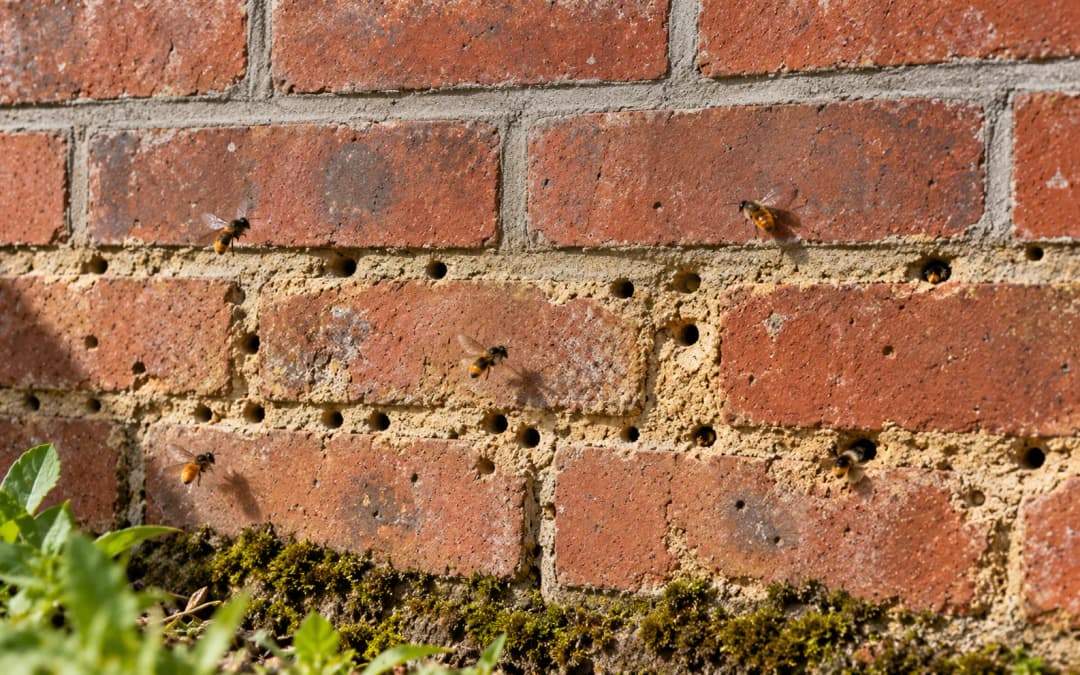
Oxford City Council explains why: mortar bees "burrow into soft or perished mortar joints in brick walls". Strong, sound mortar is too hard for them. So the bees are a symptom of soft joints rather than the cause of the problem. Over many years, though, the same soft wall can be used again and again, and the holes let in water.
Where damage does build up, it tends to be on:
- old lime mortar that has weathered;
- walls with soft, sandy joints;
- soft bricks or stone;
- sheltered, sunny walls that the bees return to each spring.
Do masonry bees sting?
Rarely. Oxford City Council says mortar bees are not aggressive and are more of a nuisance than a danger: they can sting, but their stings can't penetrate human skin. Rochdale Borough Council says the females have a sting but rarely use it unless provoked.
That makes them very different from wasps, which defend their nest. You can usually garden, hang washing and let children play near a wall with masonry bees, as long as nobody pokes sticks into the holes.
If anyone in the house has had a serious allergic reaction to a bee or wasp sting before, take extra care with any stinging insect and keep their adrenaline auto-injector to hand. The NHS says to call 999 if lips, mouth, throat or tongue suddenly swell, or if someone is struggling to breathe after a sting.
How do you get rid of masonry bees?
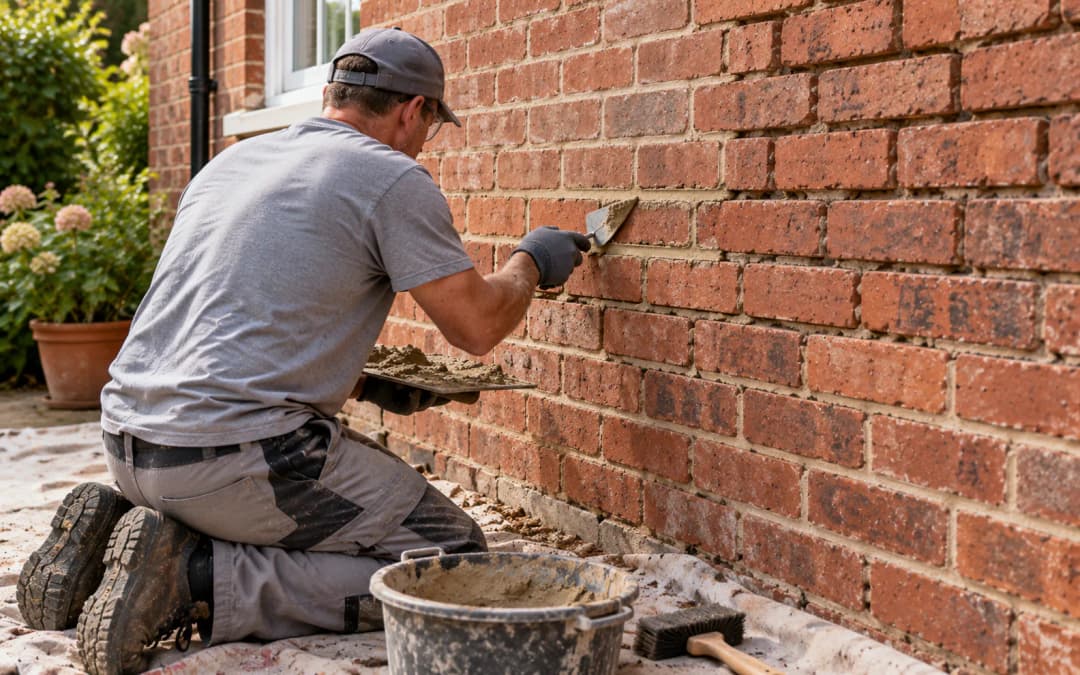
You stop them by making the wall unattractive, not by killing the bees. Oxford City Council says repointing soft or perished mortar is "the only effective way of preventing these bees". The steps councils recommend are:
- Wait until the bees have finished. Oxford says they are seen for only a few weeks in spring and raise only one brood a year.
- Rake out the soft joints to a depth of about 15 mm. Both Oxford City Council and Rochdale Borough Council give this figure.
- Repoint with the right mortar. It should be hard enough to discourage the bees but not too strong for the bricks. Mortar that is harder than the brick can push damage into the brick itself, so on older or softer brickwork get advice from a builder.
- Fill the existing galleries. Rochdale suggests using a mortar gun and a wetter-than-usual mix so the burrows are filled.
- Use fine netting in spring if you need a short-term barrier while you plan the work. Rochdale says netting should go up in spring, when the bees are searching for nest sites.
- Offer an alternative. Rochdale suggests artificial nesting boxes to draw bees away from the wall. A bee hotel nearby gives them somewhere else to go.
Rochdale also says limewash "isn't usually a useful deterrent on its own".
When is the best time to repoint?
Late summer to autumn. Oxford City Council recommends repointing "in late summer, after the bees have ceased their activities but before the possibility of frost damage". Rochdale advises summer or autumn so females cannot reuse the old holes.
| Time of year | What the bees are doing | What you can do |
|---|---|---|
| March to June | Adults flying, digging and laying eggs | Leave them; put up fine netting if you must keep them off a wall |
| July to August | Young developing inside the sealed cells | Plan repointing and book a builder |
| Late summer to autumn | No adults flying | Rake out to about 15 mm and repoint before frost |
| Winter | Young dormant in the wall | Avoid repointing in frost; finish before spring |
| Following spring | New adults emerge | Repointed joints give them nowhere to nest |
The flight season is from the Wildlife Trusts; the repointing timing is from Oxford City Council and Rochdale Borough Council.
Should you spray masonry bees with insecticide?
We don't recommend it as a fix. Spraying the holes does nothing about the soft mortar, so new bees can arrive next spring. The bees are solitary pollinators that do very little harm, and our approach to bees in general is to relocate where we can and use treatment only as an absolute last resort. Solitary bees in a wall cannot be relocated like a honeybee colony, so for masonry bees we give advice and point you to repointing.
Rochdale Borough Council does mention one specific use: adding a water-based insecticide to the mortar mix if repointing has to be done in spring. That is a job for a builder following the product label, not a reason to spray a wall.
There are times when a visit is worth it:
- bees are coming through the wall into a room;
- you are not sure whether they are masonry bees, honeybees or wasps;
- the brick or stone itself is being burrowed into.
Does the council deal with masonry bees?
Often not. Nottingham City Council lists bees as "not treated" in its pest control prices, and council advice, such as Oxford's and Rochdale's, points you to repointing rather than treatment. In practice, the work is for a builder, and a pest controller is useful when you need the insect identified or bees are getting indoors.
When to call a professional
Call us if you are not sure what is nesting in your wall, if bees are getting into a bedroom or loft, or if there are lots of bees using a single hole, which may mean honeybees, bumblebees or wasps rather than masonry bees. Wasps and honeybee colonies need a very different approach.
Our bee removal service relocates honeybees with local beekeepers wherever possible, and phone advice is free. For masonry bees we will usually tell you to leave them and repoint later, and we won't sell you a treatment you don't need. If you do need a visit, just ask us for a price; our pest control prices page explains what affects it.
We cover Nottinghamshire, Derbyshire, Leicestershire and Lincolnshire, including Nottingham, Derby, Leicester and Lincoln, 7 days a week from 6am to 8pm. Call or WhatsApp a photo to 07999 935 929, or book online.
Sources
Frequently Asked Questions
About the author
The Urgent Pest Control team
A family-run pest control company based in Southwell, treating homes and businesses across Nottinghamshire, Derbyshire, Leicestershire and Lincolnshire since 2020. Our guides are written from the jobs we do and checked against UK sources. More about us
Cite this guide: “Masonry Bees: Do They Damage Walls and How Do You Stop Them?”, Urgent Pest Control, 20 October 2026. https://urgentpestcontrol.uk/blog/masonry-bees