Pest Control for Food Businesses: What EHOs Look For
What the law requires on pest control for food businesses, what an EHO checks, what a pest control contract should include, and the records to keep.

By the Urgent Pest Control team
Updated · 7 min read
The short answer
Every food business in Great Britain must have adequate procedures to control pests under Regulation (EC) 852/2004 Annex II, now assimilated law. At inspection, an environmental health officer looks for signs of pests, proofing, cleanliness, waste control and records showing checks and action. A pest control contract with documented visits is the usual way to show it.
- Annex II of Regulation (EC) 852/2004, still in force in Great Britain as assimilated law, says adequate procedures are to be in place to control pests.
- Pest control is assessed under the physical condition of the premises, one of the three elements of a food hygiene rating.
- Officers can serve a hygiene improvement notice, or a hygiene emergency prohibition notice where there is an imminent risk to health.
- The FSA's Safer food, better business pack says to check for pests regularly and record contractor visits and recommendations in your diary.
- A good pest control contract gives you scheduled visits, written reports, a site plan of devices and a record of actions, which is what an inspector will ask to see.
On this page
- What does the law say about pest control in food businesses?
- What does an EHO look for at a food hygiene inspection?
- What happens if an inspector finds pests?
- Which pests cause the most problems in food premises?
- What should a pest control contract include?
- What records should a food business keep?
- When to call a professional
Every food business in Great Britain, from a restaurant or takeaway to a factory, must have adequate procedures to control pests. At inspection, an environmental health officer (EHO) checks for signs of pests, the condition and proofing of the building, cleanliness, waste storage and the records that prove you check and act. Urgent Pest Control's commercial pest control contracts give food businesses across Nottinghamshire, Derbyshire, Leicestershire and Lincolnshire the visits and paperwork that show it.
This guide covers the law, what an EHO looks for, the most common pest problems in food premises, what a pest control contract should include and the records to keep.
What does the law say about pest control in food businesses?
The law requires adequate procedures to control pests, and premises built and kept so that pest control is possible. The core requirement is in Annex II of Regulation (EC) No 852/2004 on the hygiene of foodstuffs, which continues to apply in Great Britain as assimilated law (the name for retained EU law since 1 January 2024 under the Retained EU Law (Revocation and Reform) Act 2023). Chapter IX, paragraph 4, says simply: "Adequate procedures are to be in place to control pests."
Other parts of Annex II back this up:
- Chapter I, paragraph 2(c): the layout, design and construction of premises must permit good food hygiene practices, "in particular, pest control";
- Chapter II, paragraph 1(d): windows that open to the outside must, where necessary, be fitted with insect-proof screens that can be easily removed for cleaning;
- Chapter VI, paragraph 3: refuse stores must be kept clean and, where necessary, free of animals and pests.
These hygiene rules sit within the framework of the Food Safety Act 1990, and in England they are enforced through the Food Safety and Hygiene (England) Regulations 2013. Local authority food officers carry out the inspections.
The government's guidance on starting a food business puts it in practical terms: premises must allow you to follow good food hygiene practices, "including protection against contamination and pest control", and food waste must be removed from food rooms as quickly as possible to avoid attracting pests.
What does an EHO look for at a food hygiene inspection?
An EHO looks at three things for your rating, and pest control is part of one of them. The Food Standards Agency's guidance on the food hygiene rating scheme lists:
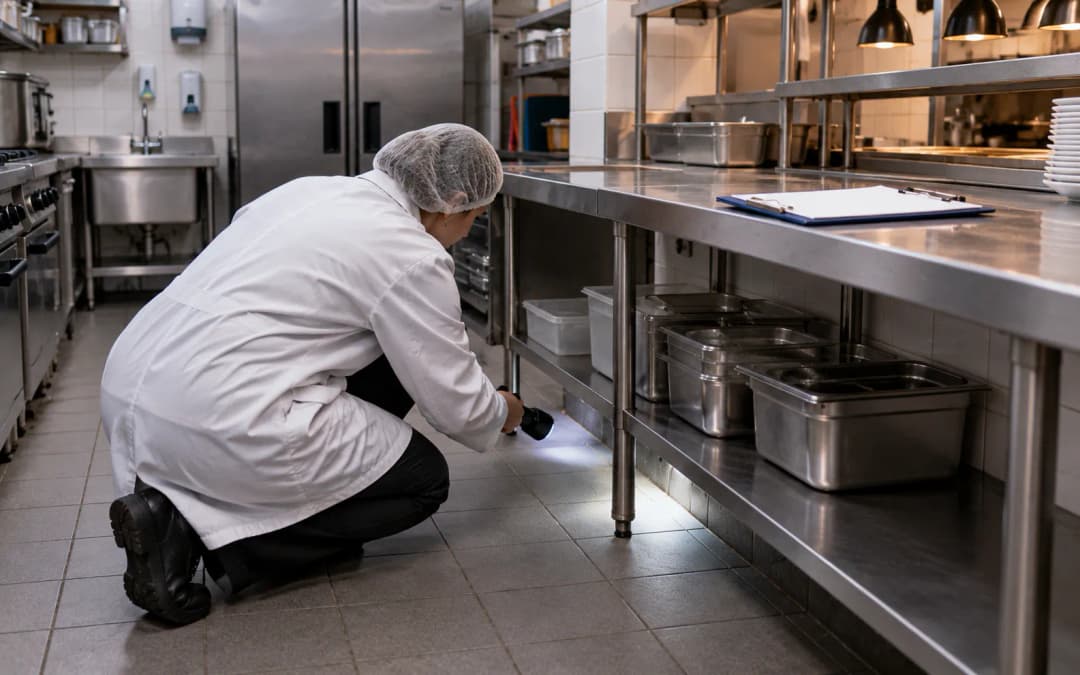
- how hygienically food is handled, prepared, cooked, cooled and stored;
- the physical condition of the business, "including cleanliness, layout, lighting, ventilation, pest control and other facilities";
- how you manage food safety, looking at processes, training and systems, which gives the officer confidence about future standards.
In practice, these are the pest-related things an officer is likely to check:
| What they check | What good looks like |
|---|---|
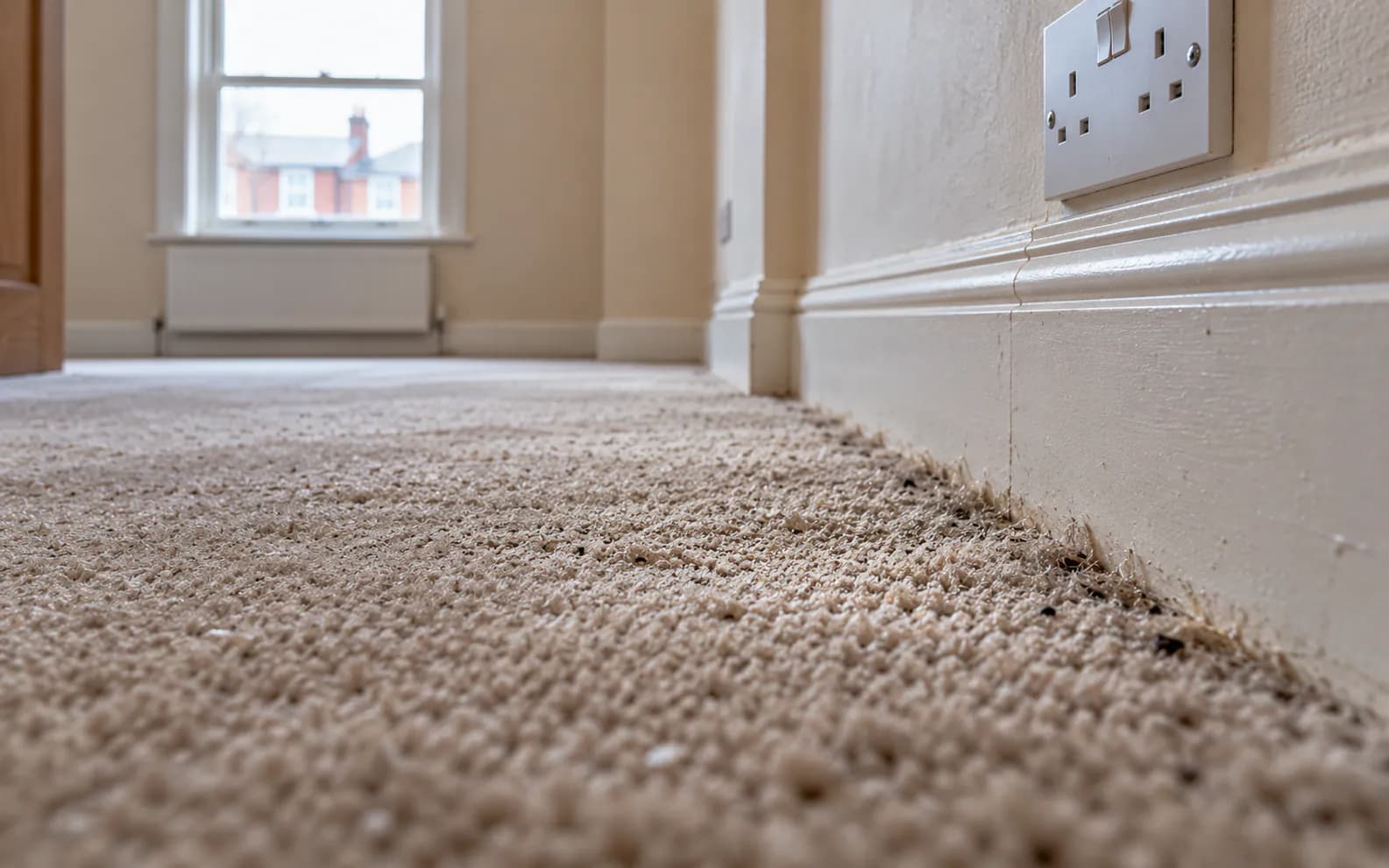
| Signs of pests | No droppings, gnawed packaging, smear marks, live or dead insects, egg cases or feathers in food areas |
| Proofing | Doors close fully, gaps around pipes and cables are sealed, windows have insect screens, air bricks are intact |
| Cleanliness | No food debris under equipment or in voids; no food or dirty plates left out overnight |
| Waste | Bins have close-fitting lids, refuse areas are clean, waste is removed from food rooms promptly |
| Deliveries | Goods are checked on arrival and rejected if they show signs of pests |
| Pest control arrangements | A contract or documented procedures, with recent visit reports |
| Records and actions | Sightings logged, recommendations from the contractor acted on and signed off |
| Chemical safety | Bait and insecticides are kept away from food, packaging and food-contact surfaces |
Ratings run from 5 ("hygiene standards are very good") to 0 ("urgent improvement is necessary"). The FSA guidance explains that if you disagree with a rating you must appeal in writing within 21 days, and that you can ask for a re-rating inspection once you have accepted the rating and made the required improvements.
What happens if an inspector finds pests?
It depends on how serious and how current the problem is. Minor issues are normally raised in the inspection letter, but officers have formal powers under the Food Safety and Hygiene (England) Regulations 2013:
- Hygiene improvement notice (regulation 6). Sets out the failings and the steps needed to fix them, with at least 14 days to comply. Failing to comply is an offence.
- Hygiene emergency prohibition notice (regulation 8). Used where an officer is satisfied there is an imminent risk of injury to health. It is fixed to the premises and can stop the business, or part of it, operating until the officer certifies the risk has been removed.
An active rodent or cockroach infestation in a food room is exactly the kind of situation where an officer may consider these powers. Even where it doesn't come to that, evidence of pests usually means a lower rating and a revisit.
Which pests cause the most problems in food premises?
Rodents, insects such as cockroaches and flies, and birds. The government's guidance on starting a food business names three groups: rodents (rats and mice); insects (cockroaches, beetles, ants and flies); and birds such as pigeons. The FSA's Safer food, better business pest control sheet lists the signs of each:
| Pest | Signs the FSA tells businesses to look for |
|---|---|
| Rats and mice | Footprints in dust, droppings, holes in walls and doors, nests, gnawed goods or packaging, grease or smear marks, urine stains on packaging |
| Flies and flying insects | Bodies of insects, live insects, webbing, nests, buzzing, maggots |
| Cockroaches | Eggs and egg cases, moulted skins, the insects themselves, droppings |
| Ants | Small piles of sand or soil, the insects themselves, flying ants on hot days |
| Birds | Feathers, droppings, nests, noise, the birds themselves |
| Beetles and weevils | Moving insects, particularly in dry food, small maggots |
Our guides to getting rid of cockroaches, pharaoh ants and biscuit and plaster beetles cover some of these in more depth.
What should a pest control contract include?
Scheduled visits, call-outs between visits, a device plan and written reports after every visit. A good contract does two jobs: it keeps pests out, and it gives you the paperwork to prove it. The FSA's Safer food, better business pack suggests businesses "could employ a pest control contractor" and, if they do, keep a record of the contractor's contact details, visits, feedback and action points, noting when those actions were carried out.
When comparing contracts, check for:
- A site survey first, identifying risks such as gaps, drains, waste areas and neighbouring premises;
- Scheduled routine visits at a frequency matched to the risk, explained in writing;
- Call-outs between visits if you see signs of pests, with a clear response arrangement;
- A site plan showing every bait station, trap, monitor and fly control unit, numbered;
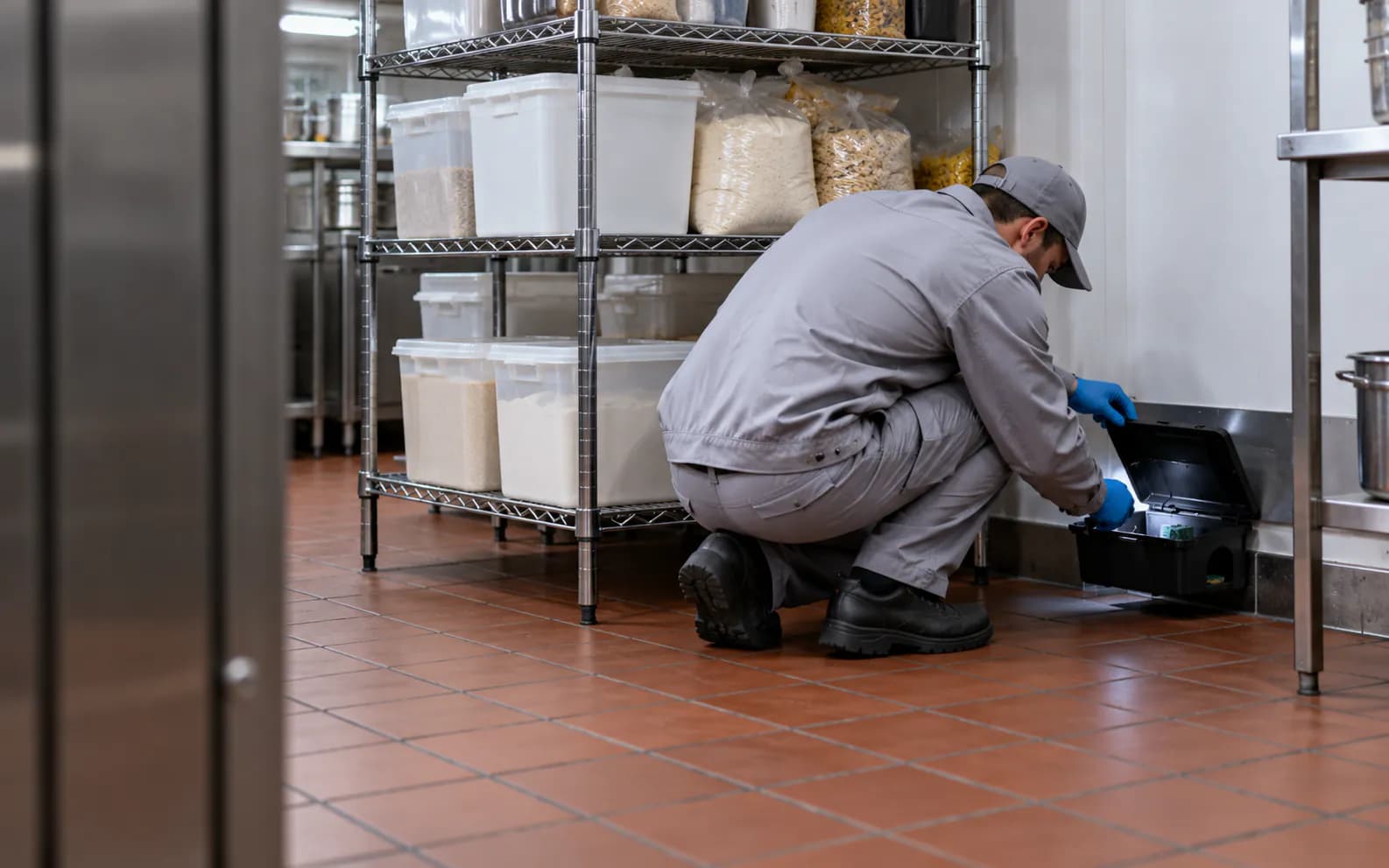
- Tamper-resistant bait stations for rodents, placed and secured so bait can't reach food;
- Written reports after every visit, recording activity, products used, recommendations and who is responsible for each action;
- Product safety information for anything used on site;
- Proofing and hygiene recommendations in plain language, with follow-up to check they were done.
Keep the reports together in your food safety file, or in the diary section of Safer food, better business, so they are easy to show an inspector.
What records should a food business keep?
Keep records that show a routine and a response: the contract, the device plan, visit reports, sightings and the action taken. A simple checklist:
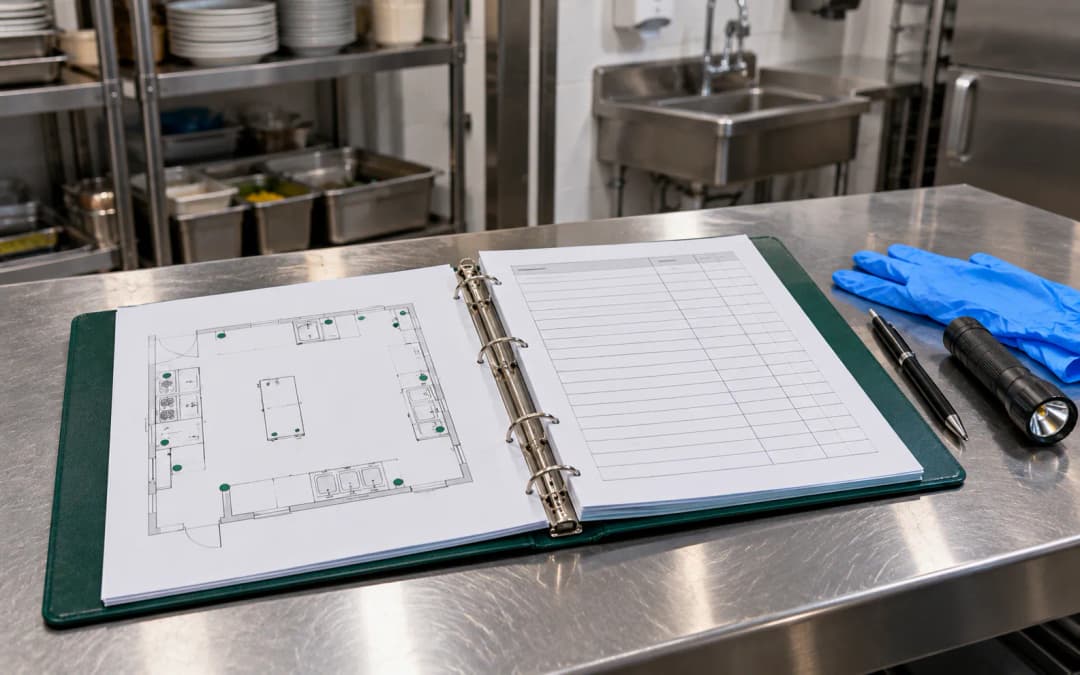
- your pest control contract or written pest control procedures;
- the current site plan of devices;
- every visit report, with recommendations signed off when completed;
- daily or weekly checks for signs of pests, as recorded in your opening and closing checks;
- delivery checks, including any goods rejected for signs of pests;
- any sighting, what you did, and when the contractor attended;
- proofing and repair work completed, with dates;
- staff training on recognising and reporting signs of pests.
The FSA's "What to do if things go wrong" advice is clear: if you see signs of an infestation, call a pest contractor immediately; wash, disinfect and dry equipment or surfaces that pests may have touched; throw away any food that pests may have touched; and write down what went wrong and what you did about it.
When to call a professional
Call a professional straight away if you find droppings, gnawed packaging, cockroaches, ants trailing into food areas or birds inside, and before an inspection if you have no current pest control arrangements. The FSA's own advice is to call a pest contractor immediately when you see signs of an infestation.
Our commercial pest control service covers cafés, restaurants, takeaways, shops, pubs and food production units. We survey the site, agree a schedule, explain the likely cost before any work starts, and give you written reports after every visit. We work 7 days a week, so visits can be made before you open or after you close, and our vehicles are unmarked. We cover Nottingham, Leicester, Derby, Lincoln and towns such as Newark.
"I’ve been using this company for my business in Newark since it opened and wouldn’t use anyone else." — Tim Dallison, July 2022, Google review
Our hours are 6am to 8pm, with emergency call-outs 365 days a year. Call or WhatsApp 07999 935 929, or book a site survey.
Sources
- Regulation (EC) No 852/2004, Annex II (legislation.gov.uk)
- Food Safety Act 1990 (legislation.gov.uk)
- Food Safety and Hygiene (England) Regulations 2013 (legislation.gov.uk)
- Food Standards Agency: food hygiene rating scheme guidance for businesses
- Food Standards Agency: Safer food, better business, pest control (PDF)
- GOV.UK: starting a food business
- Retained EU Law (Revocation and Reform) Act 2023 (legislation.gov.uk)
Frequently Asked Questions
About the author
The Urgent Pest Control team
A family-run pest control company based in Southwell, treating homes and businesses across Nottinghamshire, Derbyshire, Leicestershire and Lincolnshire since 2020. Our guides are written from the jobs we do and checked against UK sources. More about us
Cite this guide: “Pest Control for Food Businesses: What EHOs Look For”, Urgent Pest Control, 20 October 2026. https://urgentpestcontrol.uk/blog/pest-control-for-food-businesses