When Is Flying Ant Day in the UK? Flying Ants Explained
When is flying ant day? Research shows it isn't one day but a season from June to early September, triggered by warm, still weather. What to do if they swarm.

By the Urgent Pest Control team
Updated · 7 min read
The short answer
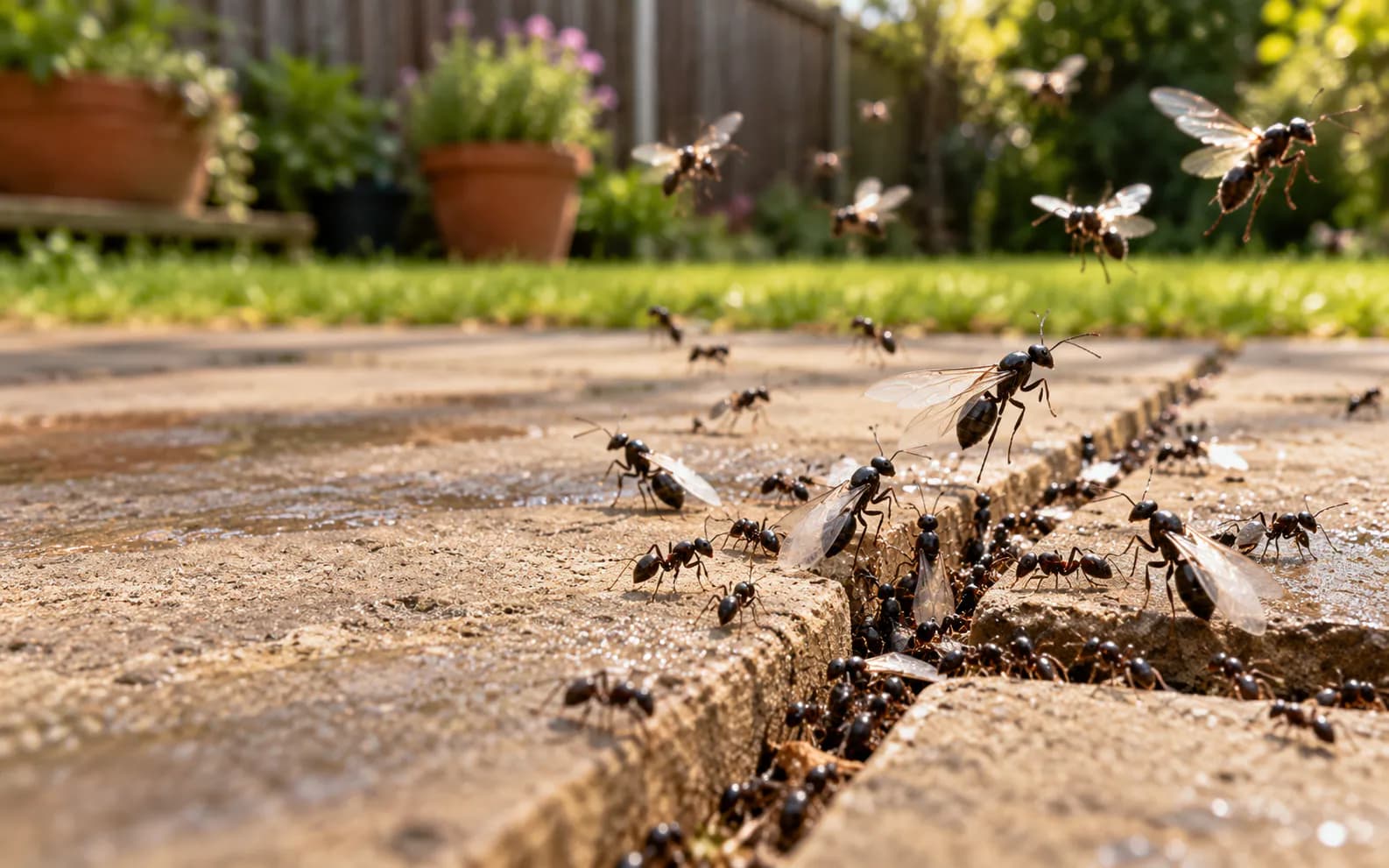
There is no single flying ant day. Royal Society of Biology research found winged ants fly across a season from June to early September, mostly in July and August, on warm, still days when the weather has improved. Different nests fly on different days, so your street may see swarms weeks apart from the next town.
- Flying ant day is really a flying ant season: swarms appear from June to the start of September, with most sightings in July and August.
- A Royal Society of Biology citizen-science survey found ants flew only when it was warmer than 13°C and wind speeds were below 6.3 metres per second.
- Nearly 90% of the winged ants sampled were black garden ants, Lasius niger.
- Flying ants are males and new queens on a mating flight; males die within a day or two and mated queens shed their wings to start new nests.
- Swarms pass quickly, but ants trailing indoors afterwards point to a nest close to the house.
On this page
- When is flying ant day in the UK?
- Why do people think there is one flying ant day?
- What triggers flying ants to swarm?
- Can you predict flying ant day?
- What are flying ants?
- Are flying ants harmful?
- What should you do when flying ants swarm?
- What does a swarm tell you about ants in the house?
- When to call a professional
There is no single flying ant day. Research by the Royal Society of Biology found that winged ants fly across a season from June to early September, mostly in July and August, on warm, still days. Different nests fly on different days. If ants keep trailing into your home after the swarms, our ant control service can find and treat the nest.
This guide explains what flying ants are, what triggers them, what the research actually found, and what to do when they appear around your home.
When is flying ant day in the UK?
Flying ant "day" is really a flying ant season that runs from June to the start of September. The Natural History Museum says swarming usually happens in July or August, during hot and humid weather, but can appear any time between June and the start of September.
The best evidence comes from a citizen-science survey run by the Royal Society of Biology with Professor Adam Hart of the University of Gloucestershire. The survey ran for three years from 2012, and members of the public sent in sightings and samples from across the UK. The results were published in the journal Ecography.
The published paper reports more than 13,000 observations, with sightings from June to September and 97% of them in July and August (Hart and colleagues, Ecography). The Royal Society of Biology summarises the headline finding: there is no single flying ant day, and ants flew on as many as 96% of days from June to September.
Why do people think there is one flying ant day?
Because in any one garden it often looks like a single event. A nest can release hundreds of winged ants in an afternoon, and neighbouring nests under the same patio may fly at the same time in the same warm spell.
What the survey showed is that this local synchrony doesn't scale up. The Royal Society of Biology reports that neighbouring gardens often saw flying ants on different dates, sometimes weeks or months apart. The Ecography paper found sightings were not significantly clustered at national, regional or local scales. Your flying ant day and your friend's in the next town may be weeks apart.
What triggers flying ants to swarm?
Weather is the trigger: warm, still days after conditions have improved. The Royal Society of Biology reports that flights occurred only when it was warmer than 13°C and wind speeds were below 6.3 metres per second. The Natural History Museum adds that ants flew on days when conditions had improved compared with the previous day, and that flying ant days anecdotally often follow some summer rain.
| Factor | What the research found | Source |
|---|---|---|
| Season | June to the start of September | Natural History Museum |
| Peak months | 97% of sightings in July and August | Ecography paper |
| Temperature | Flights only when warmer than 13°C | Royal Society of Biology |
| Wind | Flights only when wind speed was below 6.3m/s | Royal Society of Biology |
| Weather change | Conditions improved compared with the previous day | Natural History Museum |
| Town vs country | Ants fly earlier in urban areas, probably because towns are warmer | Natural History Museum; Ecography paper |
| Species | Nearly 90% of winged ants sampled were black garden ants | Royal Society of Biology |
The paper also found that nests in towns and those next to heat-retaining structures produced winged ants earlier. In practice, that means nests under patios, paths and south-facing walls are often the first to fly.
Can you predict flying ant day?
Not to a specific date. The Ecography paper found that the exact timing differed substantially between the three survey years, so last year's date is a poor guide to this year's. What you can predict is the kind of day it will be.
Watch for these conditions between late June and the end of August:
- a warm afternoon, comfortably above 13°C;
- light or no wind;
- a clear improvement on the day before, such as sunshine after a wet or cooler spell;
- humid, close air, which the Natural History Museum associates with swarming.
Town gardens tend to see flights earlier than the surrounding countryside, so in the East Midlands a city-centre street in Nottingham, Derby or Leicester may see winged ants before a village a few miles out. Nests under sun-warmed patios and paths are often first. If a warm, still afternoon arrives after rain in July, it is worth closing the windows on the patio side of the house.
What are flying ants?
Flying ants are the winged males and new queens of an ordinary ant colony, not a separate species. They leave the nest to mate. In the UK they are almost always black garden ants, Lasius niger; the Natural History Museum notes red ants (Myrmica rubra) swarm too.
The event is called the nuptial flight. According to the Natural History Museum:
- winged males and young queens leave the nest together and mate in the air;
- after mating, males usually live only another day or two;
- mated queens chew off their own wings and look for a place to start a new nest;
- a new queen digs a chamber, lays her first eggs and doesn't eat for weeks until her first workers can forage;
- a queen can live for up to 15 years, and large nests can have more than 20,000 workers.
That last point explains why the same patio produces flying ants year after year. The colony underneath is long-lived.
Are flying ants harmful?
No. Flying ants are a nuisance rather than a danger. They don't damage your home, and the swarm is short-lived: Oxford City Council notes that the swarms themselves persist for only 2 to 3 hours.
Coventry City Council says the black garden ant, which makes up nearly 90% of flying ants, is not known to transmit any serious disease organisms to humans, and describes the mating flight as a nuisance. The NHM points out the benefits too: ant tunnelling improves soil, and the flights feed birds such as swifts and gulls.
The main problems are practical. Ants come in through open windows and doors, end up in hair and drinks, and cover garden furniture. Cafés and kitchens with open doors should be ready to close them on warm, still afternoons.
What should you do when flying ants swarm?
Most of the time, you only need to keep them out for an afternoon. Use this checklist:
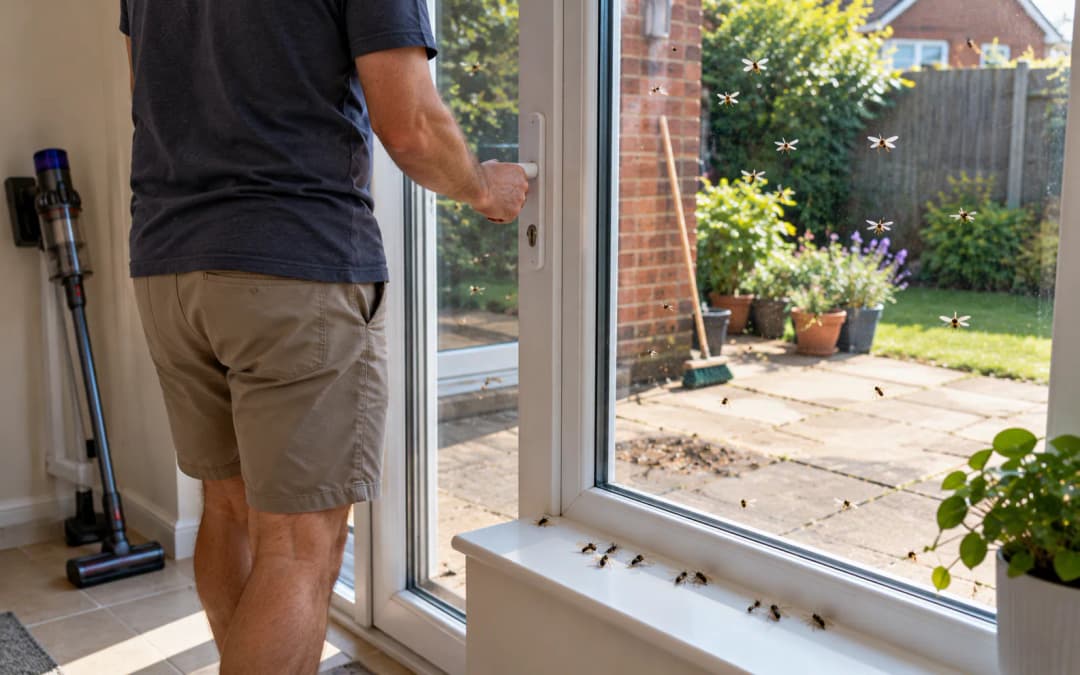
- Close windows and doors on the side of the house where the swarm is.
- Vacuum up any that get inside; they are slow and easy to collect.
- Brush or hose them off patios once the swarm has passed.
- Note where they came out: a gap between paving slabs, a crack by the doorstep or the base of a wall.
- Avoid spraying insecticide across the patio or lawn, which won't stop the swarm and isn't necessary.
- If a queen lands on you, simply brush her off; she is looking for somewhere to start a nest.
What does a swarm tell you about ants in the house?
A swarm shows exactly where a mature nest is. If the exit holes are right against the house wall, under a doorstep or beside an air brick, that nest is likely to be the source of any black ants trailing into your kitchen.
Once the season is over, check those spots and the nearest door thresholds and air bricks for gaps. Our guide on how to get rid of ants in the house explains how to bait a trail and seal entry points. If you are seeing tiny yellow ants indoors in winter as well as summer, they are not garden ants: see our guide to pharaoh ants.
When to call a professional
You don't need a pest controller for flying ants themselves; the swarm passes on its own. Call a professional if ants are trailing into the house before or after the swarms, if winged ants are emerging indoors from a floor, skirting board or wall cavity, or if you run a food business where ants keep getting in.
Urgent Pest Control's ant control service identifies the species first, then uses bait or insecticide as needed, usually over about 1 to 2 weeks. The price depends on the species, the property and the time of the visit; our pest control prices page explains what affects it. We use pet-safe treatments where possible.
We work 7 days a week, 6am to 8pm, with emergency call-outs 365 days a year, across Nottingham, Derby, Leicester, Lincoln and the surrounding towns. Call or WhatsApp 07999 935 929, or book online.
Sources
- Natural History Museum: flying ant day, when winged ants take their nuptial flight
- Royal Society of Biology: flying ant survey
- Hart, Hesselberg, Nesbit and Goodenough: the spatial distribution and environmental triggers of ant mating flights, Ecography (University of Gloucestershire repository)
- Oxford City Council: black ant (garden)
- Coventry City Council: ants information sheet (PDF)
Frequently Asked Questions
About the author
The Urgent Pest Control team
A family-run pest control company based in Southwell, treating homes and businesses across Nottinghamshire, Derbyshire, Leicestershire and Lincolnshire since 2020. Our guides are written from the jobs we do and checked against UK sources. More about us
Cite this guide: “When Is Flying Ant Day in the UK? Flying Ants Explained”, Urgent Pest Control, 20 October 2026. https://urgentpestcontrol.uk/blog/flying-ant-day