How to Get Rid of Ants in the House
How to get rid of ants in the house: follow the trail, find the nest, use bait the right way, seal entry points, and know when it isn't the black garden ant.

By the Urgent Pest Control team
Updated · 7 min read
The short answer
To get rid of ants in the house, follow the trail to where the ants get in, clean away their food, place ant bait on the trail so workers carry it to the nest, and seal the entry gap once activity stops. Most UK house ants are black garden ants nesting outdoors; tiny yellow ants need a professional.
- Most ants in UK homes are black garden ants (Lasius niger) that nest outside and come in looking for sweet food.
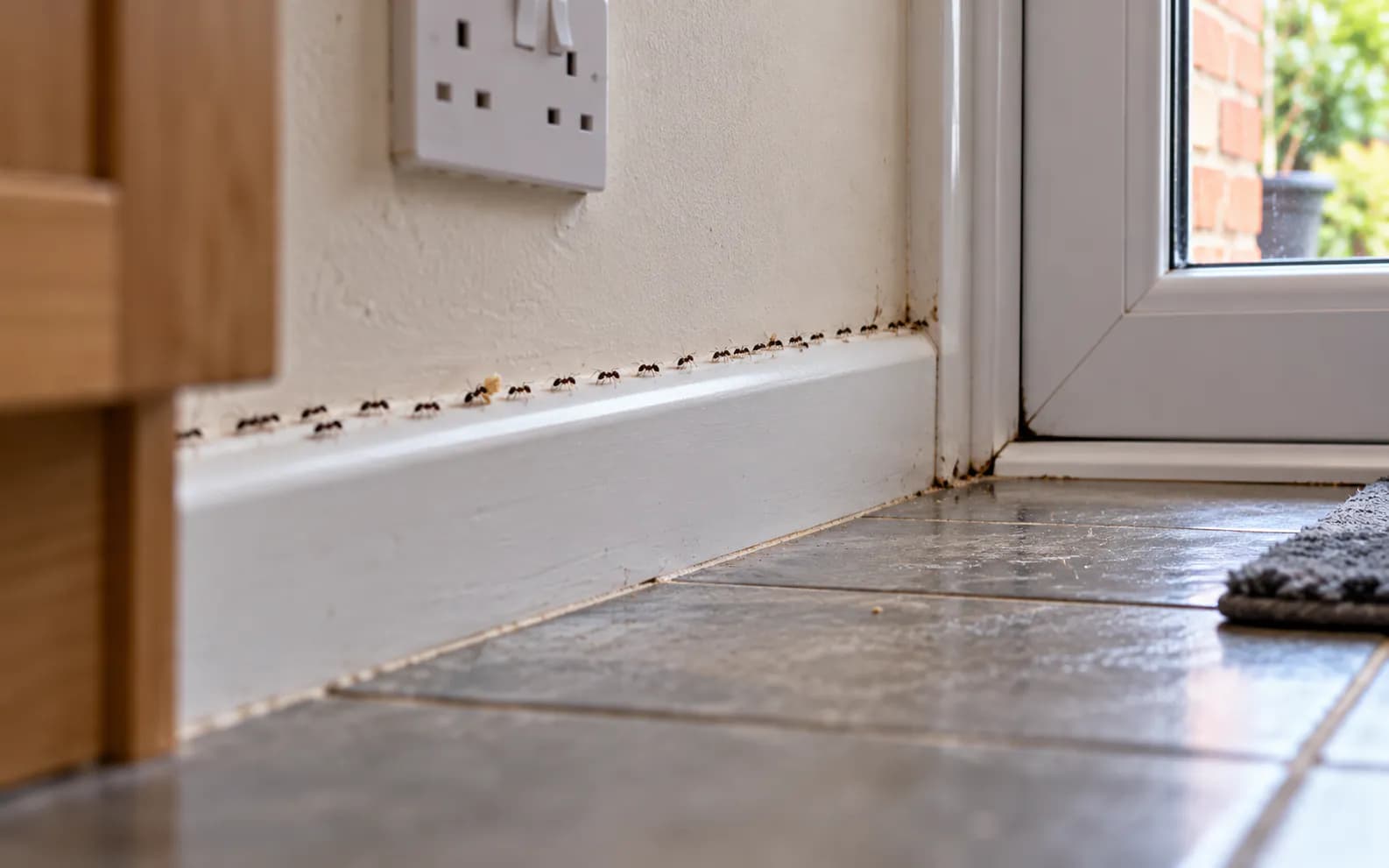
- Follow the trail both ways: one end shows the food, the other shows the entry point and often the nest.
- Bait works because workers carry it back to the nest, so don't spray the trail while bait is out.
- Tiny yellow or orange ants indoors may be pharaoh ants, which councils warn can spread if treated with ordinary insecticides.
- Our ant treatments start with identifying the species, then bait or insecticide over about 1 to 2 weeks.
On this page
To get rid of ants in the house, follow the trail to where they come in, remove the food they're after, put ant bait on the trail so the workers carry it back to the nest, and seal the gap once they've gone. Sprays only kill the ants you can see. Most indoor ants in the UK are black garden ants nesting outside; our ant control service deals with stubborn colonies and with pharaoh ants.
This guide covers how to identify which ant you have, a step-by-step plan for the common black ant, why sprays often make things worse, and when to call a professional.
Which ants come into UK houses?
Most ants in UK kitchens are black garden ants, Lasius niger. The Natural History Museum says there are about 60 species of ant in the UK, but the black garden ant is the one that lives alongside us in towns and gardens. A much smaller number of homes, mostly flats and large heated buildings, have pharaoh ants.
| Clue | Black garden ant | Pharaoh ant |
|---|---|---|
| Colour | Dark brown to black | Transparent yellow to orange, with black eyes |
| Size | Small but easy to see | About 2mm, very small |
| Where the nest is | Outside: under paving, in lawns, walls and borders | Inside the building, in warm wall voids, ducts and behind fittings |
| When you see them | Mostly spring and summer, worse in warm spells | Any time of year |
| Typical setting | Houses with gardens, ground-floor kitchens | Blocks of flats, hospitals, large heated buildings |
| What works | Bait on the trail, sealing entry points | Specialist bait programme; ordinary sprays can spread them |
Pharaoh ant details come from Bolton Council and Cherwell District Council. If yours look small and pale, read our guide to pharaoh ants before you buy anything.
Why have I suddenly got ants in my house?
Because foraging workers have found food and laid a scent trail for the rest of the colony to follow. Warm weather brings workers out in numbers, which is why trails appear suddenly in spring and summer. Oxford City Council explains that the black ant nests outside in grass and walls and under paving, and that foraging workers travel widely in search of food along well-defined trails, which is how they end up in kitchens.
Sweet foods are the main draw: spilt drinks, jam, honey, sugar, fruit and pet food. Once a forager finds food, other workers follow the same route, which is why a few ants become a steady line within hours.
How do you get rid of black ants in the house?
Work through these steps in order. The aim is to stop the trail, then reduce the colony, then close the door behind it. Give it a week or two: baiting is slower than spraying, but it is the step that actually reaches the nest.
- Watch, don't spray. Follow the trail both ways. One end leads to the food; the other leads to the entry point, usually a gap at a door threshold, an air brick, a crack in mortar or a gap around a pipe. Oxford notes that the nests of black ants can be located by following their trails.
- Remove the food. Wipe up crumbs and sticky spills, put sugar and cereals in lidded containers, rinse recycling and don't leave pet food down longer than needed.
- Bait the trail. Place a shop-bought ant bait station or gel directly on the trail near the entry point. Workers carry the bait back to the nest. Expect more ants for a day or two as they find it.
- Leave the bait alone. Don't clean or spray around it while ants are feeding. Insecticide sprays and strong cleaners can put them off the bait.
- Clean the trail once they've gone. When activity stops, wash the route with soapy water to remove the scent trail.
- Seal the entry point. Fill cracks and gaps with a suitable filler or sealant. Oxford advises paying particular attention to "small insignificant cracks", which can be major entry points.
Follow the label on any product, and keep baits away from children and pets.
Can you treat the ants' nest outside?
Sometimes, but it isn't always necessary. The Royal Horticultural Society recommends tolerating ants in gardens wherever possible, because they do little direct damage to plants. It also notes that removing a colony often doesn't last, because its place is taken by incoming queens.
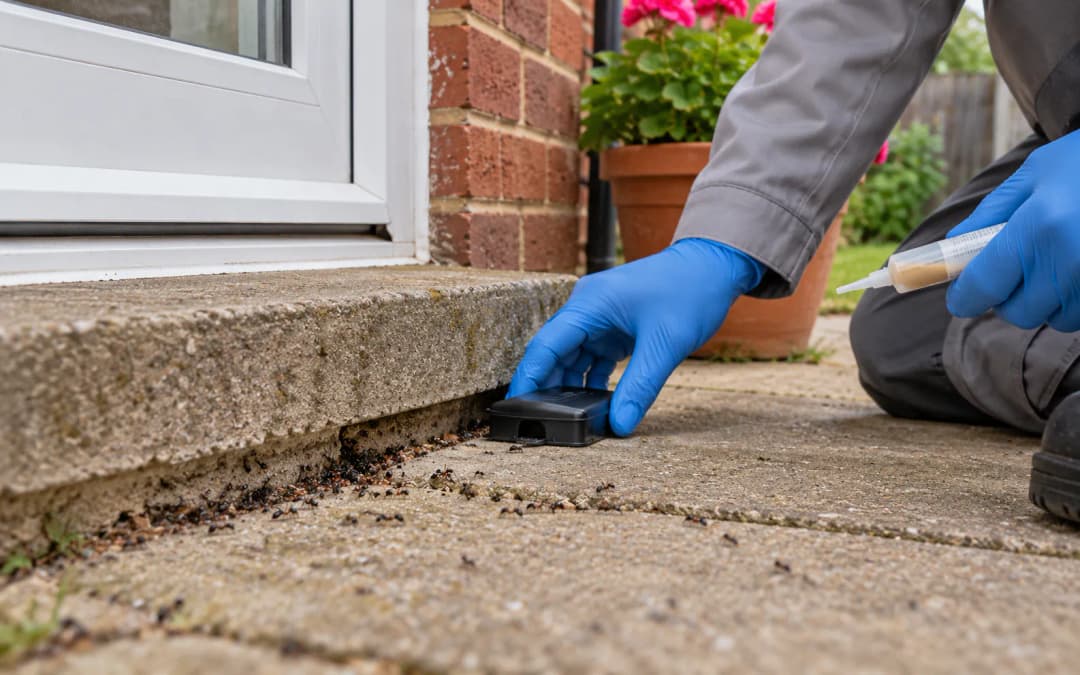
The practical priority is keeping them out of the house. If a nest is right against the house wall or under a doorstep, an outdoor bait placed near the entrance can help. Oxford City Council also describes insecticide treatments applied in and around the nest, and a residual barrier at entry points such as doors, windows, ventilators, ducts and drains, which is the approach professionals take.
Where do ants get into a house?
Ants get in through the smallest gaps at ground level, usually close to where the nest is outside. Because black garden ants nest under paving, in lawns and in walls, the entry point is normally on the side of the house nearest the patio, path or border.
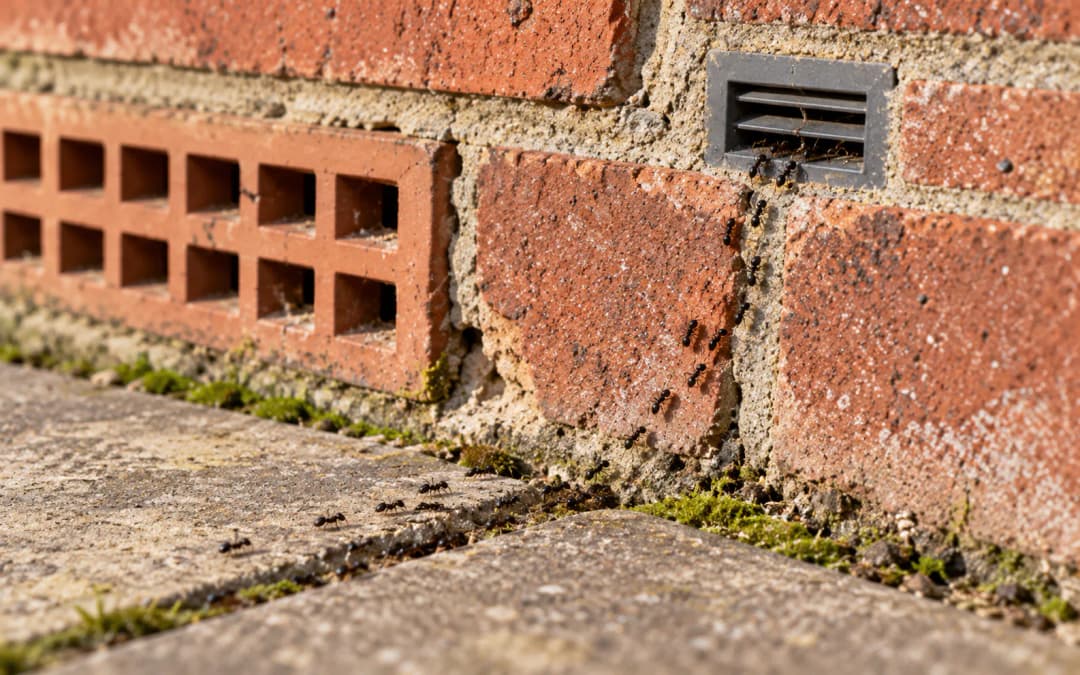
Check these places first:
- door thresholds and the gap under back and patio doors;
- air bricks and weep vents low in the wall;
- cracks in mortar joints and around window sills;
- gaps where waste pipes, gas pipes and cables come through the wall;
- the edges of conservatory and extension floors, where the slab meets the old house;
- kitchen plinths and the void behind units, which ants use as a hidden route to the worktop.
Oxford City Council lists doors, windows, ventilators, ducts and drains as the entry points to protect. If you have followed the trail to a gap but can't find where it goes outside, the ants may be travelling through a wall cavity or under a floor, which is a job for a professional rather than more bait.
Why can sprays make an ant problem worse?
A spray kills the ants it touches but not the queen, and the colony carries on. Worse, spraying the trail while bait is down stops workers taking the bait back, so the colony is never reached.
With pharaoh ants, sprays are actively harmful. Bolton Council warns that traditional insecticides "can also encourage the spread of the ants as they will avoid treated areas", because their colonies have many queens and can split into new colonies. That is why identification comes first.
How do you stop ants coming back?
Prevention is mostly about food and gaps. Use this checklist each spring:
- Keep worktops, floors and the area behind the bin crumb-free.
- Store sweet foods in sealed containers and wipe jars after use.
- Feed pets at set times and wash bowls rather than leaving food down.
- Check door thresholds, air bricks, window frames and pipe entries, and seal cracks.
- Rinse recycling before it goes in the bin.
- Cut back plants and soil that touch the house wall, which give ants an easy route in.
- Look for trails early in warm weather and bait straight away.
Winged ants in the house in summer are a different event: the colony's mating flight. Our guide to flying ant day explains what they are and why they vanish within days.
When to call a professional
Call a professional if ants keep coming back after you've baited the trail, if you can't find where they're getting in, if the nest is inside a wall or under a floor, or if the ants are tiny and yellow or orange. Call straight away for ants in a food business or a block of flats.
Urgent Pest Control's ant control service starts by identifying the species, then uses bait or insecticide as the situation needs, usually over about 1 to 2 weeks. On a visit, the technician follows the trail back to the entry point, checks plinths, air bricks and pipe entries, and looks outside for the nest, so the treatment goes where the colony actually is. Prices depend on the species, the property and the time of the visit (see our pest control prices); we'll explain the likely cost before any work starts, and we use pet-safe treatments where possible.
Ant problems that resist shop-bought products are a common reason people call us. One customer wrote:
"Hundreds of ants… I’d tried everything from natural to chemical (over the counter) but had no impact." — Sally Selby, June 2023, Google review
We work 7 days a week, 6am to 8pm, with emergency call-outs 365 days a year, across Nottingham, Derby, Leicester, Lincoln and the surrounding towns. Call or WhatsApp 07999 935 929, or book online. If you run a café, shop or kitchen, see our guide to pest control for food businesses.
Sources
Frequently Asked Questions
About the author
The Urgent Pest Control team
A family-run pest control company based in Southwell, treating homes and businesses across Nottinghamshire, Derbyshire, Leicestershire and Lincolnshire since 2020. Our guides are written from the jobs we do and checked against UK sources. More about us
Cite this guide: “How to Get Rid of Ants in the House”, Urgent Pest Control, 20 October 2026. https://urgentpestcontrol.uk/blog/how-to-get-rid-of-ants-in-the-house