Booklice (Psocids): What They Are and How to Get Rid of Them
Booklice are tiny pale insects, about 1mm long, found in food cupboards, books and damp rooms. Why you have them, if they are harmful and how to clear them.

By the Urgent Pest Control team
· 7 min read
The short answer
Booklice, or psocids, are tiny, pale, wingless insects about 1 to 2mm long that live in warm, damp places and feed on microscopic mould and starchy foods such as flour. They are harmless and not a sign of poor hygiene. Get rid of them by throwing out affected food, cleaning and thoroughly drying cupboards, and reducing humidity.
- The common booklouse, Liposcelis bostrychophila, is about 1mm long, pale grey or fawn and wingless, according to English Heritage.
- Coventry City Council says psocids are harmless, are not caused by poor hygiene and are just as common in the cleanest homes.
- All adults of the common booklouse are female and can lay eggs, so numbers can explode in warm, damp conditions.
- The life cycle is normally about 6 months but can be as short as 6 weeks at 25°C.
- Coventry City Council advises against using insecticide in food cupboards because of the risk of contaminating food.
On this page
Booklice, also called psocids, are tiny, pale, wingless insects about 1 to 2mm long that live in warm, damp places and feed on microscopic mould and starchy foods such as flour. They are harmless and are not a sign of a dirty home. To get rid of booklice, throw out affected food, clean and thoroughly dry the cupboard, store dry goods in sealed containers and bring the humidity down. They share those damp conditions with silverfish, so if you are also seeing larger, silvery insects, our silverfish treatment covers homes across Nottinghamshire, Derbyshire, Leicestershire and Lincolnshire.
Most booklice problems can be solved without any insecticide. This guide explains how to identify them, why they appear and what works.
What are booklice?
Booklice are small, soft-bodied insects of the group Psocoptera, and despite the name they are not lice. The Royal Entomological Society says there are about 100 species in the UK, most of which live outdoors on plants and tree bark feeding on algae, lichens and fungi. They are not parasites. Only a few species live indoors, typically in houses or food stores, and the society names Liposcelis and Trogium as the common domestic ones, both always wingless.
The society explains that indoor species feed on moulds growing on flour-based foods or on damp books and paper, and that some have adapted to eat flour directly and to absorb water vapour from the air. That last point is why humidity matters so much.
What do booklice look like?
Booklice look like pale specks of dust that move. English Heritage's pest fact sheet on booklice describes the common booklouse, Liposcelis bostrychophila, as "very small, translucent, pale grey or fawn, rounded insects with no wings and a segmented body", with a large head and long thin antennae. Adults are 1mm long; the nymphs are 0.2–0.8mm, very pale and nearly transparent.
Coventry City Council gives a range of 1–2mm for adults depending on species, coloured pale yellow-brown to dark brown. English Heritage notes that the adults run around very quickly when disturbed, and that the details can only be seen with a microscope or a strong hand lens.
They are often confused with other tiny household insects:
| Booklouse | Springtail | Silverfish | |
|---|---|---|---|
| Size | About 1–2mm | Mostly 1–2mm indoors | Much larger, clearly visible |
| Look | Pale grey, fawn or brown; big head, long antennae | White, grey or dark specks | Silvery scales, tapered body, tail bristles |
| Movement | Runs quickly | Jumps | Runs fast |
| Where | Food cupboards, books, damp paper | Sinks, baths, plant pots | Bathrooms, kitchens, cellars |
| Damage | Contaminates dry food; grazes paper in large numbers | None | Paper, books, photographs, wallpaper |
Our guides to springtails and silverfish cover those two in detail. English Heritage makes a useful point here: a lot of damage to paper that is blamed on booklice has in fact been caused by silverfish. If you can't tell which you have, photograph one on white paper and try our pest identifier.
Why do I have booklice?
You have booklice because somewhere in the house is warm and humid. English Heritage says they "will only live in damp conditions" and that the key factors are warm, damp conditions. Coventry City Council says they dislike light and disturbance and prefer dark, warm, humid places such as the folds of packaging in food cupboards.
They are not a hygiene problem. Coventry City Council states that psocids "are not caused by poor hygiene, and are just as common in the cleanest of homes". The council also says its research shows that psocids found in the home are rarely found where food is produced; in other words, they usually come from your cupboards, not from the factory.
The typical causes of the humidity are:
- condensation in a kitchen with poor ventilation, especially wall cupboards above a kettle, hob or dishwasher;
- cupboards fixed to a cold outside wall;
- a slow leak under a sink or behind a unit;
- books, papers or cardboard stored in a damp room, cellar or garage.
Coventry City Council adds that some foods, including flour, naturally contain some moisture, and that booklice multiply most in the summer months when temperatures are higher.
How fast do booklice breed?
Fast, when it is warm and damp. English Heritage says the life cycle of the common booklouse is normally about 6 months, but can be as short as 6 weeks at 25°C, depending on temperature, humidity and the food available.
The species is parthenogenetic. As English Heritage explains, that means there are no males and all adults can lay eggs, which "can result in very rapid population explosions when it is hot and damp and there is abundant food". Coventry City Council says a psocid may live for about 6 months and lay up to 100 eggs in that time.
This is why booklice seem to appear from nowhere. A few in the fold of a flour bag in spring can become a large population by late summer if the cupboard stays humid.
Are booklice harmful?
No. Coventry City Council describes them as "common but harmless". They are not lice, and they feed on mould and starchy material rather than on people.
They are a nuisance in two ways. In food, the Royal Entomological Society says their presence is unpleasant to most people and faecal contamination is a concern, so infested food should be thrown away. On paper, English Heritage says booklice scratch the surface of books and paper, leaving bare or translucent patches, but adds that it takes a very large number to cause noticeable damage and that they only cause damage where humidity is high.
The humidity itself deserves attention. Government guidance on damp and mould says damp and mould mainly affect the airways and lungs. Booklice feed on microscopic mould, so they are a hint that conditions suit it.
How do you get rid of booklice in kitchen cupboards?
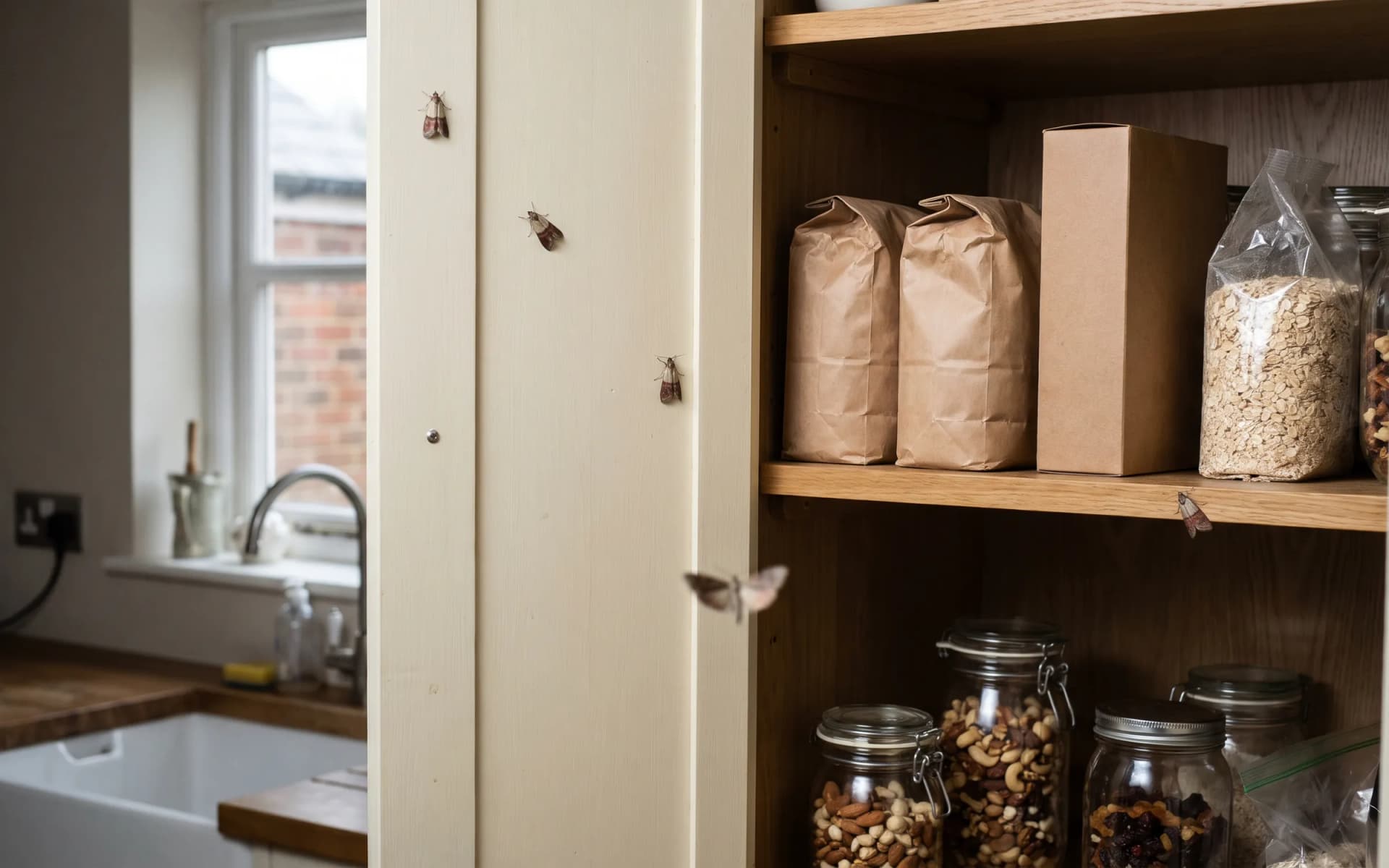
Remove the infested food, clean, dry the cupboard completely and reduce the humidity. Coventry City Council's advice is not to use an insecticide in food cupboards, because of the danger of contaminating your food.
- Empty the cupboard. Take everything out, including shelf liners.
- Check every packet. Look in the folds and seams of flour, cereal, sugar, milk powder, pasta and rice packaging. Coventry City Council says to remove and dispose of all contaminated foods. Bag them and put them in the outside bin.
- Vacuum and wipe. Vacuum corners, shelf-support holes and hinges, then wipe every surface. Coventry City Council stresses cleaning all the nooks and crannies where they may hide.
- Dry it thoroughly. Leave the doors open, and use a fan or a hairdryer on a cool setting if needed. The council says to make sure the cupboard is completely dry before replacing any food.
- Restock in sealed containers. Store vulnerable foods like flour in washable, lidded containers, as the council advises.
- Fix the humidity. Ventilate when cooking and washing up, use the extractor, and find any leak.
- Check again in two weeks. A few stragglers are normal; fresh numbers mean the cupboard is still damp or a packet was missed.
How do you get rid of booklice in books and papers?
Dry them out. English Heritage says booklice only cause damage when collections are kept at high humidity, so moving books and papers to a dry, ventilated room is the cure.
Take books off the shelf, brush or vacuum them gently, and wipe the shelves. Don't push bookcases tight against a cold outside wall; leave a gap for air. Avoid storing books, photographs and documents in cellars, garages or lofts that get damp, and use sealed plastic boxes for anything precious. Throw away damp cardboard boxes, which hold moisture and mould.
How do you stop booklice coming back?
Keep cupboards and rooms dry and stock turning over. Coventry City Council's five key points are a good checklist:
- keep the kitchen and food storage cupboards clean, well ventilated and dry;
- check food cupboards regularly, using the contents in best-before date order;
- store vulnerable foods like flour in washable, lidded containers;
- check food packaging before you buy it to make sure it is undamaged;
- check food when you open it to make sure it is not infested.
The council also recommends keeping dry foods in cool, ventilated cupboards, and opening windows if condensation forms during cooking or washing. Government guidance on damp adds the wider measures: working extractor fans in kitchens and bathrooms, trickle vents kept open, and a home that is adequately heated.
When to call a professional
Call a professional if booklice are still present after you have cleared, cleaned and dried the cupboards, if they are in several rooms, if you can't find the source of damp, or if you aren't sure what the insects are. Tiny insects in a kitchen can also be beetles or springtails, and each needs a different approach; our guide to biscuit and plaster beetles covers two more cupboard pests.
Urgent Pest Control can confirm the species and look for the damp that is feeding the problem. We'll tell you honestly if the answer is ventilation or a plumber rather than a treatment. Where silverfish are present as well, our silverfish treatment applies a residual treatment to the cracks and voids they use, with moisture and ventilation advice for the rooms affected. We'll explain the likely cost before any work starts, and the final price depends on the job (see our pest control prices).
We cover Nottingham, Derby, Leicester, Lincoln and the surrounding counties, 7 days a week from 6am to 8pm, with emergency call-outs 365 days a year. Book online or call 0330 822 7460.
Sources
Frequently Asked Questions
About the author
The Urgent Pest Control team
A family-run pest control company based in Southwell, treating homes and businesses across Nottinghamshire, Derbyshire, Leicestershire and Lincolnshire since 2020. Our guides are written from the jobs we do and checked against UK sources. More about us
Cite this guide: “Booklice (Psocids): What They Are and How to Get Rid of Them”, Urgent Pest Control, 18 November 2026. https://urgentpestcontrol.uk/blog/booklice