Signs of Woodworm: How to Tell If It Is Active and What to Do
The signs of woodworm are small round holes, fine bore dust and beetles at windows. How to tell active woodworm from old damage and how to get rid of it.

By the Urgent Pest Control team
· 7 min read
The short answer
The signs of woodworm are small round holes in timber, 1–2mm across for the common furniture beetle, fine gritty bore dust beneath them, and small brown beetles near windows in spring and summer. Holes alone do not prove it is active: clean, sharp-edged holes and pale, fresh dust do. Old, dark holes often need no treatment.
- Common furniture beetle exit holes are 1.5–2mm wide and the adults are 2.5–5mm long, according to the Natural History Museum.
- The Society for the Protection of Ancient Buildings says active holes have sharp edges and bore dust the colour of freshly cut timber.
- Larvae tunnel inside the wood for years before emerging: 3–5 years according to the Natural History Museum.
- Wood-boring beetles only establish where timber is damp, so fixing damp and ventilation is part of the cure.
- Holes alone can be decades old; an infestation that has died out does not justify treatment.
On this page
The signs of woodworm are small round holes in timber, fine powdery dust beneath them and, in spring and summer, small brown beetles on windowsills. Holes on their own do not mean the wood is still being eaten: many infestations died out years ago. Clean, sharp-edged holes and fresh, pale dust point to active woodworm. If you are not sure, our woodworm treatment service starts with a free survey to confirm whether it is active and which beetle is responsible, across Nottinghamshire, Derbyshire, Leicestershire and Lincolnshire.
This guide covers what to look for, how to tell old damage from a live infestation, and how to get rid of woodworm.
What is woodworm?
Woodworm is the larva of a wood-boring beetle, not a worm. A PestWatch article in the British Pest Control Association's magazine calls the common furniture beetle, Anobium punctatum, the most abundant wood-destroying insect in UK buildings, attacking both structural timber and furniture.
The Natural History Museum sets out the life cycle. Each female lays 20–100 eggs, which hatch in three to five weeks. The cream-coloured, C-shaped larvae bore straight into the wood and tunnel through it for three to five years. They then pupate, and the adults cut their way out through the exit holes, in early summer, and live for only two to four weeks. The BPCA article gives two to four years for the larval stage; either way, the damage is done slowly and out of sight.
What are the signs of woodworm?
There are six signs to look for. Use a torch held at a low angle across the timber.
| Sign | What it looks like | What it tells you |
|---|---|---|
| Exit holes | Round holes, 1.5–2mm wide for furniture beetle | Beetles have emerged at some point; not proof of current activity |
| Bore dust (frass) | Small piles of fine, gritty dust below or beside holes | Fresh, pale dust suggests activity |
| Adult beetles | Dull reddish to dark brown beetles, 2.5–5mm long, on windowsills or near timber | The clearest evidence of a live infestation |
| Tunnels in the wood | Galleries visible where timber is cut, broken or worn | Larvae have fed there |
| Crumbling edges | Corners and edges of boards or joists that break away | Heavier or long-standing attack |
| Weak or springy floorboards | Boards that give underfoot | Possible structural damage; have it checked |
The hole and beetle sizes are from the Natural History Museum. The BPCA article lists new emergence holes, frass, and adults or larvae in the timber as the signs of an active infestation, and says adults can fly and may be found on window ledges from March to September.
The places to check are the ones you rarely look at: the loft timbers, the underside of the stairs, the backs and undersides of old furniture, floorboards in the corners of rooms and joists in the cellar. The Natural History Museum says structural timber such as roofs, floorboards and joists is most affected, particularly in attics.
How do you tell if woodworm is active or old?
Look at the edges of the holes and the colour of the dust. The Society for the Protection of Ancient Buildings (SPAB) says active outbreaks are identified by holes with sharp rather than round edges, where the interiors and the bore dust are "not dark but the colour of freshly-cut timber".
| Check | Likely active | Likely old |
|---|---|---|
| Edges of holes | Sharp and clean | Rounded and worn |
| Inside the holes | Pale, like freshly cut wood | Dark and dirty |
| Dust | Fresh, pale dust that reappears after cleaning | None, or dark, old dust |
| Beetles | Live or freshly dead beetles in spring and summer | None seen |
| Timber | Damp or poorly ventilated | Dry for years |
If you are still unsure, test it. SPAB and Babergh District Council describe the same method: cover a group of holes with acid-free tissue paper stuck down with water-soluble glue, and check it over a year. Emerging beetles punch through the paper. Alternatively, clean the surface beneath the suspect timber and nearby windowsills, and watch for new dust or beetles. Babergh notes that adults mainly emerge in spring, so it is hard to confirm activity at other times of year.
It matters because old damage usually needs nothing done. The BPCA article says an infestation may have died out because the timber is unsuitable, its moisture content has dropped or it was treated in the past, and in that case treatment is not justified.
Which beetle is it?
Hole size and dust tell most of the story. These are the two main wood-borers in UK buildings, with details from SPAB and the BPCA article.
| Beetle | Exit holes | Bore dust | Timber it attacks |
|---|---|---|---|
| Common furniture beetle | 1–2mm | Gritty, lemon-shaped pellets | Softwoods and hardwoods; floorboards, joists, roof timbers, furniture |
| Deathwatch beetle | 2–3mm | Bun-shaped pellets | Partly decayed hardwood, mainly oak, in historic buildings |
Two others are worth knowing. The BPCA article says the wood-boring weevil is arguably the second most common wood-boring beetle in UK buildings, but it is restricted to damp, at least partly decayed timber, often behind skirting boards, and is usually controlled by dealing with the wet rot. SPAB notes that the house longhorn beetle is found in some southern areas.
Deathwatch beetles have a flight season of roughly April to June, and SPAB says their tapping on timber in spring can give them away. Not every small brown beetle on a windowsill is a wood-borer, either: compare yours with our guides to biscuit and plaster beetles and carpet beetles, or use the pest identifier.
Why does damp matter?
Because woodworm needs it. SPAB says wood-borers, like the fungi that rot timber, only establish where dampness exists. Babergh District Council calls wood-boring insects "a symptom of excess damp" and says an infestation is likely to continue until the humidity is reduced.
That is why woodworm turns up in cellars, under suspended floors with blocked air bricks, around leaking gutters and in roofs with condensation. SPAB's first recommendation is to remove all sources of dampness and dry the timber to below about 15% moisture content.
How do you get rid of woodworm?
Confirm it is active, fix the damp, then treat the affected timber. In that order.
- Confirm activity. Use the signs above, the tissue test, or a survey. Treating dead woodworm is wasted money.
- Identify the beetle. Furniture beetle, deathwatch beetle and weevil need different approaches. Weevil, for example, is usually dealt with by curing the wet rot it depends on.
- Fix the damp and ventilation. Clear air bricks, mend leaks and gutters, and improve loft ventilation.
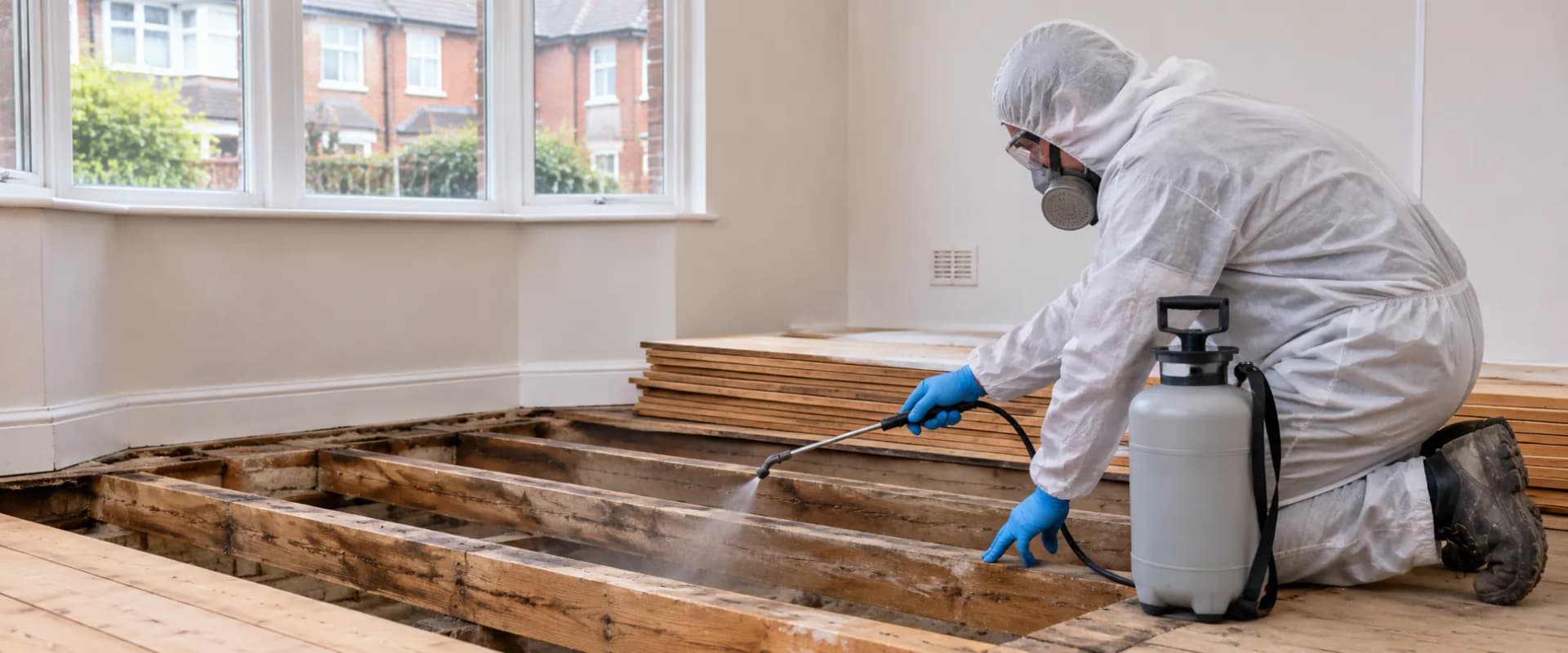
- Treat the timber. A professional woodworm insecticide is applied by spray or brush so that it soaks into the surface and kills larvae as they tunnel out, and any eggs laid on treated wood. Floorboards may need lifting to reach the joists. The Natural History Museum lists a residual insecticide such as permethrin among the control options.
- Repair what is weakened. Badly damaged timbers may need replacing by a joiner or builder. SPAB advises conservative repairs rather than automatic wholesale replacement.
Small pieces of furniture can be treated with retail woodworm products, following the label. Keep people and pets away from any treated area until it has dried and the room has been ventilated.
Two cautions. If your home is listed or historic, speak to your council's conservation officer first: Babergh District Council, for example, says a comprehensive spray treatment of a listed building needs consent, and that treatment should be limited to areas of active infestation. And if bats use the roof, get advice before any timber treatment, because, as Chesterfield Borough Council points out, destroying a bat roost is an offence under the Wildlife and Countryside Act 1981 and many insecticides harm bats.
Does woodworm affect buying or selling a house?
It often comes up. A building or mortgage survey will frequently note woodworm holes, and a lender may ask for a specialist survey to confirm whether the infestation is active and what, if anything, needs doing. SPAB cautions against chemical treatment of extinct outbreaks "merely to obtain a guarantee", so a survey that distinguishes active from old damage is worth having. On the insurance side, see does home insurance cover pest control?
When to call a professional
Call a professional if you find fresh dust or beetles around structural timber, if floorboards feel weak or springy, if woodworm has been flagged on a survey, or if you simply cannot tell whether the holes are old. Lofts, floors and joists are best surveyed before anyone treats anything, to confirm activity, how far it extends and whether any timber has been weakened.
Urgent Pest Control's woodworm survey is free. We check whether the infestation is active, which beetle it is and how far it has spread, then give you a written quote before any work starts. Treatment is by spray or brush with a professional insecticide, and we point out any damp or ventilation problems that need fixing so it does not return. If timbers need replacing, we'll tell you. We can also provide a written report for a sale or purchase.
We cover Nottingham, Derby, Leicester, Lincoln and the surrounding counties, 7 days a week from 6am to 8pm. Book online or call 0330 822 7460.
Sources
- Natural History Museum: Furniture beetle (Anobium punctatum) identification guide
- Society for the Protection of Ancient Buildings: Wood-boring insects
- Babergh District Council: Wood-boring insects
- BPCA Professional Pest Controller: PestWatch, insects that destroy wood in buildings
- Chesterfield Borough Council: Beetles and mites from birds' nests (bats and roof treatments)
Frequently Asked Questions
About the author
The Urgent Pest Control team
A family-run pest control company based in Southwell, treating homes and businesses across Nottinghamshire, Derbyshire, Leicestershire and Lincolnshire since 2020. Our guides are written from the jobs we do and checked against UK sources. More about us
Cite this guide: “Signs of Woodworm: How to Tell If It Is Active and What to Do”, Urgent Pest Control, 18 November 2026. https://urgentpestcontrol.uk/blog/signs-of-woodworm