Pantry Moths: How to Identify and Get Rid of Food Moths
Small moths in the kitchen and webbing in the flour? How to identify pantry moths (Indian meal moths), find the source and clear them from your cupboards.

By the Urgent Pest Control team
· 8 min read
The short answer
Pantry moths are almost always Indian meal moths, Plodia interpunctella, whose larvae feed on dried food such as flour, cereals, nuts, dried fruit and pet food. Silk webbing in the food is usually the first sign. To get rid of them, find and bin the infested food, clean out the cupboards and store dried goods in sealed containers.
- The pantry moth is the Indian meal moth, Plodia interpunctella; English Heritage gives the adult as 10–12 mm long with a cream band across the folded wings.
- The Natural History Museum says silken webbing in the food is usually the first sign of an infestation.
- English Heritage says the larvae do not eat wool, fur or feathers and will not damage textiles.
- A female lays up to 100 eggs, and in warm rooms there can be 3–4 generations a year, according to English Heritage.
- The BPCA says the most effective step is to throw away infested products, preferably into an outside bin.
On this page
- What are pantry moths?
- What do pantry moths look like?
- Is it a pantry moth or a clothes moth?
- What are the signs of pantry moths?
- Where do pantry moths come from?
- What is the pantry moth life cycle?
- How do you get rid of pantry moths?
- Do moth sprays work on pantry moths?
- Why do pantry moths keep coming back?
- Are pantry moths a problem for food businesses?
- When to call a professional
Pantry moths are almost always Indian meal moths, Plodia interpunctella, a small moth whose larvae feed on dried food: flour, cereals, nuts, dried fruit, chocolate and pet food. Silk webbing in the packet is usually the first sign. You get rid of them by finding and throwing out the infested food, cleaning the cupboards thoroughly and storing dried goods in sealed containers. If you are not sure whether you have food moths or fabric moths, Urgent Pest Control's moth treatment service starts by identifying the species.
This guide covers food moths only. For moths damaging wool and carpets, see our guides to clothes moths and how to get rid of carpet moths.
What are pantry moths?
"Pantry moth" and "food moth" are everyday names for the Indian meal moth. The Natural History Museum lists it among the common insect pests of homes and says its larvae feed on a wide variety of dried food products, most often cereals, nuts, seeds and dried fruit.
The BPCA groups it with the "stored product insects", alongside biscuit beetles and grain weevils, in its advice sheet on stored product insects. These insects live and breed inside the food itself, and the BPCA is clear that they will infest clean homes too. Finding them says nothing about your housekeeping.
What do pantry moths look like?
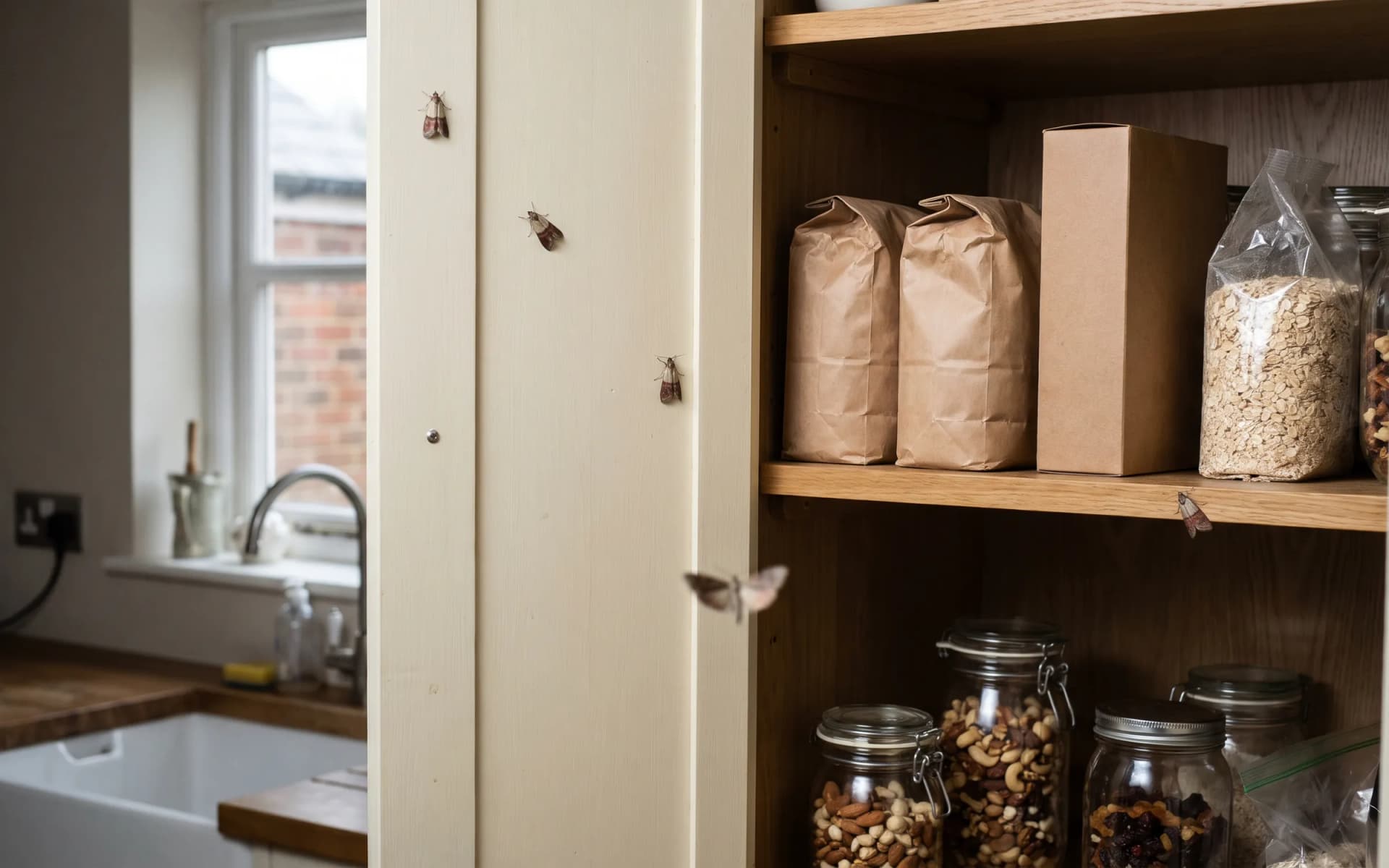
The adult is a small, narrow moth with two-tone wings: pale at the front and reddish-brown at the back. English Heritage's fact sheet gives the adult as 10–12 mm long, with a brownish head and "a cream band across the folded wings with grey and chestnut brown bands at the rear". The Natural History Museum describes the forewings as purplish brown with pale yellowish-buff bases, and notes that some adults are very dark.
The larvae are the stage that does the damage. English Heritage describes them as creamy-white with an orange-brown head, growing up to 15 mm long, and producing silk webbing and gritty pellets of droppings called frass.
Is it a pantry moth or a clothes moth?
Look at the wings and at where you found it. A banded moth in the kitchen is a pantry moth; a small, plain, golden moth in a wardrobe is a clothes moth.
| Feature | Pantry moth (Indian meal moth) | Clothes moth |
|---|---|---|
| Wings | Cream band at the front, grey and chestnut brown behind | Plain, no banding |
| Size | 10–12 mm long | Much smaller |
| Head | Brownish | Ginger |
| Where you see it | Kitchen, larder, utility room, near pet food | Wardrobes, carpets, under furniture |
| What the larvae eat | Dried food | Wool and other animal fibres |
| Damage to fabric | None | Holes in clothes, bare patches in carpet |
The comparison comes from English Heritage, which notes that webbing clothes moths are much smaller, with a ginger head and no banding on the wings. It names one other lookalike: the brown house moth, which is a similar size but copper-coloured with black spots and no banding.
What are the signs of pantry moths?
Webbing in the food, and small moths in the kitchen. The Natural History Museum says silken webbing is usually the first sign of an infestation, and the BPCA says the first thing most people notice is the adult moths flying around. Check for:
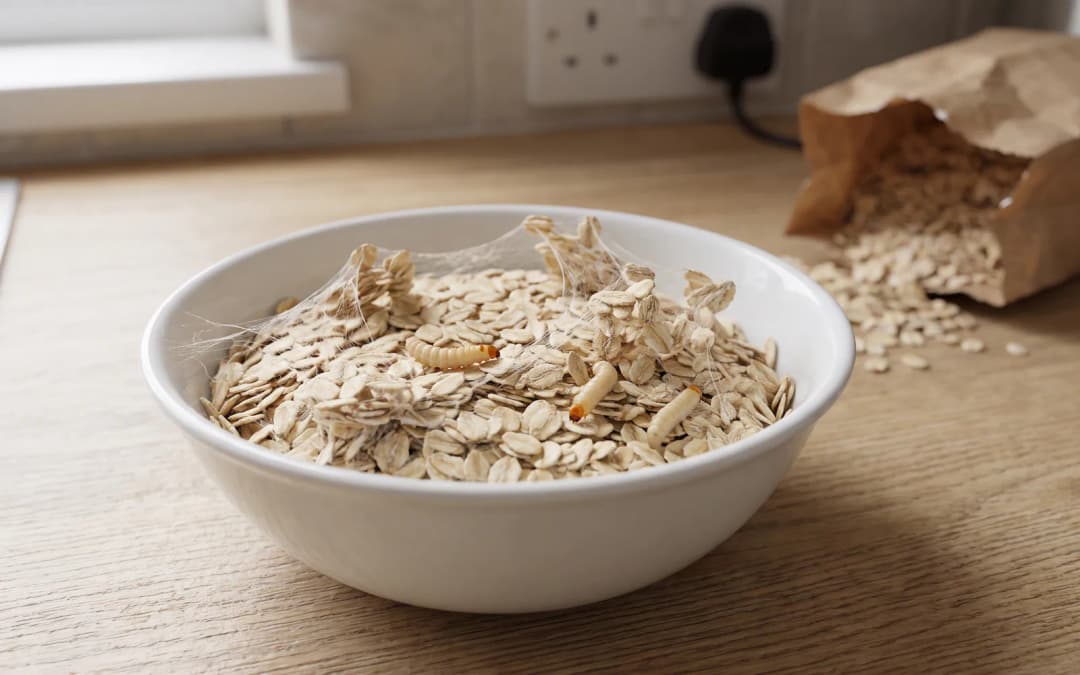
- silk threads or webbing in flour, cereal, rice, nuts or dried fruit, sometimes sticking the food into clumps;
- small creamy-white caterpillars in the food or on the inside of the packet;
- gritty frass in the bottom of packets and on shelves;
- small holes in paper, card or thin plastic packaging;
- larvae crawling up walls or across the ceiling;
- white silk cocoons in the corners of cupboards, shelf-pin holes and the join between wall and ceiling;
- adult moths resting on walls and ceilings in the evening.
Where do pantry moths come from?
From the shop, in most cases. The BPCA says stored product insects can enter the food chain at any point, and that it is not possible to prevent them entirely because you will not know an item is infested until you get it home.
Packaging is little protection. English Heritage says the larvae may bore through paper and card, and the BPCA notes that Indian meal moth larvae can bite through plastic and cardboard. That is how one bag of bird seed becomes a cupboard-wide problem.
Certain foods come up again and again. English Heritage says the larvae will eat chocolate and are "a particular problem in dried pet food", and warns that buying dry pet or bird food in bulk means it sits around long enough for larvae to become moths and lay more eggs. The BPCA adds that the source can usually be traced to part-used products forgotten at the back of the cupboard.
What is the pantry moth life cycle?
Egg, larva, pupa, adult, and in a warm kitchen it runs several times a year. According to English Heritage:
- A female lays up to 100 small eggs in food or on packaging.
- The eggs hatch into tiny larvae that feed, grow and spin webbing.
- Fully grown larvae leave the food and often climb upwards to find a crack or crevice, where they spin a silk cocoon.
- After one or two weeks the adult emerges, mates and starts again.
In warm rooms the cycle may take 3–4 months, giving 3–4 generations a year. The Natural History Museum's figures show how much warmth matters: larvae take about 35 days to grow at 20 °C but only about 16 days at 25 °C. A cupboard beside the oven or boiler is the worst place to keep dried food.
How do you get rid of pantry moths?
Find the infested food and get it out of the house. English Heritage says successful control "relies on identifying the food source they are living in and disposing of the infested food". Work through it in order:
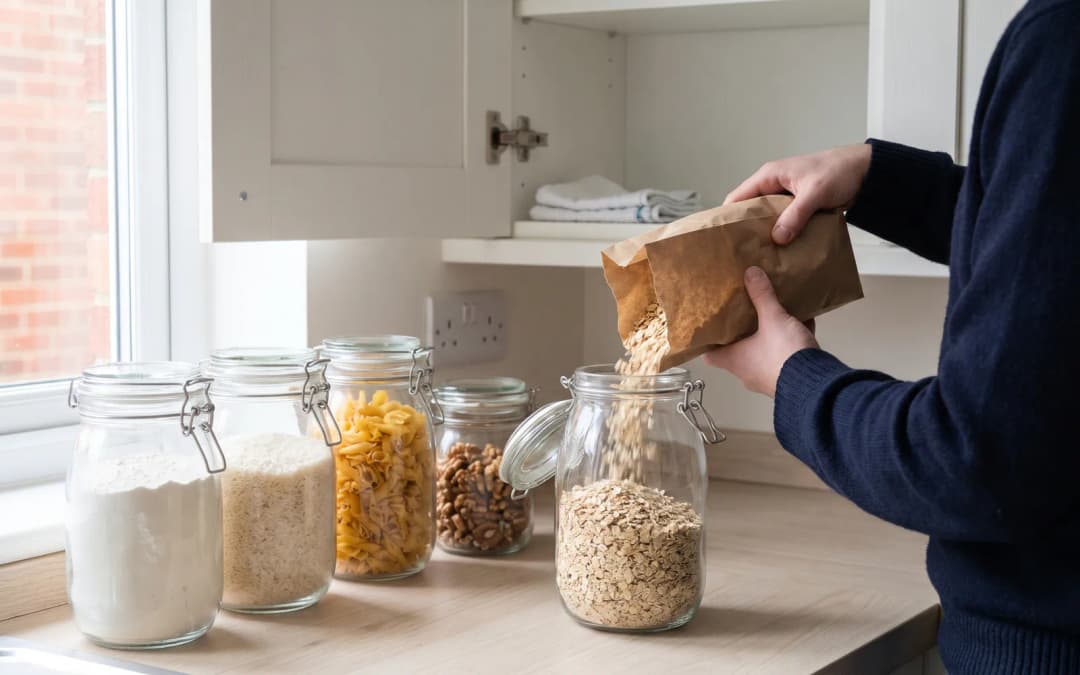
- Empty every food cupboard. Check each packet of dried food, including unopened ones, herbs, spices, baking ingredients, pet food and bird seed.
- Bin anything with webbing, larvae or holes. The BPCA says to throw infested products away, preferably into an outside bin.
- Vacuum the cupboards. Go into corners, shelf-pin holes, hinges and the gap behind the shelves, then empty the vacuum outside.
- Brush out the cocoons. English Heritage says pupal cases need removing with a stiff brush and vacuum. Check the tops of cupboards and the wall-ceiling join.
- Wash down and dry. Clean up all spills and food debris before anything goes back.
- Repack into sealed containers. English Heritage says sealed plastic containers protect dried food from egg-laying insects and also contain any infestation you have missed.
- Keep checking. Look in the containers every week or two for a couple of months, and use older stock first.
If you can trace the problem to one product bought recently, the BPCA suggests returning it to the shop so they can investigate.
Do moth sprays work on pantry moths?
Not well, and they do not belong near food. English Heritage says spraying insecticide is "rarely effective and usually not desirable in areas where food is handled or stored". The larvae are inside the food, where a spray cannot reach them.
The Natural History Museum says that for severe infestations, insecticide treatment must be carried out by a qualified professional. Sticky moth traps are useful for a different reason: they show you whether moths are still emerging, which tells you if a source has been missed. They are a monitor, not a cure.
Why do pantry moths keep coming back?
Because something is still feeding them. If moths reappear weeks after a clear-out, look again at:
- pet food, bird seed and fish food kept in the garage, utility room or under the stairs;
- baking ingredients used once a year, such as nuts, dried fruit, cake decorations and chocolate;
- dried flowers, seed mixes and anything grain-based outside the kitchen;
- cocoons left in cupboard crevices, which hatch after the food has gone;
- food that was repacked into containers while already infested.
Other pests leave similar clues in dried food. If you are finding small brown beetles and no webbing, see our guide to biscuit and plaster beetles, or try the pest identifier.
Are pantry moths a problem for food businesses?
Yes, and the stakes are higher. The BPCA warns that Environmental Health Officers can issue enforcement notices to businesses without adequate pest management, and says any stored product insect infestation in a business should go to a professional. Cafes, bakeries, shops and anyone storing dried goods should have monitoring in place. Our guide to pest control for food businesses explains what inspectors expect.
When to call a professional
Most pantry moth problems at home can be solved without a pest controller: the BPCA says a home infestation is relatively simple to manage if it is caught early. Call a professional if moths are still appearing a month or more after a thorough clear-out, if you cannot find the source, if you are not sure whether you have food moths or fabric moths, or if the problem is in a business.
Urgent Pest Control identifies the species first, because the treatment for a pantry moth is completely different from the treatment for a clothes or carpet moth. We'll explain what we have found and the likely cost before any work starts; our pest control prices page shows what affects it.
We cover Nottingham, Derby, Leicester, Lincoln and the rest of Nottinghamshire, Derbyshire, Leicestershire and Lincolnshire, 7 days a week from 6am to 8pm. Book online or call 0330 822 7460.
Sources
Frequently Asked Questions
About the author
The Urgent Pest Control team
A family-run pest control company based in Southwell, treating homes and businesses across Nottinghamshire, Derbyshire, Leicestershire and Lincolnshire since 2020. Our guides are written from the jobs we do and checked against UK sources. More about us
Cite this guide: “Pantry Moths: How to Identify and Get Rid of Food Moths”, Urgent Pest Control, 18 November 2026. https://urgentpestcontrol.uk/blog/pantry-moths