How to Get Rid of Fruit Flies in Your Kitchen and Home
Fruit flies breed in ripe fruit, bins, drains and spills. How to find the source, trap the adults and stop them coming back, step by step.

By the Urgent Pest Control team
· 8 min read
The short answer
To get rid of fruit flies, find and remove what they are breeding in: overripe fruit and vegetables, bin residue, empty bottles, spills under appliances and slime in drains. Then trap the remaining adults with a jar of cider vinegar under a paper funnel. Sprays alone fail because new flies keep emerging from the source.
- Fruit flies are about 3mm long, usually with red eyes, according to the University of Kentucky's entomology department.
- A female can lay about 500 eggs and development from egg to adult takes about a week, so numbers build fast.
- Oxford City Council says fruit flies indoors are usually there because of fermenting fruit or old vegetables.
- Every breeding site has to be found and removed; a cider vinegar jar trap then catches the remaining adults.
- Bromley Council tells food businesses not to use fly sprays because of the risk of chemical contamination.
On this page
- What are fruit flies?
- Why do I have fruit flies?
- Where do fruit flies breed in a house?
- How do you get rid of fruit flies, step by step?
- How do you make a fruit fly trap?
- Do fly sprays work on fruit flies?
- Are they fruit flies or drain flies?
- How do you stop fruit flies coming back?
- What about fruit flies in pubs, cafes and kitchens?
- When to call a professional
To get rid of fruit flies, find and remove what they are breeding in, then trap the adults that are left. The source is nearly always something moist and fermenting: overripe fruit or vegetables, residue in a bin, empty bottles, a spill under the fridge or slime in a drain. A jar of cider vinegar with a paper funnel catches the stragglers. If they keep coming back, or you run a kitchen or bar, Urgent Pest Control's fly control service traces the breeding source for homes and businesses across Nottinghamshire, Derbyshire, Leicestershire and Lincolnshire.
Fly spray on its own doesn't work for long. It kills the adults you can see while the next generation is already developing in the source, so the steps below start with the source.
What are fruit flies?
Fruit flies are tiny flies of the genus Drosophila that breed in fermenting fruit, vegetables and sugary liquids. The University of Kentucky's entomology department describes the adults as about 1/8 inch long (roughly 3mm), usually with red eyes, a tan front half and a black rear half.
They breed quickly. According to the University of Kentucky, a female can lay about 500 eggs near the surface of fermenting or moist organic material, the larvae feed near the surface, and development from egg to adult takes about a week when conditions allow. That is why a few flies around the fruit bowl can become a cloud within a fortnight.
Why do I have fruit flies?
You have fruit flies because something in or near the room is fermenting. Oxford City Council says fruit flies usually appear indoors because of fermenting fruit or old vegetables attracting them. Bromley Council's guidance for food businesses adds that they breed very quickly in areas with rotting fruit and vegetables, beer, fruit juices, vinegar and milk that is going off.
They get in two ways, according to the University of Kentucky: as eggs or larvae on produce brought into the home, or as adults flying in through windows and doors. Once inside, they need only a small amount of moist, fermenting material to keep breeding.
Where do fruit flies breed in a house?
Fruit flies breed anywhere that stays moist and has fermenting residue, not only in the fruit bowl. The sites in this table come from the University of Kentucky's list.
| Where to look | What they are breeding in | What to do |
|---|---|---|
| Fruit bowl and vegetable rack | Ripe or damaged fruit, tomatoes, bananas, potatoes and onions | Eat it, refrigerate it or bin it; cut away damaged parts |
| Kitchen bin and food caddy | Residue on the bottom and under the liner | Empty daily, then wash and dry the bin itself |
| Recycling box | Dregs in bottles and cans | Rinse before recycling and empty the box often |
| Under and behind appliances | Spilled juice or other liquids, for example under the fridge | Pull the appliance out and clean the floor |
| Sink and drains | Organic film in the waste and trap | Clean the plughole, waste and trap thoroughly |
| Mops and cloths | Damp, dirty mop heads and cleaning rags | Wash and dry them, or replace them |
| Home brewing and preserving | Poorly sealed wine, cider, beer or preserving jars | Seal containers properly |
In practice the source is often something forgotten: a potato that has rolled to the back of a cupboard, a bag of onions going soft at the bottom, or the liquid under a bin liner. Check there first.
How do you get rid of fruit flies, step by step?
Remove every breeding site, clean, then trap the adults. The University of Kentucky is blunt about the order: all potential breeding areas must be located and eliminated, and only then is it worth dealing with the adult flies.
- Clear the produce. Eat, refrigerate or throw away ripe fruit and vegetables. Put anything you are binning straight into the outside bin, not the kitchen bin.
- Empty and wash the bins. Wash the kitchen bin, food caddy and recycling box, including the bottom and the lid.
- Check the hidden spots. Look in cupboards, under the fridge and cooker, and behind the bin for spills and forgotten produce.
- Test the drains. Tape a clear plastic bag over the plughole overnight, as the University of Kentucky suggests for drains you can't inspect. Flies in the bag in the morning mean that drain is a source, and the waste and trap need a thorough clean.
- Wash mops and cloths. Replace anything that smells sour.
- Trap the adults. Set jar traps (below) wherever you see flies.
- Keep it up for at least a week. Flies already developing will keep emerging for several days, so keep fruit covered or refrigerated and bins clean until the traps stay empty.
How do you make a fruit fly trap?
Put a little cider vinegar in a jar and fit a paper funnel in the top. The University of Kentucky's method is to roll a sheet of paper into a funnel, place it in a jar and bait the jar with a few ounces of cider vinegar; a slice of banana also works as bait. Flies follow the smell down the funnel and struggle to find their way out.
Place traps where the flies gather, such as near the fruit bowl, the bin and the sink, and renew the bait every few days. Remember what a trap is for: it removes adults and tells you whether numbers are falling. It doesn't touch the eggs and larvae in the source.
Do fly sprays work on fruit flies?
Sprays kill the adults they hit, but they don't solve a fruit fly problem on their own. The University of Kentucky suggests a pyrethrum-based aerosol only after the breeding sources have been removed, to kill the remaining adults. Oxford City Council lists flying insect sprays, traps and UV electric fly killers as options once the attracting food has gone.
If you use a household spray, follow the label and keep it away from food, worktops and fish tanks. For food businesses the advice is different: Bromley Council tells them not to use fly sprays because they can cause chemical contamination, and to rely on cleaning and electric fly killers placed away from food preparation surfaces.
Are they fruit flies or drain flies?
Fruit flies are tan with red eyes and hover around fruit, bins and drinks; drain flies are grey, fuzzy and moth-like and sit on walls near sinks and showers. The difference matters because the source is different.
| Fruit fly | Drain fly | |
|---|---|---|
| Look | About 3mm, tan front and black rear, usually red eyes | Small, dark and fuzzy, with scaly, moth-like wings |
| Behaviour | Hovers around fruit, bins, bottles and glasses | Rests on walls and ceilings, makes short hopping flights |
| Breeds in | Fermenting fruit, vegetables, spills, bins and drains | The slime layer in drains, traps and standing water |
| First step | Remove fermenting material | Clean the slime out of the pipes and traps |
Our guide to drain flies covers that problem in full. Sluggish, larger flies gathering at upstairs windows in autumn are a different pest again; see cluster flies. If you aren't sure which fly you have, a photo and our pest identifier will narrow it down.
How do you stop fruit flies coming back?
Give them nothing to breed in. Most of this is routine:
- keep ripe fruit in the fridge in warm weather, or eat it promptly;
- check the vegetable rack weekly for anything going soft;
- empty the kitchen bin and food caddy often, and wash them out;
- rinse bottles, cans and cartons before they go in the recycling;
- wipe up spills straight away, including under appliances;
- keep sink wastes and traps clean, and wash mops and cloths;
- seal home brew, cider and preserving jars properly.
The University of Kentucky also recommends tight-fitting insect screens on windows and doors, which is worth considering for a kitchen that is badly affected every summer.
What about fruit flies in pubs, cafes and kitchens?
Food businesses have to deal with fruit flies properly, because flies in a food area are a hygiene issue. Bromley Council's guidance says fruit flies are associated with poor kitchen or bar hygiene, and tells businesses to clean outside drains regularly, particularly those near kitchens, and not to use fly sprays.
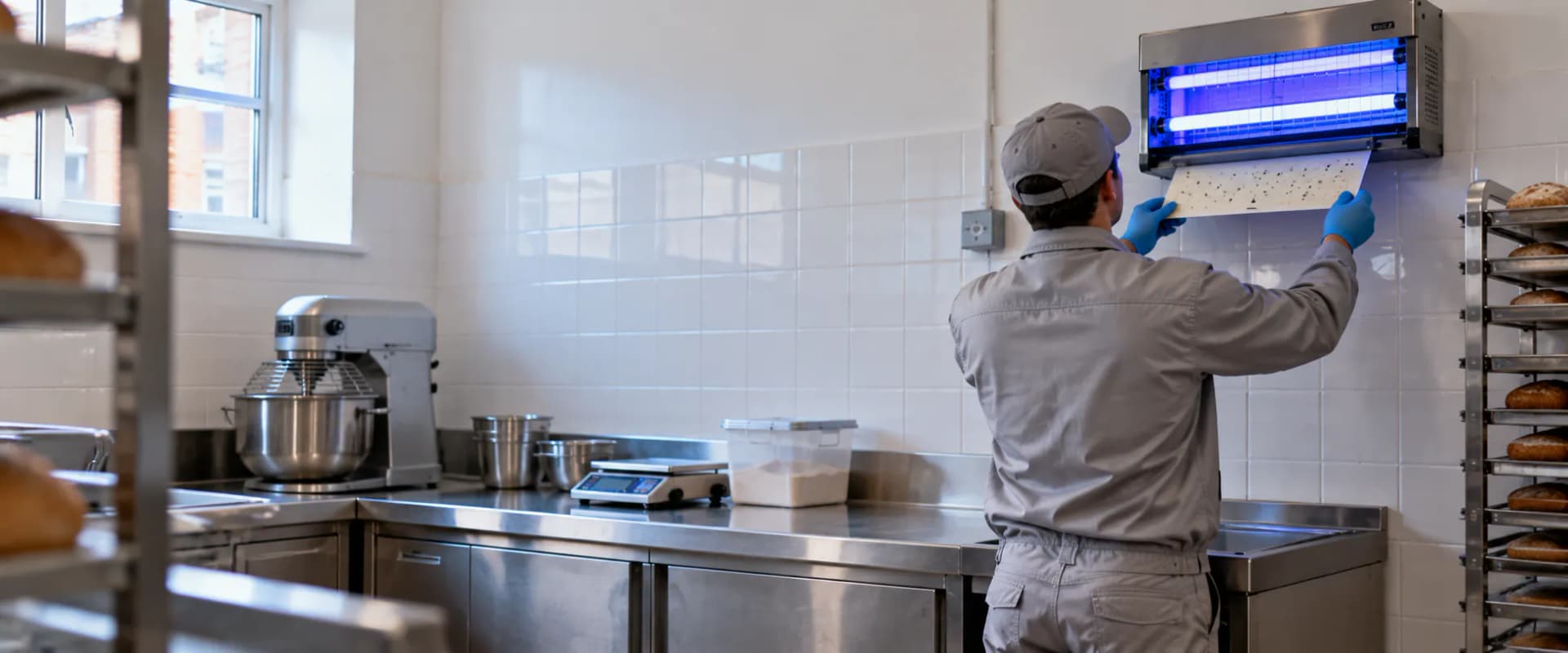
On electric fly killers, the same guidance says they should not be fitted above a surface where food is prepared, should not be visible from outside (they may attract flies in), and should have their ultraviolet tubes replaced as the manufacturer instructs. In bars, the usual sources are drip trays, the floor under the bottle skip, soft drink nozzles, and the floor drains behind the bar. Our guide to pest control for food businesses explains what inspectors expect.
When to call a professional
Call a professional if fruit flies are still appearing two weeks after you have cleared the produce, cleaned the bins and tested the drains, if you can't find the source, or if you run a food business. A persistent problem usually means a breeding site nobody has found yet, such as a leak under a unit, a floor drain or residue beneath fixed equipment.
When we attend a fly problem we identify the fly first, because fruit flies, drain flies, house flies and bluebottles each point to a different source. We then trace and treat the breeding site rather than only the flies you can see, and we supply electric fly killers for kitchens and food businesses. We'll explain the likely cost before any work starts; the final price depends on the job (see our pest control prices).
We cover Nottingham, Derby, Leicester, Lincoln and the surrounding counties, 7 days a week from 6am to 8pm, with emergency call-outs 365 days a year. Book online or call 0330 822 7460.
Sources
Frequently Asked Questions
About the author
The Urgent Pest Control team
A family-run pest control company based in Southwell, treating homes and businesses across Nottinghamshire, Derbyshire, Leicestershire and Lincolnshire since 2020. Our guides are written from the jobs we do and checked against UK sources. More about us
Cite this guide: “How to Get Rid of Fruit Flies in Your Kitchen and Home”, Urgent Pest Control, 18 November 2026. https://urgentpestcontrol.uk/blog/how-to-get-rid-of-fruit-flies