Carpet Beetle Larvae (Woolly Bears): How to Identify and Kill Them
Carpet beetle larvae, or woolly bears, are small hairy grubs that eat wool, fur and feathers. How to identify them, where they hide and how to kill them.

By the Urgent Pest Control team
· 8 min read
The short answer
Carpet beetle larvae, known as woolly bears, are short, fat, hairy brown grubs up to about 5mm long that eat wool, fur, feathers and dead insects. They don't bite, but their hairs can irritate skin. Kill them by vacuuming edges and crevices, freezing infested items at -18°C, removing old bird nests and applying a residual insecticide.
- Varied carpet beetle larvae grow from under 0.5mm to about 5mm and may take one or two years to mature, according to English Heritage.
- Empty, hairy cast skins are often the first sign; the larvae also leave pellets of frass and neat holes in wool.
- The larvae do not bite; a 2021 report in Emerging Infectious Diseases describes bite-like skin reactions caused by their hairs.
- The Natural History Museum advises freezing affected items at -18°C for a day or two to kill larvae.
- Larvae feed on dead insects and old bird nests as well as textiles, so the source is often in the loft.
On this page
- What do carpet beetle larvae look like?
- How do you tell carpet beetle larvae from other insects?
- Where do you find carpet beetle larvae?
- What are the signs of carpet beetle larvae?
- What damage do carpet beetle larvae do?
- Do carpet beetle larvae bite or irritate skin?
- How do you kill carpet beetle larvae?
- When to call a professional
Carpet beetle larvae, known as woolly bears, are short, fat, hairy brown grubs up to about 5mm long that eat wool, fur, feathers and dead insects. The larvae do all the damage; the adult beetles feed on pollen. To kill them, vacuum edges and crevices thoroughly, freeze or discard infested items, remove the source (often an old bird nest or dead insects) and apply a residual insecticide. If they keep appearing, Urgent Pest Control's carpet beetle treatment covers Nottinghamshire, Derbyshire, Leicestershire and Lincolnshire.
This guide is about the larvae specifically. For the adult beetles, the three UK species and prevention, see our main guide to carpet beetles.
What do carpet beetle larvae look like?
A carpet beetle larva is a small, bristly, brown-banded grub, which is why it is called a woolly bear. English Heritage's fact sheet on the varied carpet beetle describes the larva as "short and fat with bands of darker hairs" and gives a size range of 0.5mm to 5mm as it grows.
The Natural History Museum adds detail for the fully grown varied carpet beetle larva: 4–4.5mm long, with a light brown to orange head, darker plates at the front and rear of the body, and thick tufts of backward-pointing hairs on the last three abdominal segments.
Not every woolly bear looks the same. The museum describes three species found in UK homes:
| Varied carpet beetle | Two-spot carpet beetle | Brown (vodka) carpet beetle | |
|---|---|---|---|
| Full-grown larva | 4–4.5mm | Up to 6.5mm | Up to 8mm |
| Shape | Short, fat and bristly | Torpedo-shaped, tapering to the tail | Torpedo-shaped, tapering to the tail |
| Colour | Brown with darker bands | Golden yellow to brown, banded | Bronze-brown above, yellowish-brown below |
| Tail | Dense tufts of hairs at the rear | Two long orange hair tufts | Two brush-shaped hair tufts |
| Typical food | Wool, fur, feathers, dried insects | Feathers, dead flies and wasps, wool, fur, leather | Wool, fur, hide, feathers, floor fluff |
The museum notes that the two torpedo-shaped larvae superficially resemble a very dark silverfish, and that newly hatched larvae are under 0.5mm long, far too small to notice.
How do you tell carpet beetle larvae from other insects?
Look for hairs, bands and slow movement. A woolly bear is visibly hairy, striped across the body and crawls slowly; it does not jump, run fast or bite.
- Clothes moth larvae are the usual confusion. The Natural History Museum describes carpet beetle damage as small, clean holes without silk webbing; webbing or silk points to moths, covered in our guide to clothes moths.
- Fleas are dark, flat-sided and jump. See what fleas look like.
- Bed bugs are flat, oval and found around the bed, not in the wardrobe.
- Silverfish are silvery, fast and found in damp rooms.
If you have a larva or a shed skin, a photo against white paper and our pest identifier will help.
Where do you find carpet beetle larvae?
You find them in dark, undisturbed places where fluff, hair and dead insects collect. English Heritage says the larvae "wander around but are often in dark and hidden places in crevices and folds where dirt accumulates", and that they feed on dead insects, especially flies, and live in birds' nests, wasp nests and animal burrows.
Because newly hatched larvae are under 0.5mm, English Heritage notes they can get into cupboards and drawers through very small cracks. Once larger, they wander and may attack more than one object, which is why larvae turn up in odd places such as a bath, a windowsill or a bed.
Use this checklist when you search:
- along carpet edges and the gripper strip, especially behind and under furniture;
- under rugs, and under heavy furniture that never moves;
- in wardrobes and drawers holding wool, fur, feathers or silk;
- inside airing cupboards and blanket boxes;
- in the folds and seams of upholstered furniture and feather cushions;
- between floorboards and behind skirting boards;
- in the loft, around old bird nests, wasp nests and drifts of dead flies;
- around taxidermy, felt and other items of animal origin.
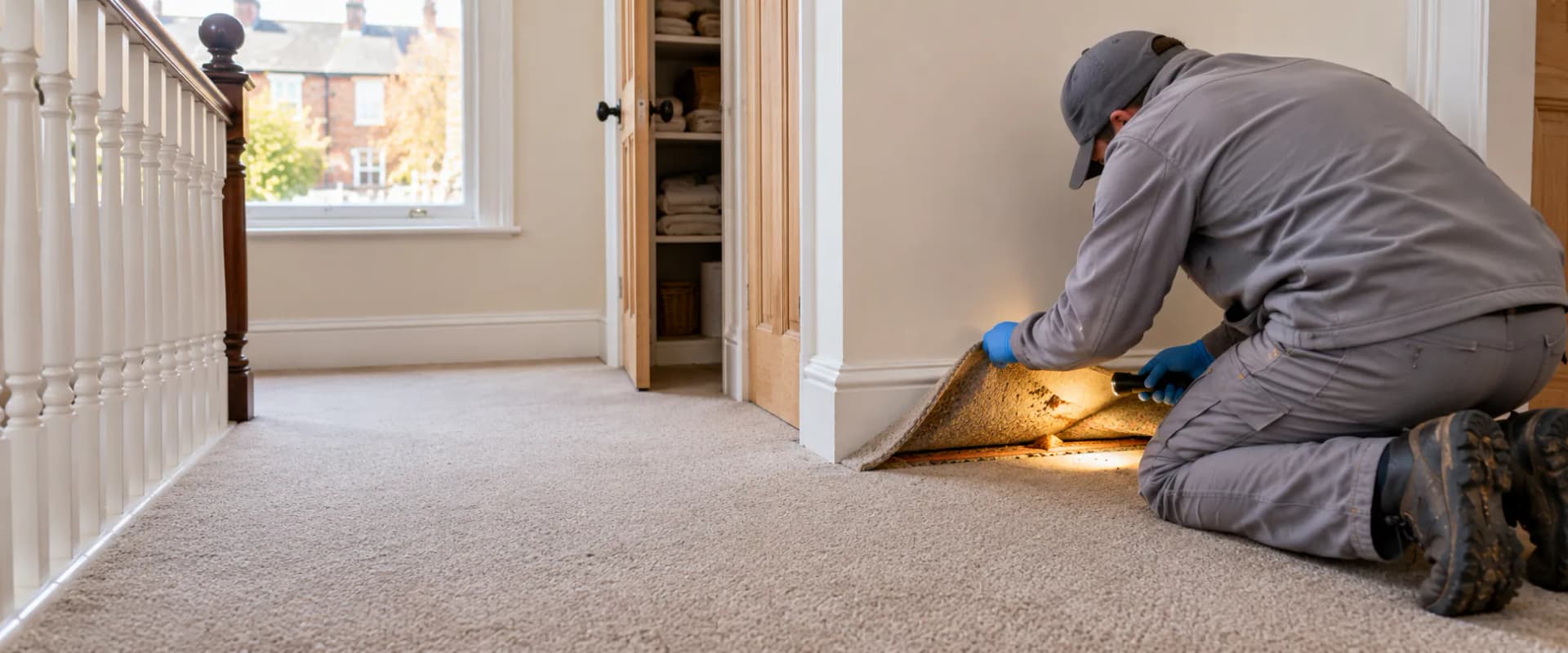
On an inspection, a technician typically lifts a corner of fitted carpet near the worst damage and checks the loft above the affected room, because the larvae people find on a bedroom floor have often come from a nest or dead insects overhead. Homes that get cluster flies in the loft each autumn are a common example.
What are the signs of carpet beetle larvae?
The first sign is usually a shed skin, not a live larva. English Heritage says that as the larvae grow "they leave empty hairy cast skins, or husks, which may be the first signs of beetle attack", along with pellets of excreta called frass under or near infested objects. The Natural History Museum says brown carpet beetle larvae moult 12 times, so one larva leaves many skins.
Signs to look for:
- pale, hairy, hollow cast skins in fluff, drawers and carpet edges;
- fine, powdery or gritty frass beneath damaged items;
- small, neat, clean-edged holes in wool, with no silk webbing;
- bare or thinned patches at the edges of wool carpets;
- live larvae, often when a piece of furniture is moved;
- small round adult beetles on windowsills in spring and early summer.
What damage do carpet beetle larvae do?
They eat materials of animal origin, and they can do it quickly. English Heritage describes the larvae as "voracious feeders" that "will rapidly make neat holes in woollen textiles, animal specimens, fur and feathers". They also graze on animal glue in book bindings and picture frames.
Clean cotton is not normally attacked, English Heritage says, though larvae may bore through it on their way out of a feather cushion. The Natural History Museum says varied carpet beetle larvae will not feed on entirely synthetic fabrics. So the items at risk are wool carpets and rugs, wool and cashmere clothing, felt, fur, feather pillows and duvets, silk, leather and taxidermy.
The damage builds slowly because the larval stage is long. English Heritage says larvae may take one or two years to complete their growth, pupating and emerging as adults in spring.
Do carpet beetle larvae bite or irritate skin?
They don't bite, but their hairs can cause an itchy skin reaction that looks like bites. A 2021 report in the journal Emerging Infectious Diseases, published by the US Centers for Disease Control and Prevention, described 11 patients from seven families in southern France with itchy, raised red marks. The authors concluded that the lesions "mimic bites but are allergic reactions to larvae hairs pegged in the skin", and that the hairs' spear-headed shape lets them lodge in skin.
Two details from that report are useful at home. The marks were mostly under clothing, on the thighs, arms, chest and abdomen, and they affected household members unevenly. The authors also warned that this kind of dermatitis is underdiagnosed or confused with bed bug or flea bites.
The measures the authors recommended did not involve insecticide: washing clothing that touches the skin, storing it in airtight bags, removing the insects and vacuuming mattresses and infested areas. In that report the marks healed within three days of the clean-up. If you have a rash that is spreading, painful or not settling, speak to a pharmacist or your GP. If you are waking with bites and finding no larvae, check for bed bugs instead.
How do you kill carpet beetle larvae?
Kill them with a combination of vacuuming, freezing or discarding infested items, removing the source and a residual insecticide. No single step is enough, because larvae are spread through crevices you can't see into.
- Vacuum thoroughly. A fact sheet published by Cotswold District Council advises cleaning infested areas with the vacuum nozzle, concentrating on cracks and crevices, and removing and destroying the vacuum bag straight afterwards.
- Remove or destroy badly infested items. The same fact sheet says heavily infested material should be removed and destroyed.
- Freeze what you want to keep. The Natural History Museum advises placing affected items in bags in a deep freezer at -18°C for a day or two.
- Remove the source. The fact sheet notes that an infestation often starts from a bird's nest, and says to check lofts and remove old nests if it is safe to do so. The Natural History Museum also recommends blocking nesting cavities, for example with wire netting. Only remove a nest once the birds have finished with it.
- Treat with a residual insecticide. The Cotswold fact sheet recommends professional treatment with a residual insecticide, which kills remaining larvae and adults and any larvae that hatch over the following weeks. If you use a household product, follow the label exactly.
- Store clean and sealed. The museum recommends keeping woollens in securely fastened plastic bags.
Keep checking for fresh cast skins for several weeks. The Cotswold fact sheet says eggs hatch in 10 to 30 days, so a single clean-up can be followed by a new wave of tiny larvae.
When to call a professional
Call a professional if you keep finding larvae or fresh cast skins after a thorough clean, if damage is appearing in more than one room, if the source is in the loft, under floors or behind fitted furniture, or if someone in the home is reacting to the hairs. Larvae under fitted carpet and in floor voids are hard to reach with household products.
Our carpet beetle treatment starts with identifying the species so the right places are treated. We apply a residual treatment to carpets, edges, wardrobes and voids, set pheromone monitoring traps and run the programme over 4–6 weeks to break the life cycle. If the culprit turns out to be moths, that is a different treatment, and we'll tell you. We'll explain the likely cost before any work starts; the final price depends on the job (see our pest control prices).
We cover Nottingham, Derby, Leicester, Lincoln and the surrounding counties, 7 days a week from 6am to 8pm, with emergency call-outs 365 days a year. Book online or call 0330 822 7460.
Sources
Frequently Asked Questions
About the author
The Urgent Pest Control team
A family-run pest control company based in Southwell, treating homes and businesses across Nottinghamshire, Derbyshire, Leicestershire and Lincolnshire since 2020. Our guides are written from the jobs we do and checked against UK sources. More about us
Cite this guide: “Carpet Beetle Larvae (Woolly Bears): How to Identify and Kill Them”, Urgent Pest Control, 18 November 2026. https://urgentpestcontrol.uk/blog/carpet-beetle-larvae