Mice in the Loft: Signs, How They Get Up There and What to Do
Light scratching above the ceiling at night? How to confirm mice in the loft, how they climb up there, the risks to wiring and how to clear them.

By the Urgent Pest Control team
· 8 min read
The short answer
Mice in the loft show up as light scratching at night, droppings 3–6mm long on the joists and shredded insulation or stored items. They climb up inside cavity walls and along pipes rather than coming through the roof. Trap or bait them, find the gap they use at ground level and seal it, or they will return.
- Mouse droppings are black, rod-shaped and 3–6mm long, and roof spaces are one of the common places to find them, according to the BPCA.
- English Heritage says house mice are agile climbers that move through buildings via cavity walls and under floorboards.
- Mice can squeeze through cracks as small as 5mm, the BPCA says.
- English Heritage warns that rodents readily gnaw electric cables, leading to costly repairs and even the possibility of fires.
- Urgent Pest Control's mice control starts from £200 with follow-up visits included; the final price depends on the job.
On this page
- What are the signs of mice in the loft?
- Is it mice, rats, squirrels or bats?
- How do mice get into the loft?
- Why do mice choose the loft?
- What damage do mice do in a loft?
- How quickly do mice in the loft multiply?
- How do you get rid of mice in the loft?
- How do you stop mice getting back into the loft?
- When to call a professional
Mice in the loft show up as light scratching at night, small black droppings on the joists and shredded insulation, paper or fabric. They rarely come in through the roof: they get in at ground level, then climb up inside the cavity wall or along pipe runs. Clearing them means trapping or baiting, then finding and sealing the gap they used. Urgent Pest Control's mice control service starts from £200 with follow-up visits included; the final price depends on the job.
This guide covers how to confirm it is mice, how they get up there, what damage they do and how to get rid of them.
What are the signs of mice in the loft?
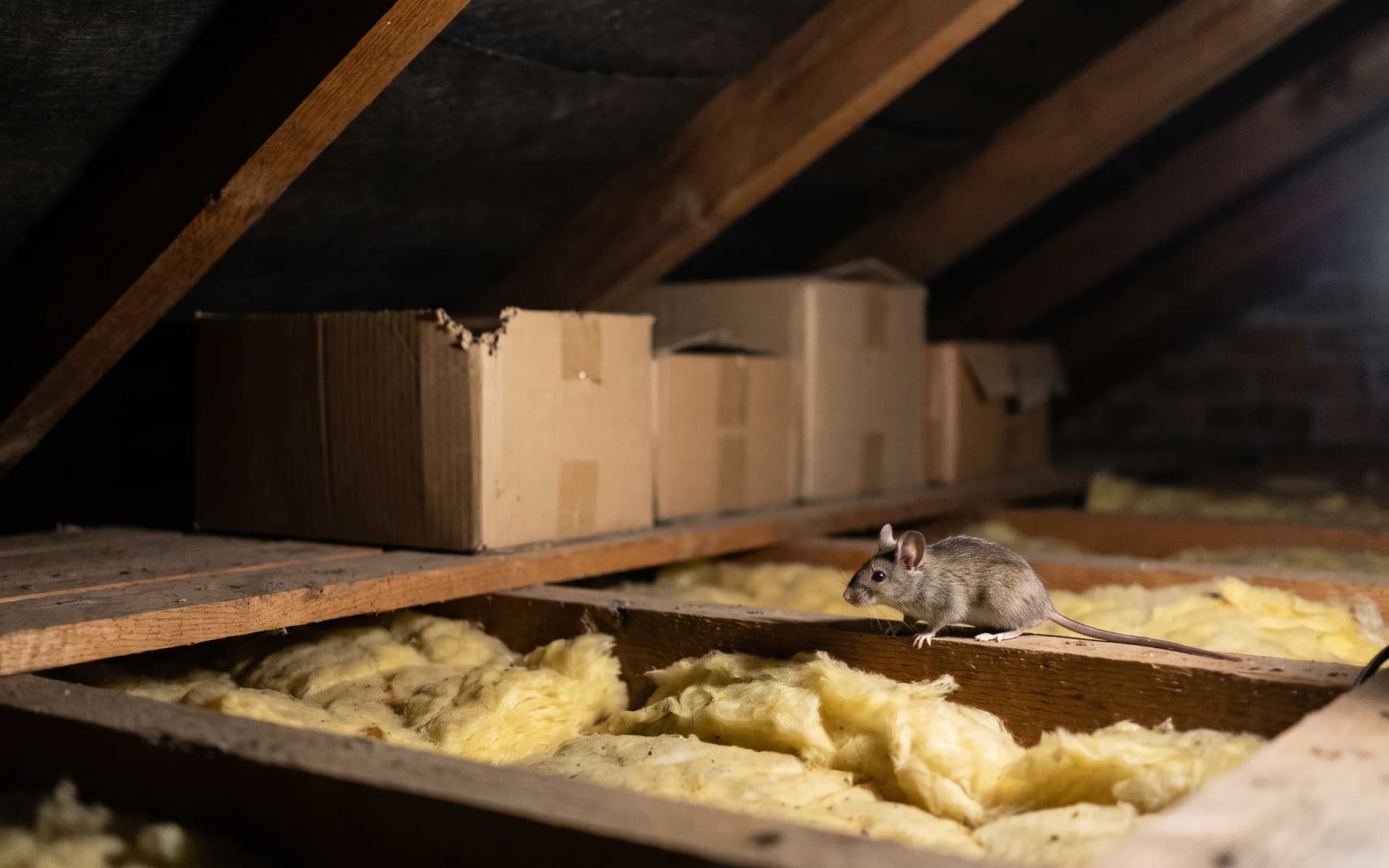
The clearest signs are small droppings along the joists and nests of shredded material. Go up in daylight with a good torch and check:
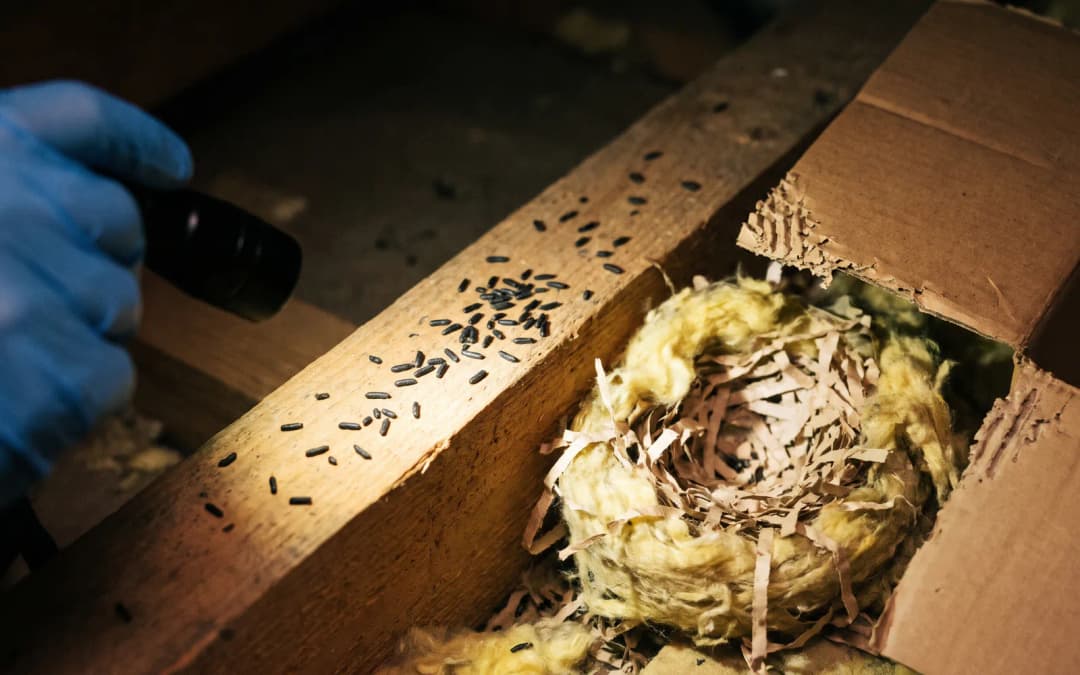
- Droppings. The BPCA's mice leaflet describes them as black, rod-shaped and 3–6mm long, and names roof spaces as a common place to find them. North West Leicestershire District Council says they resemble small black grains of rice.
- Nests. The BPCA says mice build nests out of cloth, wool and paper. English Heritage adds that they chew up paper, soft fabrics and insulation materials to make them.
- Gnawing. Look at stored boxes, cables, pipe lagging and the edges of timber. English Heritage notes that discarded fragments near a small hole often mark a nest.
- Smear marks. Dark grey marks where mice repeatedly brush past the same joist or pipe.
- Smell. English Heritage says mouse urine is very pungent and readily detected in closed spaces.
- Noise. The BPCA says mice are mainly active at night and can often be heard running about.
English Heritage makes a useful point for lofts: signs of mice are often on higher objects, such as the tops of cupboards, shelving, and wooden beams and joists in attics. Check along the tops of the joists and around the water tank, not just the floor.
Is it mice, rats, squirrels or bats?
The size of the droppings and the time of the noise will usually tell you. Do not assume: the treatment is different for each, and one of them is protected by law.
| Clue | Mice | Rats | What to do if unsure |
|---|---|---|---|
| Droppings | 3–6mm, rod-shaped | Up to 1.7cm, blunt at one end | Photograph them next to a coin |
| Noise | Light, quick scratching at night | Heavier scurrying, thuds, gnawing at night | Note the time you hear it |
| Gap needed | Cracks from 5mm; holes normally 20–30mm | Gaps of a little under 2.5cm | Check where pipes enter the loft |
The mouse figures come from the BPCA, the rat dropping size from the Mammal Society and the rat gap size from Sheffield City Council. Daytime noise is covered in our guide to squirrels in the loft. For heavier night-time noise and large droppings, see rats in the loft, and for a side-by-side comparison, our guide to rat and mouse droppings.
Bats are the one to be careful about. Gov.uk guidance says all bat species, their breeding sites and resting places are fully protected by law, and that it is an offence to intentionally or recklessly disturb a bat in a structure or place of shelter. If you see bats, or are not sure what the droppings are, stop and get them identified before anyone sets traps or lays bait.
How do mice get into the loft?
They climb up from below. English Heritage describes house mice as agile climbers that "can be found at all levels within a building" and "can easily move through buildings via cavity walls and under floorboards".
The route usually has two parts:
- In at ground level. The BPCA says mice can squeeze through cracks as small as 5mm; English Heritage says holes more than 6mm across. North West Leicestershire District Council puts it more memorably: a young mouse can get through a gap that a ballpoint pen can fit through. Typical gaps are around pipes and cables, under external doors and through damaged air bricks.
- Up through the building. Once inside the cavity or the floor void, mice follow pipe runs, cable routes and the cavity itself up to the roof space. Boxed-in soil pipes and the gaps where pipes rise into the loft are the usual way through.
Climbing plants help them too. North West Leicestershire District Council advises trimming or removing wall-climbing plants. Our guide to whether mice can climb walls explains what they can and cannot scale.
Why do mice choose the loft?
Because it is warm, quiet and full of nesting material. The BPCA says house mice, and sometimes long-tailed field mice, come into buildings seeking warmth, shelter and food, and that nests are often built in roof spaces, under floors or in wall cavities, especially during the winter.
A loft does not need to contain food. English Heritage notes that mice can survive on very little or even no water, getting what they need from their food. Mice nesting in the loft simply travel down the cavity to the kitchen at night. That is why a loft problem and droppings under the sink so often turn out to be the same mice.
What damage do mice do in a loft?
The main risks are to wiring, pipes and anything you have stored. The BPCA says mice have a compulsive need to gnaw to keep their incisors worn down, and that electric cables, water and gas pipes, packaging and woodwork may all be seriously damaged: "many instances of electrical fires and floods have been attributed to them". English Heritage says the same about cables.
There is a hygiene risk as well. The BPCA says mice have been known to spread Salmonella and Listeria, and that each mouse can leave about 80 droppings a day. Stored bedding, clothes, decorations and baby equipment in an infested loft will need washing or throwing away. Wear gloves, and damp droppings down with disinfectant before you clear them instead of sweeping them dry.
How quickly do mice in the loft multiply?
Quickly. English Heritage says mice can produce 5–10 litters a year, each of 4–8 young, and the Mammal Society says litters of 5–8 are born at roughly monthly intervals in buildings. In a heated house there is no winter break. Waiting until spring means a bigger job.
How do you get rid of mice in the loft?
Treat the loft and the rest of the route, then seal the way in. In order:
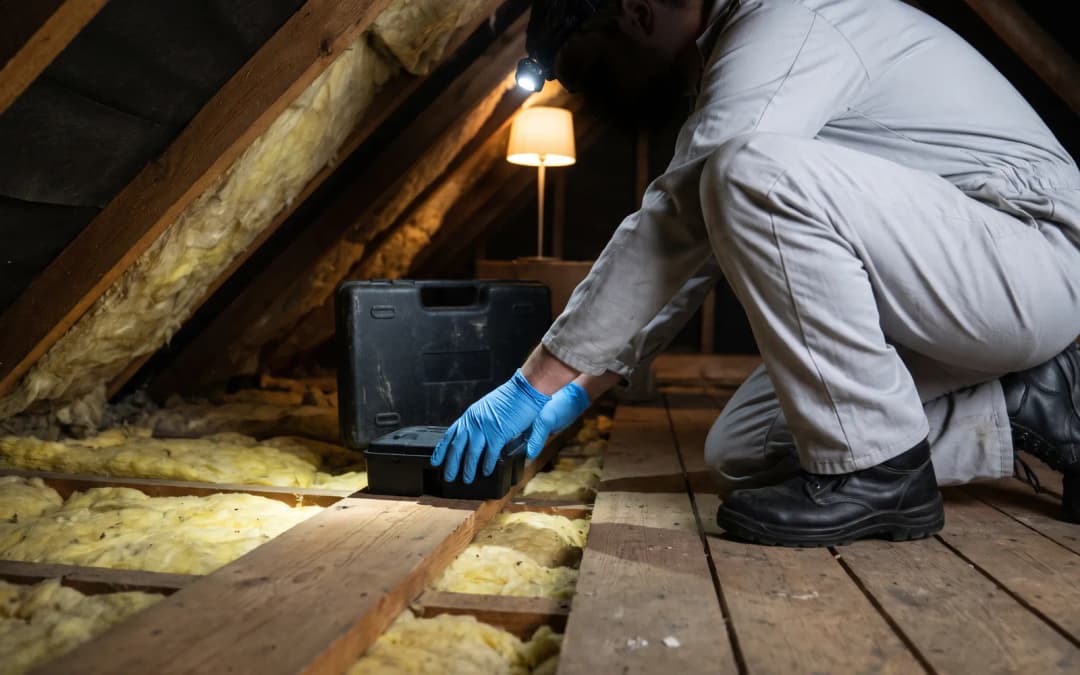
- Confirm what you have. Check the droppings and rule out bats and rats.
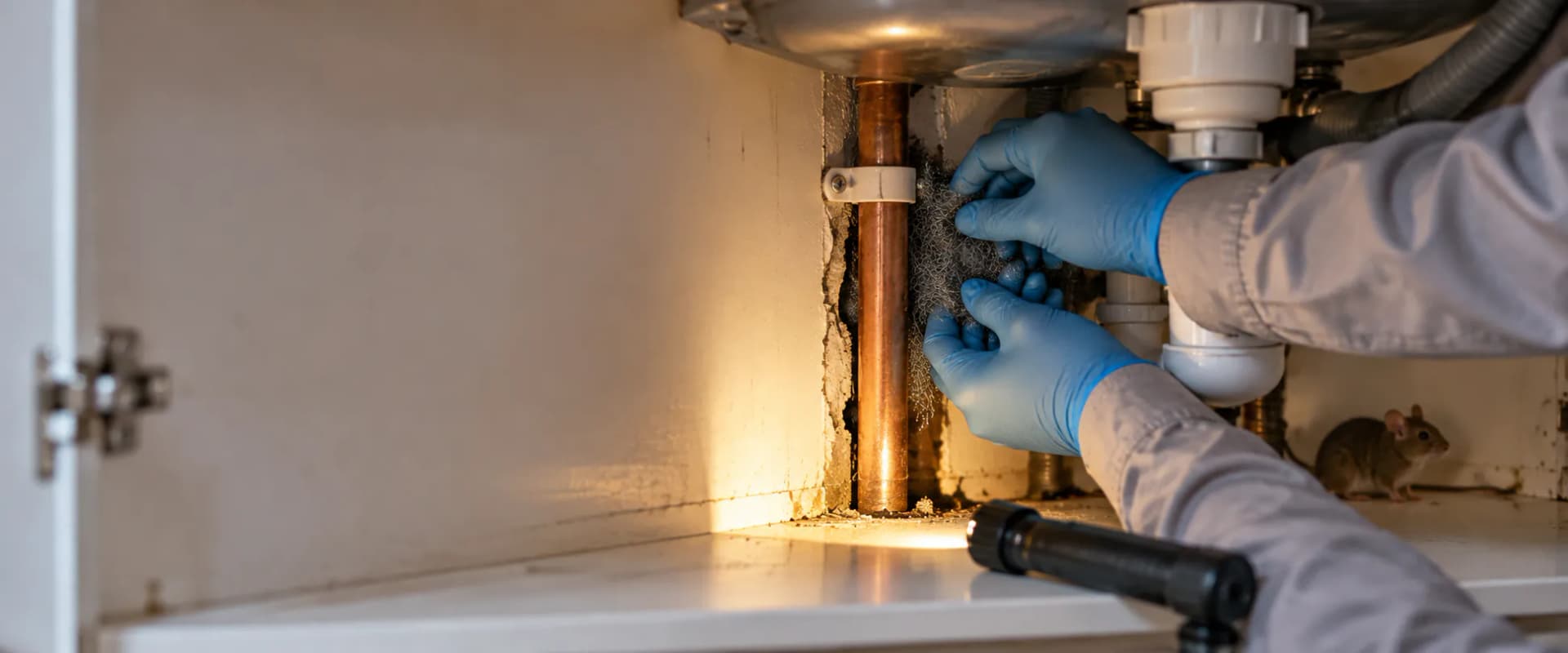
- Check downstairs too. Look under the kitchen sink, around the boiler and behind the cooker; the BPCA names the first two as common places for droppings.
- Set traps or bait where the signs are. The BPCA advises placing break-back traps close to, and at right angles to, walls, baited with nutty chocolate, raisins or something similar; cheese is a comparatively poor bait. Fix traps to a board across the joists so they sit level. Keep any poison or traps out of reach of children and pets, and follow the label.
- Check daily. Remove dead mice with gloves. The BPCA stresses searching for and disposing of dead rodents safely.
- Protect what is stored. English Heritage recommends plastic or metal containers; swap cardboard boxes for lidded plastic crates.
- Proof the entry points once activity stops. The BPCA recommends wire wool embedded in quick-setting cement for holes, and metal strips on doors.
Do not seal holes while mice are still active. Mice shut inside will gnaw a new way out or die in the void. Do not scatter loose poison in the loft either: mice that die under insulation or in the cavity smell, and English Heritage warns that carcasses and old bait feed other pests, including blowflies, carpet beetles and clothes moths. Our step-by-step guide on how to get rid of mice covers DIY methods in more detail.
How do you stop mice getting back into the loft?
Seal the gaps at ground level first, because that is where they come in. Work round the outside of the house and check:
- gaps around waste pipes, gas pipes and cables, sealed with wire wool and cement;
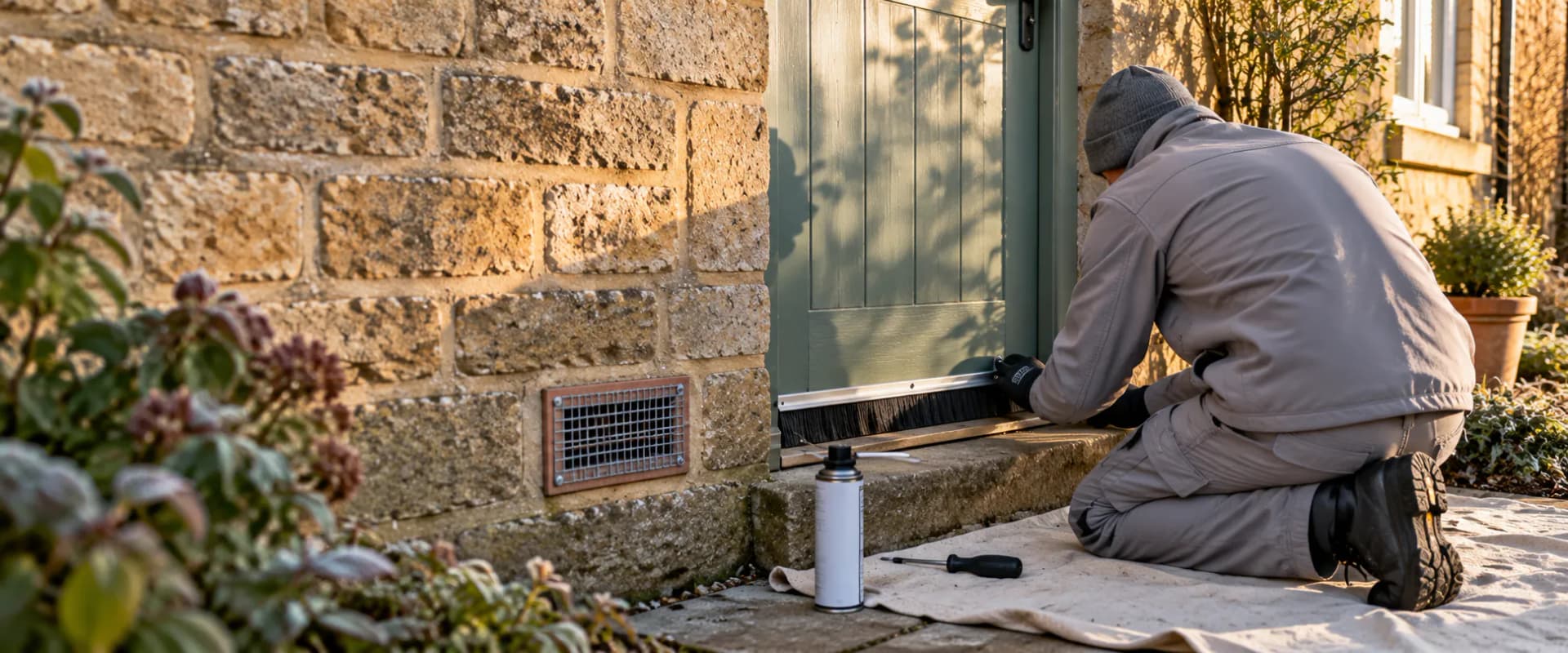
- air bricks, covered with fine mesh but never blocked. Sheffield City Council says a mesh with holes no larger than 2mm will stop mice using an air brick;
- the bottoms of external and garage doors, fitted with bristle strips;
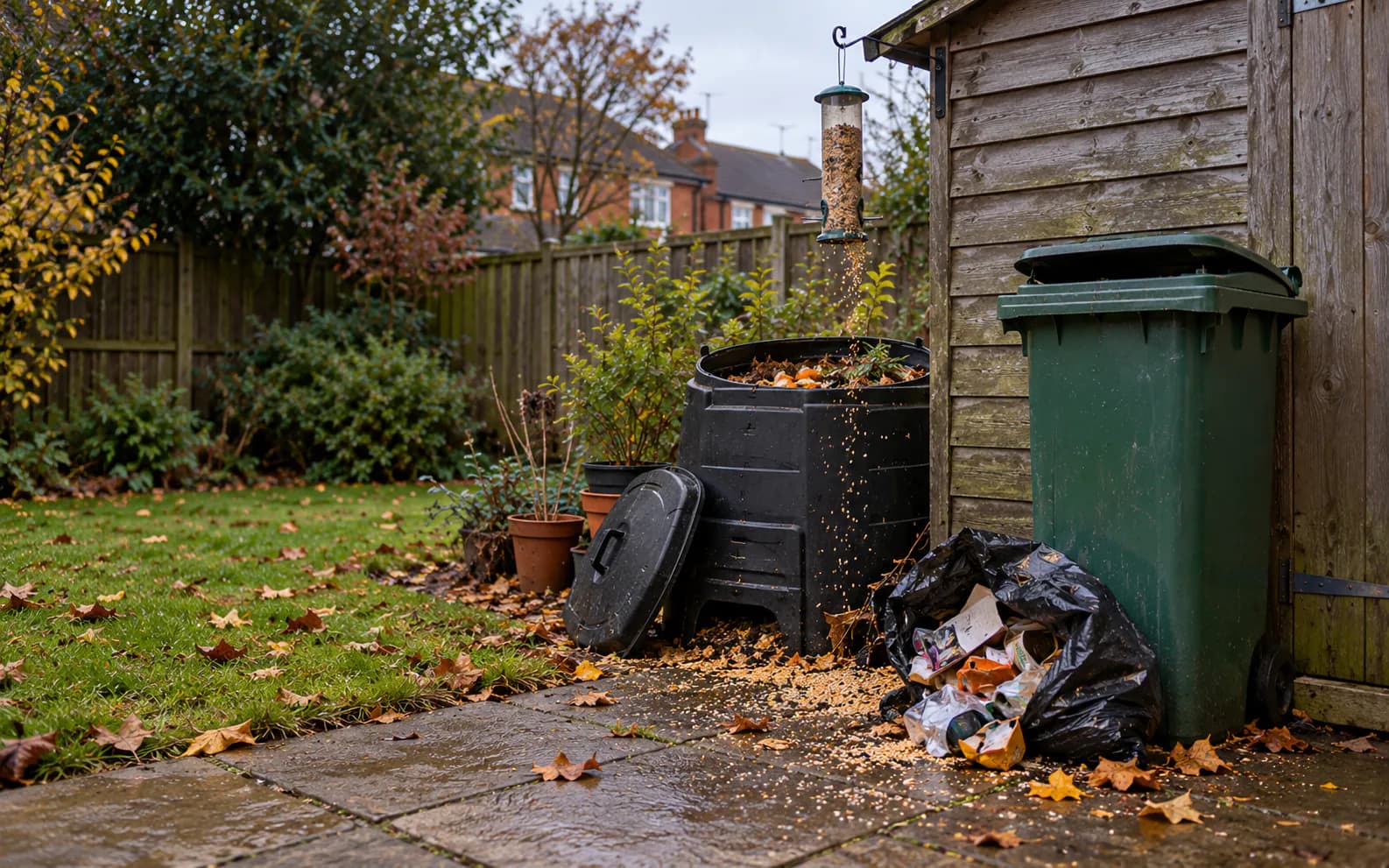
- climbing plants, cut back from the walls and eaves;
- inside, the holes where pipes pass through floors and into the loft.
When to call a professional
Call a professional if you are still hearing or seeing signs after a couple of weeks of trapping, if there are droppings in several parts of the house, if cables have been gnawed, or if you cannot find how they are getting in. The BPCA is blunt about DIY: because mice are adaptable, highly mobile and breed rapidly, control can be difficult for the untrained, and it recommends a professional for any infestation.
A technician will survey the loft, the kitchen and the outside walls, work out the route, treat with tamper-resistant bait stations or traps and come back to check them. Our mice control starts from £200 with follow-up visits included. The final price depends on the job; see our pest control prices page or our guide to mice removal costs.
We cover Nottingham, Derby, Leicester, Lincoln and the rest of Nottinghamshire, Derbyshire, Leicestershire and Lincolnshire, 7 days a week from 6am to 8pm, with emergency call-outs 365 days a year. Book online or call 0330 822 7460.
Sources
Frequently Asked Questions
About the author
The Urgent Pest Control team
A family-run pest control company based in Southwell, treating homes and businesses across Nottinghamshire, Derbyshire, Leicestershire and Lincolnshire since 2020. Our guides are written from the jobs we do and checked against UK sources. More about us
Cite this guide: “Mice in the Loft: Signs, How They Get Up There and What to Do”, Urgent Pest Control, 18 November 2026. https://urgentpestcontrol.uk/blog/mice-in-the-loft